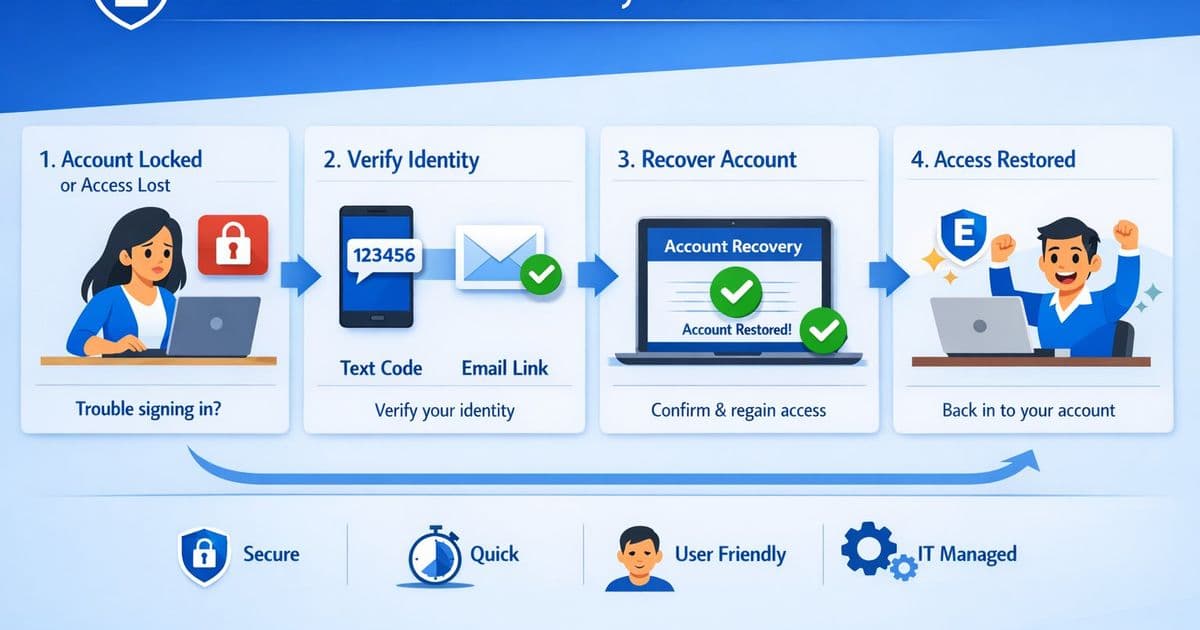
Microsoft Entra introduces automated identity verification for account recovery, eliminating human help desk vulnerabilities through government ID checks and biometric liveness detection.
The transition to passwordless authentication has been one of the most significant security advancements in enterprise IT over the past decade. Organizations have invested heavily in passkeys, FIDO2 tokens, and phishing-resistant authentication methods, dramatically reducing the attack surface for credential-based threats. However, this progress has always faced a critical vulnerability: what happens when a user loses their only authentication device?
The Help Desk Paradox
The modern help desk represents a fundamental security contradiction. While essential for user support, it has become the weakest link in enterprise security. When users lose access to their authentication devices, they traditionally call support agents who must verify identity through knowledge-based questions, personal information, or other easily compromised methods.
This human verification process has become increasingly dangerous in the age of AI-powered social engineering. Attackers can now use voice cloning technology to impersonate employees, leverage leaked personal data from breaches, or employ sophisticated social engineering techniques to trick agents into issuing temporary access credentials. The help desk, designed to assist legitimate users, has become the easiest entry point for attackers.
The Traditional Recovery Dilemma
Organizations have historically relied on two primary recovery methods, both with significant security flaws:
Self-Service Password Reset (SSPR) typically depends on "weak" factors like SMS codes or security questions. These methods are easily intercepted through SIM swapping attacks or guessed through social engineering. More critically, they don't align with organizations moving toward passwordless environments, as they still rely on knowledge-based authentication.
Help Desk Verification requires human agents to validate user identity, creating a vulnerability that sophisticated attackers can exploit through impersonation, social engineering, or leveraging publicly available personal information.
Microsoft Entra's Automated Identity Proofing
Microsoft Entra's new Self-Service Account Recovery addresses these vulnerabilities by removing human verification entirely. The system uses automated identity proofing through government-issued documents and biometric liveness checks, creating a recovery process that's as secure as the primary authentication method.
The recovery process integrates with specialized third-party identity verification providers such as True Credential, IDEMIA, and AU10TIX. These services are experts in forensic document analysis, providing the sophisticated verification capabilities that would be impractical for most organizations to develop independently.
The Verification Process
When a user initiates account recovery, they're redirected to the verification partner's service. The process involves several sophisticated security layers:
Document Capture: Users photograph government-issued identification such as passports or driver's licenses. The system immediately begins forensic analysis of the document.
Forensic Analysis: The verification service examines security features including holograms, specialized fonts, watermarks, and other anti-counterfeiting elements built into government documents. This analysis determines whether the presented ID is genuine or a sophisticated forgery.
Liveness Detection: Users must provide a "selfie" or video, but this isn't a simple photograph. The system uses advanced "Face Check" technology that projects specific light patterns or colors onto the user's face. This technique ensures the subject is a live person rather than a photograph, video, or deepfake. The system analyzes subtle movements, reflections, and physiological responses that are impossible to replicate with static media.
Verified ID and Decentralized Identity
Once the third-party service confirms the user's identity, Microsoft Entra issues a Verified ID. This represents a significant advancement in identity management: a decentralized, digital credential that resides in the user's Microsoft Authenticator app.
This Verified ID serves as digital proof of identity that Entra can trust without requiring ongoing verification with the third-party service. The credential contains cryptographic proofs of the identity verification process, allowing Entra to validate the user's identity independently.
The Final Authentication Handshake
The recovery process includes one final security check: Face Check. Entra compares the live user's face against the photo contained within the Verified ID. This comparison ensures that the person presenting the Verified ID is the same individual who underwent the initial identity verification process.
If the facial comparison succeeds, Entra considers the identity "proven" and proceeds with the recovery process.
Bootstrapping New Authentication
Once verified, Entra automatically issues a Temporary Access Pass (TAP), allowing the user to log in immediately. The system then guides the user through registering their new authentication device, passkey, or Authenticator app.
This "bootstrapping" process ensures users can quickly regain secure access without compromising security. The entire recovery process occurs without human intervention, eliminating the social engineering vulnerabilities inherent in traditional help desk support.
Strategic Advantages for Enterprise Security
This recovery solution provides several strategic benefits for IT leaders implementing Zero Trust architectures:
Zero Trust Maturity: The process fulfills the Zero Trust principle of "explicit verification" even during recovery scenarios. Organizations can maintain consistent security policies across all authentication events.
Scalability: By automating identity verification, IT teams can eliminate the most time-consuming aspect of help desk operations. Support staff can focus on complex technical issues rather than routine identity verification.
Phishing Resistance: Since recovery relies on physical ID and biometrics rather than codes or knowledge-based questions, there's nothing for attackers to phish. Even if an attacker obtains a user's personal information, they cannot complete the recovery process without the physical document and live presence.
Global Compliance: Using government-issued IDs allows organizations to meet high-assurance regulatory requirements such as NIST Identity Assurance Level 2 (IAL2). This is particularly valuable for organizations in regulated industries or operating across multiple jurisdictions.
Implementation Requirements
Organizations must address several prerequisites to implement this solution:
Verified ID Configuration: Microsoft Entra Verified ID must be configured within the tenant before enabling recovery features.
Data Quality: Entra uses attributes like first name and last name to match Verified IDs to user accounts. Organizations must ensure HR data is clean and properly synchronized across systems.
Licensing and Costs: While the recovery flow is included in Entra, verification partners and Face Check services typically charge per-verification fees. Organizations must budget for these operational costs and provision services through the Microsoft Security Store.
The Future of Identity Recovery
Microsoft Entra's Self-Service Account Recovery represents the final piece in building truly phishing-resistant authentication systems. Organizations can now implement passwordless authentication with confidence that recovery processes won't become the weak link in their security posture.
The solution addresses a fundamental challenge in identity security: maintaining high assurance throughout the entire user journey, including exceptional scenarios like device loss. By applying the same rigorous verification standards to recovery as to primary authentication, organizations can achieve consistent security without sacrificing user experience.
This approach also positions organizations for future identity innovations. As decentralized identity standards evolve and digital credentials become more prevalent, the infrastructure being built today will support more sophisticated identity scenarios while maintaining the security principles established through solutions like Self-Service Account Recovery.
For organizations committed to Zero Trust and phishing-resistant authentication, this recovery solution eliminates the last major vulnerability in passwordless deployments. The help desk paradox is finally resolved: users can recover access securely without creating opportunities for attackers to exploit human trust.
Comments
Please log in or register to join the discussion