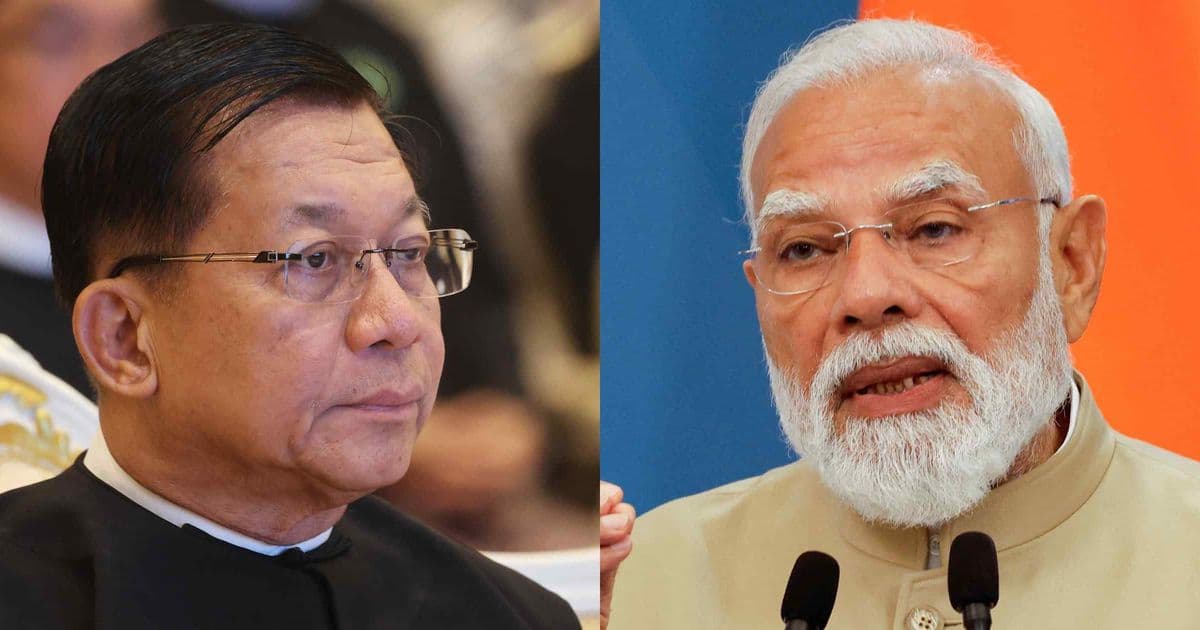
Min Aung Hlaing’s first foreign trip as Myanmar’s president will focus on deepening economic ties, securing Indian investment in infrastructure, and aligning both nations against China’s growing influence in the region.
Business news
Min Aung Hlaing landed in New Delhi on Saturday, marking his inaugural overseas trip since assuming the presidency of Myanmar. The five‑day itinerary includes meetings with Prime Minister Narendra Modi, senior officials from the Ministry of Commerce, and representatives of Indian conglomerates interested in Myanmar’s energy, logistics and telecom sectors. The visit comes as Myanmar seeks to shed the diplomatic isolation that followed the 2021 military coup, while India looks to broaden its foothold in Southeast Asia as a counterweight to China’s Belt‑and‑Road projects.
Market context
Trade volumes and investment pipelines
- Bilateral trade: In FY 2025‑26, India‑Myanmar trade reached $2.3 billion, up 12 % from the previous year, driven largely by Indian exports of pharmaceuticals, steel and agricultural inputs.
- Infrastructure contracts: Indian firms have been shortlisted for two major projects – a $1.1 billion hydro‑electric plant in Shan State and a $750 million railway upgrade linking Mandalay to the Indian border.
- Energy cooperation: Myanmar’s offshore gas fields, notably the Shwe Kya‑Sang‑Myo block, are slated for joint development with India’s Oil and Natural Gas Corporation (ONGC). Preliminary term sheets suggest a $2.4 billion investment over the next decade, with a 30 % equity stake for Indian partners.
- Strategic financing: The Asian Development Bank (ADB) has earmarked $500 million for a cross‑border logistics corridor that would link the Indian port of Kolkata with Myanmar’s Sittwe deep‑water hub, a project that could cut shipping times to the Bay of Bengal by 18 %.
Geopolitical backdrop
China currently accounts for 68 % of Myanmar’s total foreign direct investment, a share that has prompted New Delhi to pitch itself as a diversified alternative. India’s “Act East” policy, reinforced by the 2015 India‑Myanmar Act East Strategic Partnership, aims to channel at least $10 billion of Indian capital into Myanmar by 2030. The upcoming visit is therefore a litmus test for whether that target is realistic.
What it means
- Economic diversification for Myanmar – By courting Indian capital, the junta hopes to reduce its reliance on Chinese loans that often carry opaque terms. A successful partnership could unlock new revenue streams, especially in the power sector, where Myanmar faces a chronic electricity deficit of roughly 3 GW.
- Security alignment for India – Strengthening ties with Myanmar offers India a strategic buffer along its eastern frontier. Joint naval patrols in the Bay of Bengal and intelligence sharing on insurgent groups could be formalized during the talks, reinforcing India’s “neighbourhood first” security posture.
- Potential diplomatic trade‑offs – While India may gain leverage, it also risks criticism from Western capitals that continue to impose sanctions on Myanmar’s military leadership. Balancing economic engagement with human‑rights concerns will be a delicate diplomatic act for New Delhi.
- Impact on regional supply chains – If the railway and logistics corridor materialize, manufacturers in northeastern India could tap into Myanmar’s lower‑cost labor pool, reshaping supply‑chain dynamics for textiles, electronics and auto components across the sub‑continent.
Overall, Min Aung Hlaing’s India visit is less about ceremonial diplomacy and more about laying the groundwork for a multi‑billion‑dollar economic partnership that could reshape Southeast Asian trade patterns. The success of the talks will hinge on concrete financing agreements, clear timelines for project execution, and the ability of both governments to navigate the political sensitivities surrounding Myanmar’s internal governance.
Sources: Ministry of Commerce (India), Asian Development Bank, ONGC press releases, trade data from the Indian Ministry of External Affairs.
Comments
Please log in or register to join the discussion