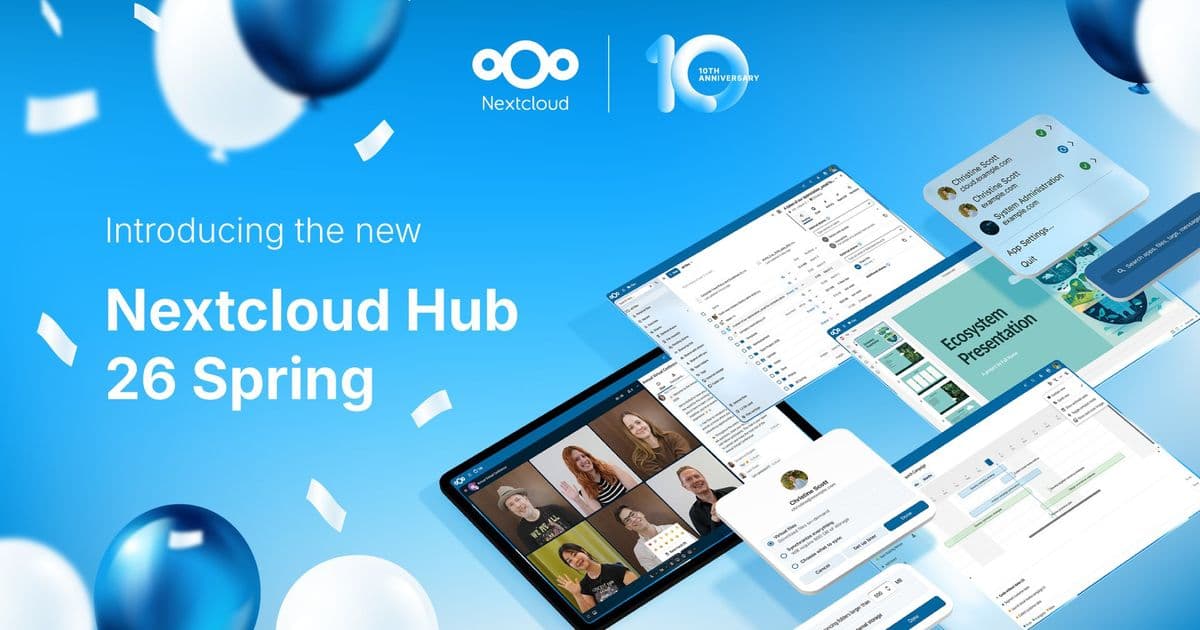
Nextcloud's tenth-anniversary release leans on incremental polish rather than reinvention. The headline items are a new Europe-built office suite, an Assistant that can now drive Unified Search and call app-level tools, and a stack of groupware delegation features. The vendor's own number says it best: 96% of the code changed here is maintenance.
Nextcloud shipped Hub 26 Spring on June 9, 2026, marking ten years since the project forked from ownCloud and set out to be the self-hosted alternative to Google Workspace and Microsoft 365. Anniversary releases tend to arrive wrapped in heavy marketing, and this one is no exception. The useful signal is buried under a lot of birthday language, so it is worth separating what is genuinely new from what is a UI refresh.
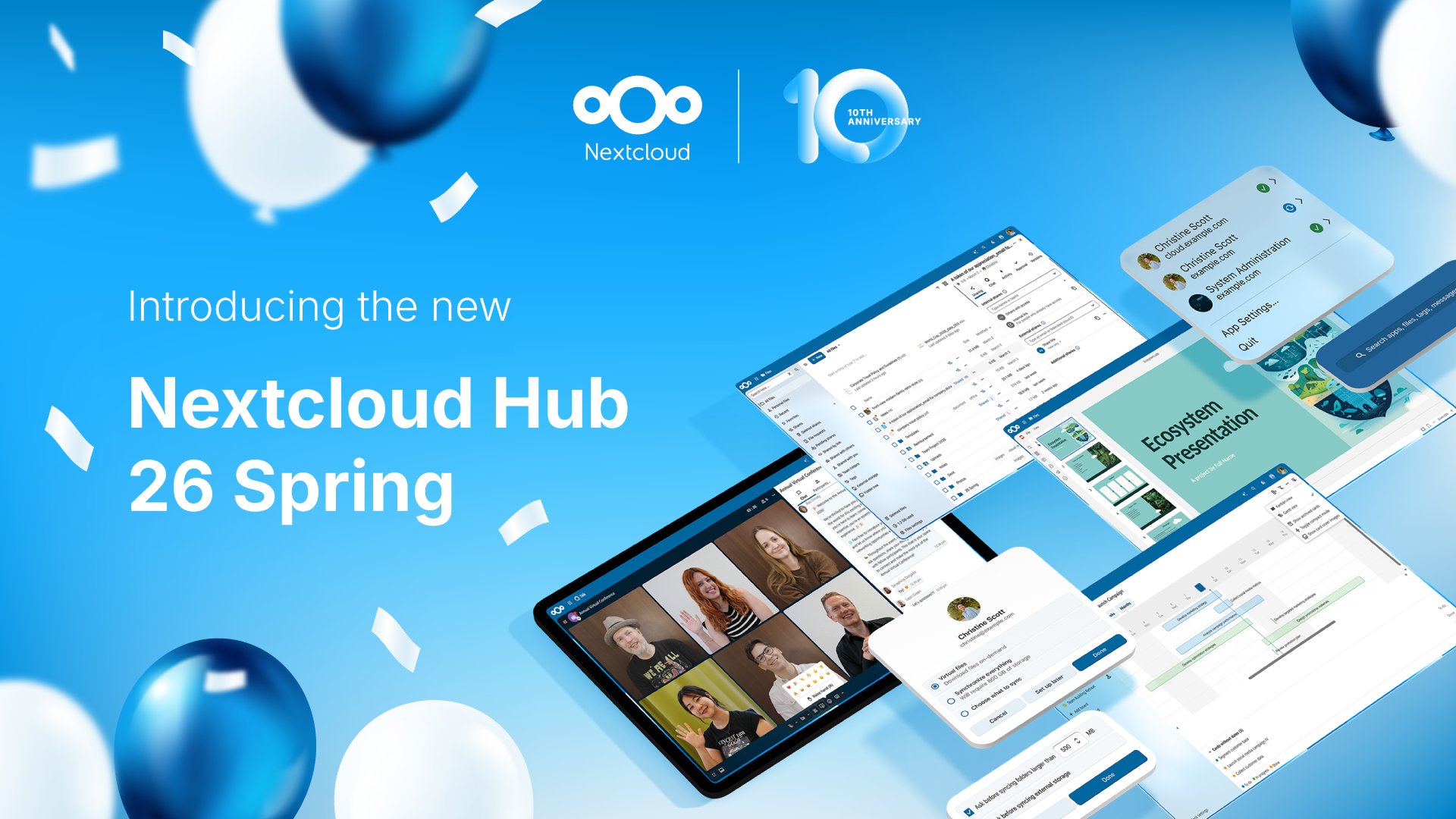
The most honest sentence in the entire announcement comes near the bottom: 96% of the code changed in this release across all repositories is maintenance work, including translations, small UI fixes, stability, security, and performance. That is not a criticism. For a platform that millions of people run as their primary file store, calendar, and mail client, prioritizing bug fixes over feature count is the correct decision. But it does mean the feature list reads longer than the actual change in capability.
What's claimed
The pitch is built around four themes: a refined interface, more office-suite choice, an upgraded AI Assistant, and a new platform strategy aimed at independent developers. The framing positions Nextcloud as the open source answer to Big Tech collaboration tools, with the data-sovereignty argument doing most of the rhetorical work.
What's actually new
A second office engine: Euro-Office
For years Nextcloud Office has meant Collabora Online, a browser-based fork of LibreOffice. Hub 26 Spring adds Euro-Office as a second default option, and this is the most substantive addition in the release.
The two engines make different trade-offs, and Nextcloud is unusually direct about them. Collabora keeps documents on your server, never shipping content to a browser-side renderer, which is why it gets the security and ODF-compatibility nod. Euro-Office takes a different architectural route that pushes more work to the browser, which reduces server load and improves responsiveness, at the cost of weaker ODF support. Its selling point is Microsoft Office file fidelity and per-user collaboration state, meaning Undo/Redo and Track Changes operate independently for each editor in a shared session. Anyone who has watched a multi-user undo stomp on someone else's edits in a web editor will understand why that detail matters.
Euro-Office is described as a coordinated European initiative under a shared governance framework involving multiple open source organizations rather than a single vendor. Treat the governance claims as a stated intention until the structure is visible in public. The technical claim, that a different rendering architecture trades ODF compatibility for performance, is plausible and testable. The compatibility claim, "maximum compatibility with Microsoft Office files," is the kind of assertion that only survives contact with real-world .docx files full of tracked changes, embedded objects, and corporate template macros. Benchmark it against your own documents before committing.
If you run Nextcloud All-in-One, you can switch between the two office backends from the AIO web interface, which lowers the cost of actually testing both against your document set.
The Assistant gets tool access
The AI story here is more interesting than the usual chatbot-in-a-sidebar pattern, because the work went into tool use rather than the model. Nextcloud Assistant can now drive Unified Search through its Context Agent feature, letting it locate items across the Hub in fewer steps, and it gained tools to act on data in Files, Mail, Tasks, Forms, and Deck boards and cards. This is the function-calling-against-app-APIs approach, where the value comes from how reliably the agent maps a request to the right tool, not from raw model capability.
On the infrastructure side, the team added Kubernetes support for Context Chat and what they call LLM2, plus reworked background job scheduling for context-enabled tasks. The scheduling work is the kind of unglamorous change that determines whether an AI feature feels responsive or feels like it hung. The Assistant also reaches mobile, with chat on iOS and Android and a context-menu action to send selected text to the Assistant from anywhere on the device.
The consistent and genuinely differentiating point is that every AI feature is optional and configurable, and you choose where inference runs. For organizations that cannot send document contents to a hosted API for legal reasons, a self-hostable assistant that can call local tools is worth more than a marginally smarter model they are not allowed to use. The open question, as with every agent system, is reliability. "New tool to use Unified Search" tells you the capability exists; it does not tell you how often the agent picks the right tool or how it fails when it picks wrong. That is the number that would actually matter, and it is not in the announcement.
Groupware delegation
The least flashy and possibly most practically useful changes are in Mail and Calendar. You can now read and reply to email on behalf of another person, create calendar events and accept invitations on someone's behalf, and forward calendar invitations so a third party can accept and add the event to their own calendar. Organizers can disable invite forwarding for sensitive meetings.
Delegation is table stakes for any team running a shared inbox or covering for colleagues on leave, and its absence has been a real friction point for organizations migrating off Exchange. Mail also gained full read-write support for external CalDAV and CardDAV, so you can connect calendars and address books from Zimbra, Open-Xchange, or a private server and have events you create in Nextcloud propagate back. That interoperability work is exactly what makes a gradual migration possible instead of a forced cutover.
Deck, Tables, Talk, and Text
Nextcloud Deck added card dependencies, start dates, and Gantt-chart views generated from board data, which pushes it from a Kanban board toward lightweight project management. Tables got column reordering, pinning, sorting, row duplication, and public links with edit access. Talk added private replies to group messages, Voice Rooms, multi-account support in the desktop client, and automatic client updates. Nextcloud Text now keeps working offline for up to five minutes of lost connection, and Collectives lets you browse previously opened pages from cache while offline.
None of these are large on their own. Collectively they are the kind of papercut removal that determines whether daily users stay or quietly route around the tool.
What's actually changing for developers
The platform strategy is the part most likely to matter over the next few years, and it is also the part with the least to show today. Nextcloud is standing up a Developer Relations team led by Anna Larch, cleaning up documentation, promising more stable APIs, and launching an ISV program to promote third-party apps through the App Store with subscriptions and support. The stated bargain is straightforward: vendors provide stable, scalable apps that run locally and meet privacy and security standards, and Nextcloud handles promotion and distribution.
The API changes in this release are the early cost of that direction. Hub 26 Spring revises navigation styling and sidebar tabs, changes info.xml requirements, unifies sharing, and removes several back-end and front-end APIs and libraries. App developers should read the API changes documentation before assuming their app still loads, because "several removed APIs" is the line that breaks integrations. A platform that wants third-party developers has to balance breaking changes against ecosystem stability, and this release breaks things in service of a cleaner foundation. Whether that pays off depends entirely on whether the promised API stability actually materializes in the releases after this one.
Limitations and caveats
A few things to keep in mind before upgrading. The Enterprise edition of Hub 26 Spring is not available at launch; it ships later, after additional testing and certification, so production deployments on enterprise support should wait. Euro-Office is new code with bold compatibility claims and limited ODF support, which is a meaningful constraint if your organization standardized on OpenDocument formats. The AI features, while architecturally sound, come with no published reliability or accuracy figures, so evaluate them on your own data rather than on the feature list. And the API removals mean third-party apps may need updates before they work on this version.
The broader pattern here is a mature open source project choosing maintenance and interoperability over spectacle, then describing that choice in language built for a product launch. The substance is real: a second office engine with a genuine architectural trade-off, agent tooling wired into existing app APIs, and groupware delegation that closes a long-standing gap against Exchange. The marketing is just louder than any single feature warrants. For self-hosters and organizations with hard data-residency requirements, the combination of local AI tooling and improved external DAV interoperability is the reason to look closely. For everyone else, this is a solid maintenance release wearing a party hat.
Comments
Please log in or register to join the discussion