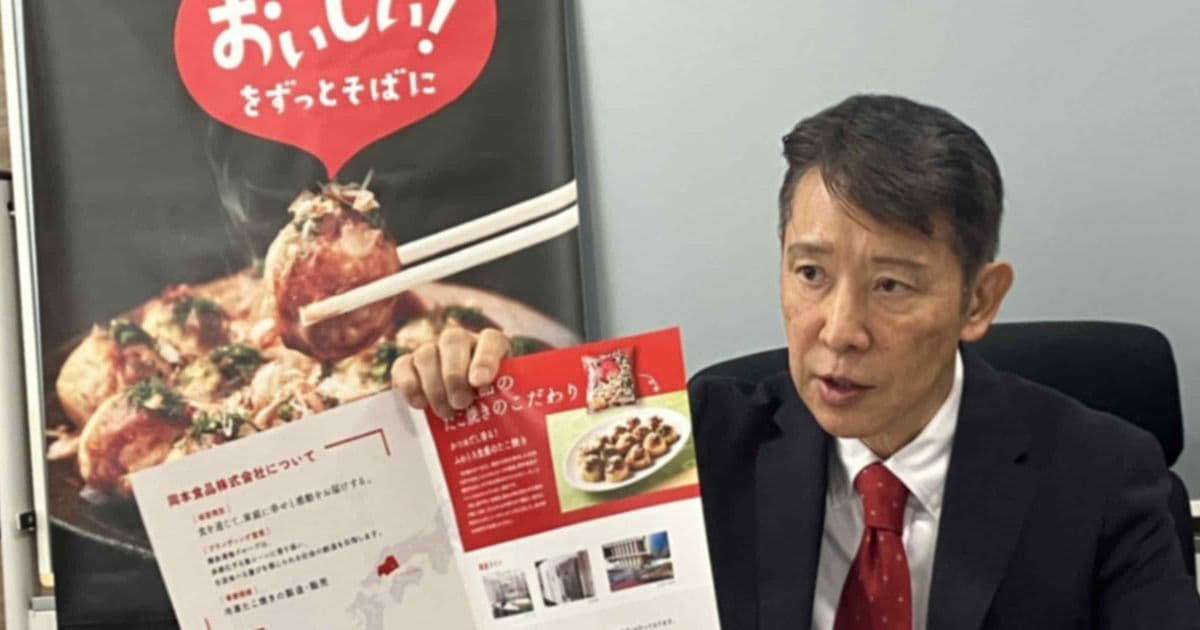
Okamoto Foods opened a second Hiroshima plant to boost frozen takoyaki output, aiming to capture rising demand for Japanese convenience foods in Vietnam, the Philippines and other ASEAN economies. The move reflects a broader shift among Japanese food manufacturers toward export‑focused growth as domestic consumption plateaus.
Japan’s frozen takoyaki maker eyes ASEAN as next growth engine
Okamoto Foods, the Hiroshima‑based producer best known for its frozen takoyaki (octopus‑filled dumplings), inaugurated a second manufacturing facility in the prefecture in May. The new plant adds 200,000 sq ft of floor space and lifts the company’s total annual production capacity from 120,000 t to 180,000 t, a 50 % jump that can support both domestic demand and an export push to Southeast Asia.
Market context: Japanese food abroad gains traction
The ASEAN region has become the fastest‑growing market for Japanese packaged foods. According to the Japan External Trade Organization (JETRO), imports of Japanese processed foods into the bloc rose 13.2 % year‑on‑year in 2025, reaching ¥210 bn (≈ $1.3 bn). Vietnam and the Philippines together accounted for 38 % of that total, driven by rising middle‑class incomes and a cultural affinity for Japanese cuisine.
Consumer surveys from Euromonitor show that frozen convenience items are the second‑largest category of Japanese food imports in Vietnam, after instant noodles, with a projected CAGR of 9.4 % through 2030. In the Philippines, the same category is expected to grow 8.1 % annually, reflecting a shift toward ready‑to‑heat meals among urban workers.
Strategic implications for Okamoto Foods
Scale economies – By consolidating production in a larger, more automated plant, Okamoto can lower its unit cost from ¥420 per kilogram to ¥380, a margin improvement of roughly 9 %. The cost savings are critical for competing on price in price‑sensitive ASEAN markets.
Supply‑chain resilience – Locating both plants in Hiroshima, close to the company’s existing logistics hub, reduces lead times to the port of Yokohama. From there, refrigerated containers reach Ho Chi Minh City and Manila in 4‑5 days, compared with the 7‑8 day window when shipping from Osaka.
Brand positioning – Okamoto’s “authentic Osaka‑style” branding resonates with tourists who have experienced takoyaki on Japanese trips. The company is leveraging that cachet by launching a "Taste of Osaka" line, featuring a premium soy‑based glaze and a limited‑edition kimchi‑infused variant tailored to Korean‑influenced palates in Vietnam.
Export financing – The plant’s expansion was partially funded through a ¥12 bn loan from the Japan Bank for International Cooperation (JBIC), earmarked for projects that enhance Japan’s food export capacity. The financing terms—5 % interest over ten years with a grace period—signal governmental confidence in the sector’s export potential.
What it means for the broader food‑tech sector
Okamoto’s move underscores a larger trend: Japanese food manufacturers are shifting from a domestic‑centric model—where aging population and stagnant consumption have limited growth—to an export‑oriented strategy that exploits the region’s appetite for Japanese flavors. Companies that can combine automation (the new plant uses AI‑guided dough‑forming robots) with localized product tweaks are likely to capture the most market share.
For investors, the expansion suggests a mid‑term earnings uplift for Okamoto Foods. Management projects a ¥3.2 bn increase in FY2027 revenue, driven largely by overseas sales, and a net profit margin expansion to 6.8 % from the current 5.9 %.
Bottom line
Okamoto Foods’ second Hiroshima factory is more than a capacity boost; it is a strategic platform for penetrating ASEAN markets that are hungry for Japanese convenience foods. By aligning production efficiencies, financing support, and product localisation, the company positions itself to ride the wave of Japanese culinary popularity across Southeast Asia, while also cushioning its domestic revenue base against Japan’s demographic headwinds.
Comments
Please log in or register to join the discussion