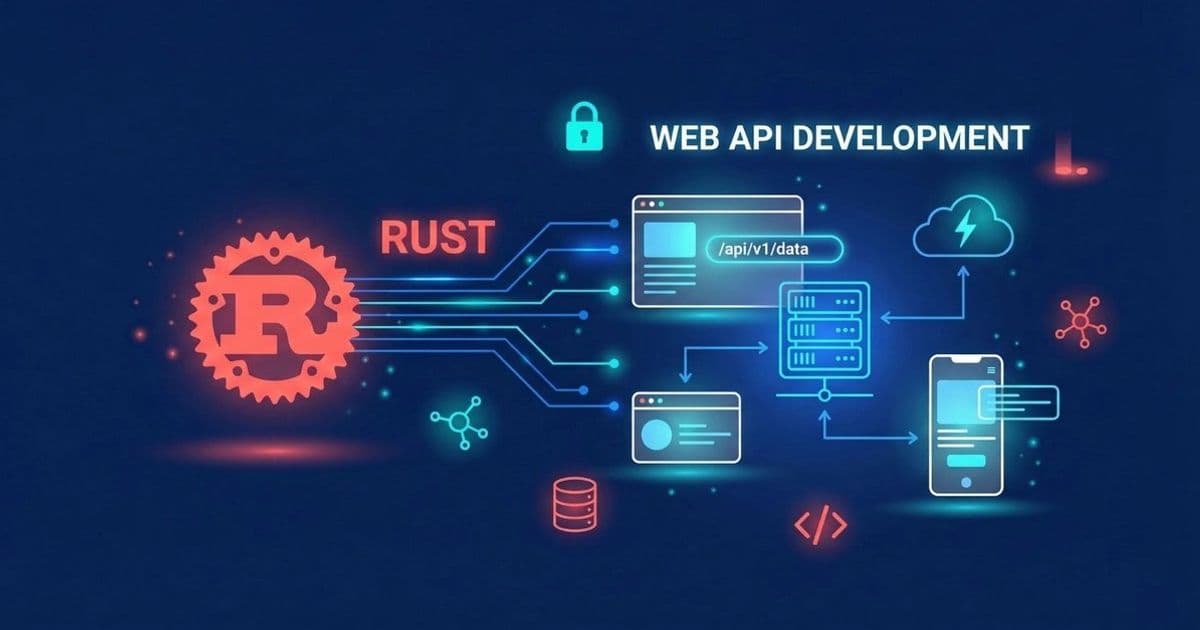
After two years of Rust development, a new open-source project provides a comprehensive boilerplate for building production web APIs with structured architecture patterns, authentication, and documentation.
Production-Ready Rust Web API Starter Kit Brings Structured Patterns to Ecosystem
The Rust programming language continues to gain traction in backend development, and a new starter kit aims to address a common pain point for developers: the lack of comprehensive examples for building production-ready web APIs. After two years of learning Rust, developer Thomi Jasir has released axum-starter, a boilerplate project that combines best practices from multiple frameworks into a cohesive template for Rust web development.
The Problem: Missing Reference Implementations
When developers approach Rust for web API development, they often face a steep learning curve compounded by limited comprehensive examples. Most tutorials stop at basic "hello world" implementations, leaving developers to figure out how to structure real applications with authentication, file uploads, database migrations, and proper architectural patterns.
"When I started learning Rust for web API development, there was no solid reference I could follow," Jasir explains. "Most tutorials stop at 'hello world.' Nobody shows you how to structure a real project with auth, file uploads, migrations, and proper layering all working together."
This gap in educational resources is particularly challenging in Rust, where the language's safety guarantees and ownership model require developers to think differently about application architecture compared to more established web development languages.
Solution Approach: Cross-Framework Architecture Patterns
The axum-starter project draws inspiration from successful patterns in other ecosystems while adapting them to Rust's idioms and constraints. The architecture combines concepts from:
- NestJS: Modular structure with clear separation of concerns
- Spring Boot: Convention over configuration and dependency injection patterns
- Laravel: Elegant routing and middleware handling
The result is a structured approach that follows a strict unidirectional Controller → Service → Repository pattern. This separation ensures clear boundaries between layers and prevents architectural leakage, a common issue in rapidly evolving projects.
Technology Stack Analysis
The starter kit leverages several mature Rust crates to provide a solid foundation:
Web Framework: Axum 0.8
Axum is a modern, ergonomic web framework built by the Tokio team. It provides a clean API for building asynchronous applications and integrates seamlessly with the Tokio async runtime. The choice of Axum over alternatives like Actix-web or Rocket reflects a focus on simplicity and developer experience while maintaining high performance.
ORM: Diesel 2.3
Diesel is a type-safe query builder and ORM for Rust. The starter kit uses it with SQLite for development and PostgreSQL for production, providing flexibility across different deployment scenarios. Diesel's compile-time query validation helps catch errors before runtime, a significant advantage over dynamically generated SQL queries.
Authentication: JWT + Argon2
The template implements JWT (JSON Web Token) authentication with Argon2 password hashing, providing secure authentication patterns out of the box. This combination offers stateless authentication with strong password security, addressing two critical aspects of web API security.
Documentation: OpenAPI / Swagger
OpenAPI/Swagger integration in development mode enables automatic API documentation generation. This feature helps maintain API contracts and simplifies integration with frontend applications or third-party services.
Observability: Structured JSON Logging
Structured logging with tracing capabilities provides better observability in production environments. JSON-formatted logs integrate seamlessly with log aggregation and monitoring systems, facilitating debugging and performance analysis.
Distributed IDs: Snowflake
The use of Snowflake IDs for primary keys addresses a common distributed systems challenge: generating unique identifiers across multiple nodes without coordination. This pattern is particularly valuable for applications that may need to scale horizontally across multiple servers.
Architecture Deep Dive
The Controller → Service → Repository pattern implemented in axum-starter provides several benefits:
- Clear separation of concerns: Each layer has a distinct responsibility, making the code easier to understand, test, and maintain.
- Testability: Services can be tested in isolation by mocking repositories, and controllers can be tested by mocking services.
- Flexibility: Components within each layer can be swapped without affecting others, allowing for gradual technology upgrades.
- Parallel development: Different team members can work on different layers simultaneously with well-defined interfaces.
The strict unidirectional data flow prevents common architectural anti-patterns like services directly accessing repositories or controllers bypassing services to interact with repositories. This discipline pays dividends as applications grow in complexity.
Practical Implementation Details
The starter kit includes several practical features that accelerate development:
Environment Configuration
The run.sh task runner automatically loads the correct .env file per environment, eliminating the need for manual environment variable management. This approach reduces configuration errors and simplifies deployment across different environments.
Sample Endpoints
Several endpoints are pre-wired to demonstrate common patterns:
- Authentication (register, login, refresh)
- User profile management
- File upload with MIME validation
- Swagger UI documentation (development only)
These examples provide starting points that developers can adapt to their specific needs rather than building from scratch.
Quick Start Experience
The project is designed to get developers running in 30 seconds with a simple clone and execute sequence. This low-friction onboarding experience lowers the barrier to entry for Rust web development.
Trade-offs and Considerations
While axum-starter provides a solid foundation, developers should consider several trade-offs:
Flexibility vs. Convention
The template follows strong conventions, which accelerates initial development but may require customization for specific requirements. Teams with established patterns may need to adapt the starter kit to their preferred approach.
Learning Curve
Despite being a starter kit, Rust's learning curve remains steep. Developers new to Rust will still need to understand concepts like ownership, borrowing, and lifetimes to effectively work with the codebase.
Ecosystem Maturity
While Rust's web ecosystem has matured significantly, it still lacks the breadth of libraries available in more established ecosystems. Some functionality may require custom implementation rather than off-the-shelf solutions.
Future Directions
The project has already garnered interest from the Rust community, with the author planning to submit it to the Awesome Rust list once it reaches 100 stars. Community feedback will be crucial for refining the starter kit and addressing edge cases that emerge from real-world usage.
"This project is not perfect. I'm sharing it because I need feedback from real developers. If you spot something wrong or something that could be better, please open an issue or PR. I'll be happy to review it," Jasir notes, indicating an openness to community contributions.
Conclusion
axum-starter represents a valuable addition to the Rust web development ecosystem, addressing a critical need for comprehensive reference implementations. By combining patterns from multiple frameworks and adapting them to Rust's strengths, the project provides a solid foundation for building production web APIs.
For developers considering Rust for backend development, starter kits like this lower the barrier to entry and demonstrate practical patterns for common challenges. As the Rust ecosystem continues to evolve, such community-driven resources will play an increasingly important role in the language's adoption.
The project is available on GitHub, and the author has published a detailed breakdown of the architecture, project structure, and setup process on their website.
Comments
Please log in or register to join the discussion