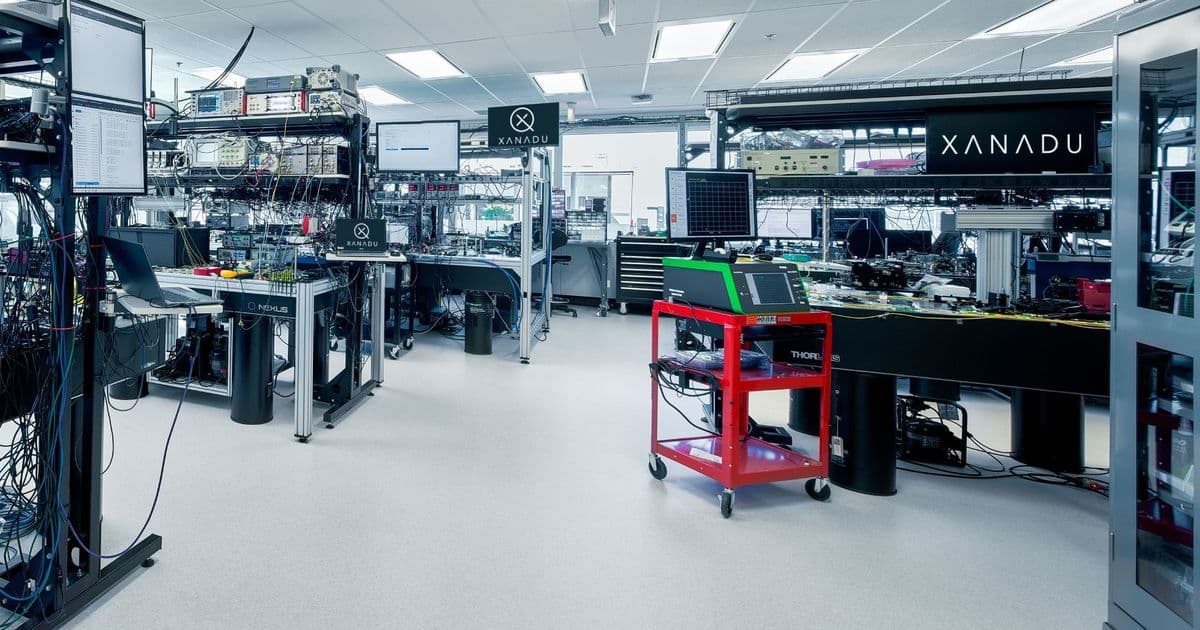
Xanadu and PsiQuantum are pursuing different approaches to photonic quantum computing, with Xanadu focusing on continuous-variable encoding using squeezed states and PsiQuantum betting on dual-rail encoding with silicon photonics manufacturing.
Quantum computing has emerged as one of the most promising frontiers in technology, with companies racing to build systems that can solve problems beyond the reach of classical computers. While superconducting qubits and trapped ions have dominated much of the attention, quantum photonics represents a fundamentally different approach that leverages the properties of light itself to encode and process quantum information.
This article examines two leading companies in the quantum photonics space: Xanadu Quantum Technologies and PsiQuantum. Both are pursuing ambitious roadmaps toward fault-tolerant quantum computers, but their technical approaches and strategic choices differ significantly.
What is Quantum Photonics?
To understand quantum photonics, we must first grasp the basics of classical photonics. Classical photonics uses light to transmit encoded information, most commonly through fiber optic cables. Light travels at its maximum speed through these cables without energy losses from electrical resistance, and multiple wavelengths can be multiplexed within the same beam to increase bandwidth.
The quantum leap occurs when we shift focus from light as a coherent beam to individual photons as information carriers. Quantum photonics uses single-photon sources and detectors to encode information in quantum properties like entanglement and superposition. Unlike classical photonics where billions of photons carry information, quantum photonics manipulates individual particles of light.
The key differentiator in current quantum photonics approaches lies in how operations are performed on individual photons and how information is encoded. PsiQuantum employs a dual-rail encoding approach where information states are derived from a photon's choice between two paths (waveguides). Xanadu uses continuous-variable encoding, examining the photon's light field distribution across properties like amplitude and phase, "squeezing" them to encode data.
Advantages and Challenges of Photonic Qubits
Quantum photonics offers several operational advantages over other approaches. Photons can be operated at room temperature, theoretically reducing installation, running, and maintenance costs compared to superconducting qubits that require cryogenic cooling. Photonic qubits are also less susceptible to environmental interference like electromagnetic noise and thermal fluctuations.
From a scaling perspective, photonics-based chips can leverage existing semiconductor manufacturing infrastructure. The natural speed of light also means gate times could have higher operational limits compared to approaches like trapped ions.
However, significant challenges remain. In PsiQuantum's dual-rail approach, generating identical photons that can be reliably entangled is extremely difficult. Minute differences in wavelength, polarization, and spatial modes can destroy systemic equilibrium. Photon generation itself is probabilistic—sometimes no photon is generated, sometimes one, and sometimes more than one.
This leads to a harsh reality: in quantum photonics, particularly in dual-rail designs, it's easy to lose more than 90% of generated photonic qubits before they perform any useful computation. To generate a 100-qubit photonic system, upwards of 10,000 photons must be generated, with everything else lost.
Xanadu's continuous-variable approach sidesteps some of these requirements and is more tolerant to photon loss, as light fields don't completely vanish with individual photon loss. However, it introduces different error correction challenges—errors are continuous (noise in amplitude and phase measurements) rather than discrete (photon present vs. absent).
Xanadu's Approach
Founded in 2016, Xanadu's mission is to build a fault-tolerant photonic quantum computing datacenter in the early 2030s. The company has been developing GKP (Gottesman-Kitaev-Preskill) qubits, a concept pioneered in 2001.
Xanadu's roadmap has been characterized by milestone announcements through scientific publications rather than public roadmaps. Their first quantum device demonstration came in Fall 2020 with the X8 photonic chip—a 4mm x 100mm 8-qubit device fabricated on silicon nitride process.
In June 2022, Xanadu introduced Borealis, their first fully programmable photonic processor with 1200 parameters leveraging 216 squeezed-state photon qubits. This enabled them to claim quantum advantage through a peer-reviewed Nature paper, demonstrating Gaussian Boson Sampling in 36 microseconds—a task they claimed would take top supercomputers 9,000 years.
By early 2025, Xanadu demonstrated Aurora, a room-temperature operated modular system with 12 physical qubits across 35 integrated photonics chips. This proved their ability to integrate all required architectural elements for fault-tolerant computing.
In June 2025, Xanadu achieved the world's first on-chip generation of GKP states with silicon manufacturing processes on 300mm wafers. They also demonstrated integrated error-correction at the chip level while improving photon detection efficiency.
The company's strategic partnerships reflect their identified bottlenecks. In July 2025, they partnered with HyperLight for TFLN (thin-film lithium niobate) chiplet technology to reduce waveguide losses. In August 2025, they collaborated with DISCO Corporation to improve GKP photon generation quality.
Looking forward, Xanadu aims for 1,000 logical qubits by 2029, expecting a 100:1 ratio requiring around 100,000 physical qubits. They're also developing quantum applications for machine learning and medical applications, including a breakthrough in photodynamic cancer therapy.
PsiQuantum's Approach
PsiQuantum, founded in 2016 and headquartered in Palo Alto, California, has taken a different strategic path. Rather than incremental development, they've focused on building toward a million-plus qubit system from the outset.
This decision led them to choose photonic quantum architecture, which can leverage semiconductor manufacturing techniques and decades of existing R&D. In 2021, PsiQuantum announced a public partnership with GlobalFoundries' Fab 8 for manufacturing their Omega quantum devices.
After years of relative silence, PsiQuantum revealed their work in 2025 through a Nature paper titled "A manufacturable platform for photonic quantum computing." The paper detailed Omega's specifications: compatibility with 300mm wafer platforms, silicon-nitride waveguides, telecom-band (1550nm) single-photon sources, and the world's first Barium Titanate manufacturing process on 300mm wafers.
The company claims state-of-the-art performance in key metrics, though this is conditional on photon detection. PsiQuantum places their achievement of large-scale, error-corrected quantum computing between 2027-2029, ahead of most competitors.
PsiQuantum's Alpha system program represents their next phase, with facilities under construction in Milpitas, California. Their 1 million-plus qubit system depends on completing housing facilities at the Illinois Quantum and Microelectronics Park, which saw groundbreaking in late 2025.
Comparing the Two Approaches
The fundamental difference between Xanadu and PsiQuantum lies in their encoding strategies and tolerance for imperfections. PsiQuantum's dual-rail approach requires near-perfect photon generation and detection, betting that silicon photonics manufacturing can overcome these challenges through scale and precision. Xanadu's continuous-variable approach is more tolerant to process imperfections but introduces different error correction challenges with continuous rather than discrete errors.
Both companies have secured significant backing and government partnerships. Xanadu has made it to DARPA's Quantum Breakthrough Initiative Stage B, while PsiQuantum qualified for DARPA's Underexplored Systems for Utility-Scale Quantum Computing Stage C program.
The Road Ahead
The quantum computing landscape remains highly competitive and capital-intensive. No pure-play quantum company currently generates revenue sufficient to sustain development costs, which helps explain the massive funding rounds both companies have secured.
The bet for both Xanadu and PsiQuantum is that when quantum advantage arrives, the investment will be justified. Their different approaches—Xanadu's incremental milestone-based strategy versus PsiQuantum's "go big or go home" million-qubit ambition—represent two philosophies for reaching the same ultimate goal.
As both companies progress toward their 2029+ targets for large-scale, error-corrected quantum computers, the photonics approach they champion may prove to be the key that unlocks practical quantum computing applications across fields from drug discovery to optimization problems that are currently intractable for classical computers.
The coming years will reveal which approach—Xanadu's tolerance for imperfections or PsiQuantum's pursuit of perfection through manufacturing—proves more viable for scaling quantum photonics to the level needed for transformative applications.
Comments
Please log in or register to join the discussion