The Register explores how QUIC is becoming as fundamental as TCP, examining its unique design, performance benefits, and why it represents the long-awaited protocol for request/response applications.
The internet's transport layer is about to undergo its most significant evolution since TCP became the backbone of reliable communication. QUIC (Quick UDP Internet Connections), once considered an experimental protocol, is rapidly becoming as fundamental to internet infrastructure as TCP itself, according to networking experts Bruce Davie and Larry Peterson.
The Challenge of Understanding QUIC
One of the first hurdles in understanding QUIC is its sheer complexity. The protocol spans four RFCs covering hundreds of pages, making it a daunting subject even for experienced network engineers. As Davie notes, trying to describe QUIC's most important features feels "a bit like the parable of the blind man and the elephant" – each aspect you examine reveals a different dimension of this multifaceted protocol.
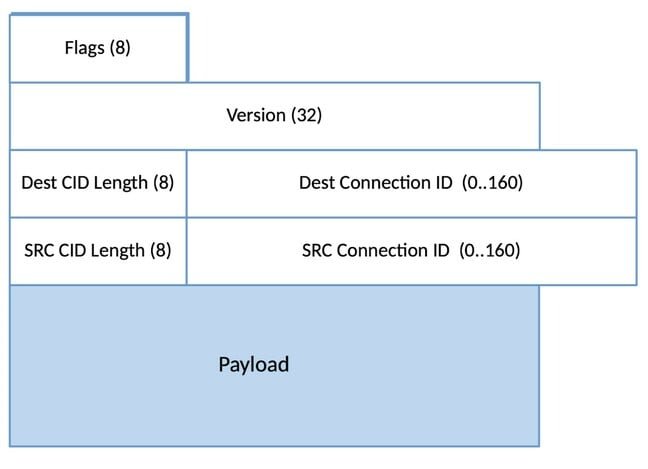
The lack of visual packet header diagrams in the official RFCs adds another layer of complexity. While the text-based representations provide comprehensive technical details, many engineers find visual representations more intuitive for understanding protocol structures. The variable-length fields and lack of 32-bit alignment in QUIC headers make traditional packet diagrams less tidy, but they remain invaluable for comprehension.
A New Approach to Layering
Perhaps the most revolutionary aspect of QUIC is how it reimagines the relationship between transport protocols and security. Traditional HTTP over TLS follows a layered approach: TCP provides a reliable byte-stream, TLS adds security on top, and HTTP runs over that secure channel. QUIC fundamentally restructures this by absorbing TLS's record layer directly into the transport protocol.
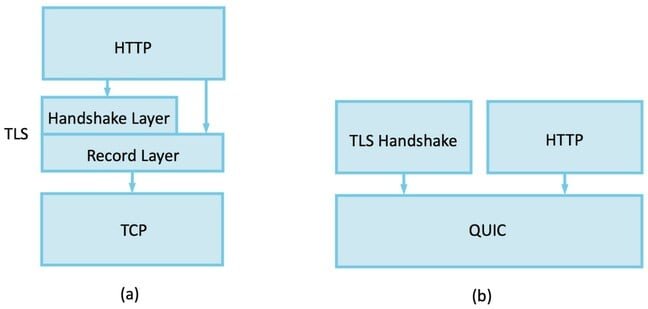
This integration allows QUIC to establish secure connections in a single round-trip time (RTT), compared to the multiple RTTs required by traditional TLS over TCP. The performance implications are significant – applications can send data in the first RTT, dramatically reducing connection establishment latency. This 0-RTT capability, while introducing some security trade-offs, represents a major advancement in web performance.
Streams: The Missing Piece for Request/Response
The introduction of streams within a single connection is what truly distinguishes QUIC as the "long-awaited answer" to request/response protocol needs. Traditional HTTP over TCP faces a fundamental limitation: it provides a reliable byte-stream abstraction that doesn't naturally fit request/response patterns.
With TCP, the only way to allow independent request processing is to open multiple parallel connections, each running its own congestion control loop. This creates inefficiencies and doesn't handle packet loss well – a single dropped packet can block all in-flight requests until retransmission occurs.
QUIC's stream mechanism solves this elegantly. Multiple streams can operate independently within a single connection, and a packet loss only impacts the specific stream whose data was in that packet. This allows for true parallel processing of requests while maintaining a single, efficient congestion control mechanism.
Congestion Control and Packet Loss Handling
QUIC's approach to congestion control and packet loss represents both continuity and innovation compared to TCP. While the default mechanism is similar to TCP NewReno, there are crucial differences. Most notably, QUIC uses sequence numbers that refer to packets rather than bytes and never reuse these numbers, even for retransmissions.
The Selective Acknowledgment (SACK) mechanism is more expansive, allowing for more gaps in the set of acknowledged packets. This provides better handling of out-of-order delivery and more efficient recovery from packet loss.
Why QUIC Succeeds Where Others Failed
QUIC's success isn't accidental. Several factors contribute to its widespread adoption:
Deployment pragmatism: By running over UDP, QUIC bypasses many of the middlebox issues that plagued previous transport protocol innovations. This UDP encapsulation ensures compatibility with existing network infrastructure while providing a clean slate for protocol design.
Performance focus: From the beginning, the QUIC team prioritized real-world performance improvements. The protocol addresses the specific pain points of web applications, particularly the overhead of small object transfers and the latency of connection establishment.
Comprehensive design: Unlike many previous attempts to create alternatives to TCP/UDP, QUIC addresses the full spectrum of transport layer requirements – reliability, security, performance, and extensibility – in an integrated manner.
The Future of Internet Transport
The rise of QUIC represents more than just another protocol update; it signals a fundamental shift in how we think about internet transport. For decades, the TCP/UDP duopoly limited innovation in transport protocols. QUIC breaks this mold while maintaining compatibility with existing infrastructure.
As web applications become increasingly complex and performance-sensitive, the advantages of QUIC become more compelling. Its ability to handle request/response patterns efficiently, establish secure connections quickly, and recover gracefully from packet loss makes it ideally suited for modern internet usage patterns.
For network engineers, understanding QUIC is no longer optional – it's becoming as essential as understanding TCP. The protocol's complexity reflects the complexity of modern internet requirements, but its benefits justify the learning curve. As Davie and Peterson suggest, QUIC's role will be "about as important as that of TCP in the coming years," making it a critical area of study for anyone involved in network architecture or application development.
The transition won't happen overnight, but the trajectory is clear. QUIC is moving from experimental status to mainstream adoption, and its impact on internet performance and architecture will be profound and lasting.
Comments
Please log in or register to join the discussion