
From a fledgling framework in 1991 to the backbone of modern video codecs, QuickTime’s evolution mirrors Apple’s own tumultuous journey. This deep dive traces its roots in the pre‑multimedia era, its pivotal role in CD‑ROM and early internet video, and its quiet persistence in today’s MP4‑centric ecosystem.
The Birth of a Multimedia Standard
In the late 1980s, Apple was a company on the brink—facing internal chaos and a market that had barely begun to grasp the promise of digital media. Amid this turbulence, a team of engineers quietly assembled what would become QuickTime, a framework designed not to reinvent every codec but to provide a flexible container for audio and video streams.
QuickTime’s first release on December 2, 1991 introduced the MOV container, a groundbreaking idea that allowed disparate codecs to coexist within a single file. This abstraction solved a core problem of the era: Macs were powerful enough to handle audio but not the computational heft required for full‑motion video. By delegating decoding to external codecs, QuickTime made video playback feasible on early Macintosh hardware.
“QuickTime was less about building new codecs and more about building a system that could plug in any codec that existed.” – Jason Snell, Macworld
Riding the CD‑ROM Wave
The arrival of CD‑ROM drives in the early 1990s provided the storage capacity necessary to host the burgeoning video files QuickTime could now play. Apple leveraged this to become a dominant player in the CD‑ROM market, powering interactive encyclopedias, movie databases, and games that shipped with rich audio‑visual content.
Apple didn’t stop at playback. The company introduced QuickTime VR, a development kit that let creators stitch together thousands of photographs into immersive 360‑degree panoramas. The Star Trek: The Next Generation Interactive Technical Manual CD‑ROM, highlighted in  , remains a legendary example of this technology, offering users a virtual tour of the Enterprise’s interior.
The Internet Era and Streaming
As the web grew, bandwidth constraints shifted the focus from local storage to streaming. Apple responded with the QuickTime Streaming Server, which delivered adaptive video quality over the early Internet. Although competitors like RealNetworks captured much of the early streaming market, QuickTime’s integration into the Mac ecosystem ensured it remained a staple for video professionals.
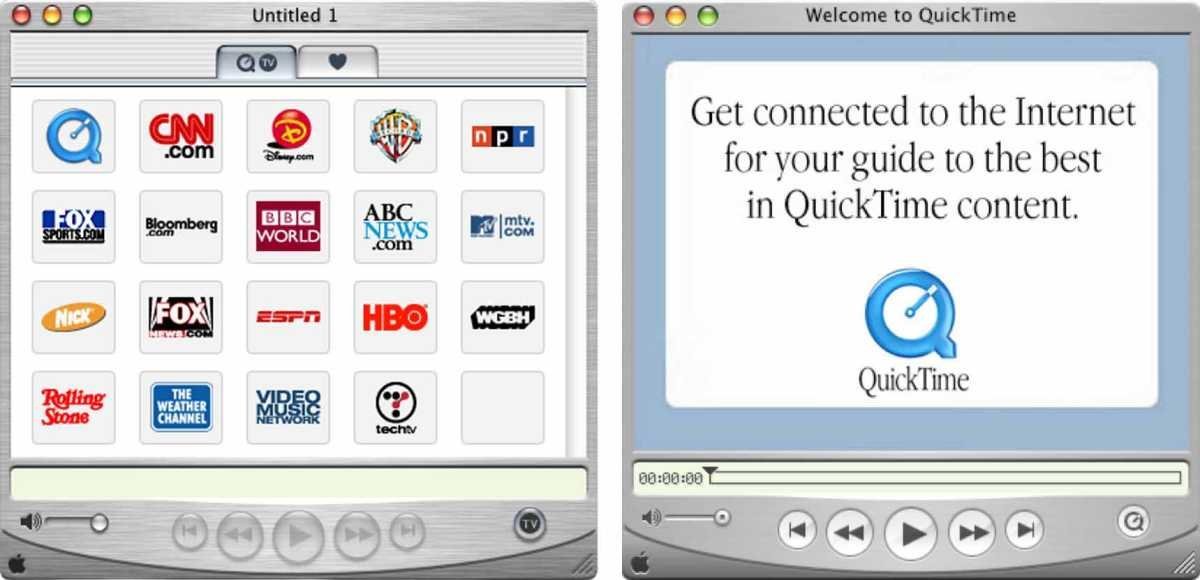
Macs shipped with QuickTime Player, and an optional QuickTime Pro extension allowed users to edit and manipulate video tracks—a surprisingly powerful feature for a player. The discontinuation of 32‑bit support in macOS Catalina in 2019 marked the end of classic QuickTime, but its legacy lives on in the form of modern frameworks and the ubiquitous MP4 container.
“QuickTime’s architecture laid the groundwork for the MP4 format we rely on today.” – Tech Analyst
A Quiet but Enduring Influence
Today, the QuickTime container is the backbone of the MPEG‑4 standard, and the same container format underpins immersive video experiences for Apple’s Vision Pro. Even as Apple’s public-facing media tools evolve, the core concepts pioneered by QuickTime—flexible containerization, codec abstraction, and adaptive streaming—continue to shape how developers handle video across platforms.
In a world where video dominates the internet, the quiet work of a 1991 framework reminds us that foundational engineering decisions can echo for decades. QuickTime may have started as a product of Apple’s “Wilderness Years,” but its impact on digital media is anything but fleeting.
Comments
Please log in or register to join the discussion