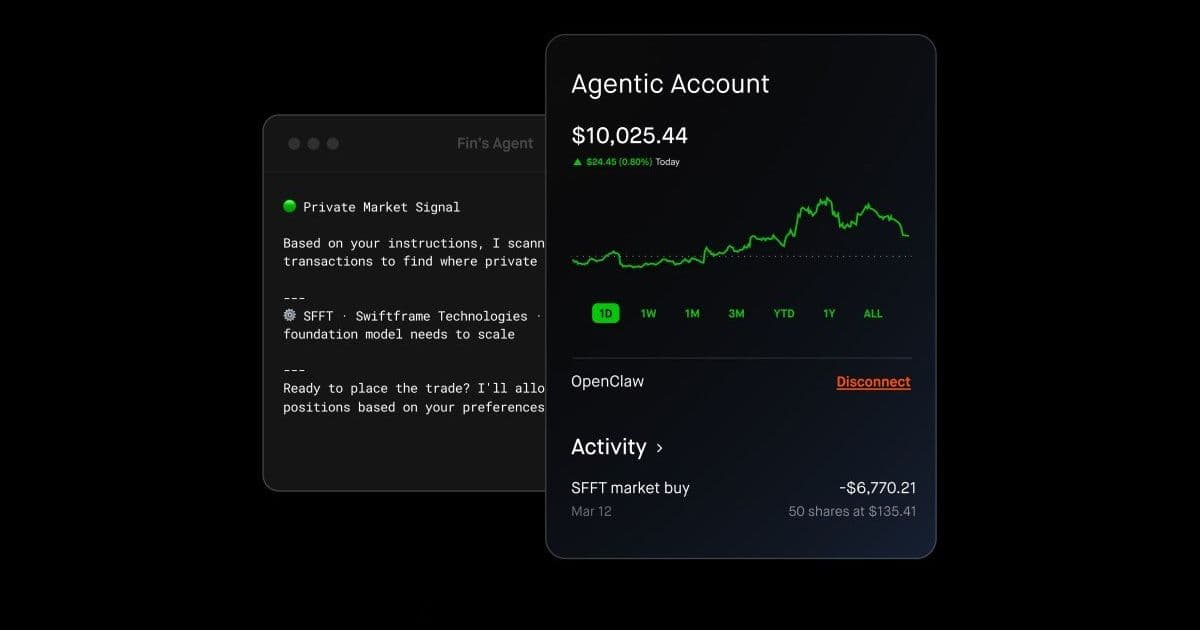
Robinhood announced a beta that lets users create a dedicated wallet for AI agents, enabling them to analyze portfolios, suggest trades and make payments under user‑defined limits, while the firm adds fraud monitoring and plans to broaden asset coverage.
Robinhood opens a sandbox for AI agents to trade stocks and pay bills
The product
Robinhood is rolling out a beta feature that gives users a separate account – essentially a wallet – that can be linked to an AI agent of their choosing. The agent can read the user’s portfolio, run risk‑checks and generate trade ideas, but it may only draw from the pre‑loaded balance in that wallet. Users receive a push notification for every trade the agent places and can watch a live feed of the agent’s activity inside the main Robinhood app.
For certain orders the interface shows a preview screen; the user must tap Approve before the trade is sent to the market. The company also introduced a virtual credit card that works in the same way: an AI agent can be given a card number, a monthly spend cap and an optional approval‑on‑each‑purchase toggle. At launch the card is limited to Robinhood Gold Card members, with broader rollout slated for the Platinum Card later this year.
How it works technically
Robinhood’s Model Context Protocol (MCP) acts as the bridge between an external LLM‑based agent and the brokerage’s back‑end. The protocol supplies the agent with:
- Portfolio composition and concentration metrics
- Sector exposure data
- Access to analyst notes and earnings transcripts
- The ability to submit order messages to the execution engine
When an agent requests a trade, MCP validates the request against the wallet’s balance and the user‑defined limits. If the request passes, it is queued for the normal order‑matching flow. A separate fraud‑detection team monitors the queue for anomalous patterns – for example, rapid large‑volume purchases or trades that deviate sharply from the user’s historical behavior – and can flag them for manual review.
Limits and safeguards
- Dedicated wallet – The agent cannot dip into the user’s main cash balance; only the funds explicitly allocated to the wallet are spendable.
- User notifications – Every order generates a real‑time alert, giving the user a chance to intervene.
- Approval workflow – For high‑risk or user‑selected trade categories, the UI requires explicit consent before execution.
- Spend caps on the virtual card – Monthly limits can be set as low as $0, effectively disabling the card.
- Fraud review – A human team reviews flagged activity and can reverse trades if needed.
Market context
Robinhood is not the first fintech to let software agents act on a user’s behalf. Stripe’s Connect APIs, Amazon’s Alexa Shopping integration and Google’s Pay with Google extensions already expose payment primitives to third‑party bots. Start‑ups such as Prava Pay are building similar “agent‑ready” payment layers that let developers embed purchase flows directly into LLM chat experiences.
What sets Robinhood apart is the focus on securities trading, a domain where regulatory compliance and real‑time risk management are far more complex than e‑commerce checkout. By sandboxing the agent in a wallet and requiring explicit user approval for many actions, Robinhood attempts to balance the convenience of autonomous trading with the fiduciary responsibilities that regulators expect from broker‑dealers.
Roadmap and competition
The beta currently supports only equities. Robinhood’s roadmap mentions adding options, cryptocurrencies, event contracts, futures and prediction markets over the next 12‑18 months. If the feature gains traction, it could pressure rivals such as eToro, Webull and Charles Schwab to expose similar agent‑friendly APIs.
Funding and strategic backdrop
Robinhood’s AI push follows its 2024 acquisition of Pluto, an AI‑driven research platform, and the launch of an in‑app AI assistant that offers personalized investment suggestions. The company has not disclosed new financing tied to the agentic trading effort, but the move aligns with a broader trend of fintechs seeking to embed generative‑AI capabilities into core product flows to increase user engagement and capture a larger share of transaction volume.
What it means for users
For a technically inclined investor, the new wallet offers a sandbox where a custom LLM – perhaps built on an open‑source model like Llama 3 – can experiment with algorithmic strategies without risking the entire account. For the average retail trader, the feature may feel like a safety net: the AI can surface opportunities, but the user retains final say on each trade.
The success of Robinhood’s approach will hinge on how well the fraud‑detection layer can keep pace with increasingly sophisticated agents, and whether regulators view the separation of wallet and main account as sufficient consumer protection.
The article references the official Robinhood announcement and the Model Context Protocol documentation for further technical details.
Comments
Please log in or register to join the discussion