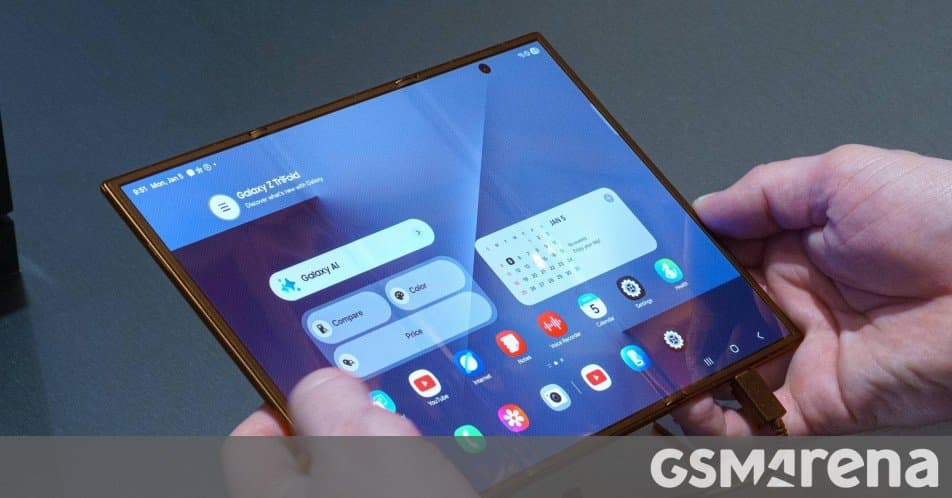
Modders swap in Honor's silicon-carbon batteries to dramatically increase the Galaxy Z TriFold's capacity from 5,600 mAh to 9,600 mAh
The Samsung Galaxy Z TriFold's modest 5,600 mAh battery has been a point of criticism since its December 2025 launch, especially when compared to both traditional smartphones and other foldables that offer 6,000+ mAh capacities. But a creative modification using Honor's silicon-carbon (Si/C) battery technology has demonstrated just how much more power could be packed into Samsung's ambitious trifold design.
The Battery Capacity Problem
When Samsung unveiled the Galaxy Z TriFold, many were surprised by its relatively small battery capacity. In an era where even standard smartphones routinely ship with 5,000+ mAh batteries, and foldables like Honor's Magic V6 offer 6,600 mAh, the Z TriFold's 5,600 mAh seemed particularly limiting for a device with three screens and complex folding mechanisms.
Honor's Silicon-Carbon Solution
Honor's Magic V6, released around the same time, incorporates silicon-carbon battery technology that allows for higher energy density in the same physical space. This technology replaces some of the traditional graphite in lithium-ion batteries with silicon-carbon composites, which can theoretically store more lithium ions and thus more energy.
YouTube channel Strange Parts took notice of this advantage and decided to experiment. They sourced Honor's Si/C batteries and successfully modified a Galaxy Z TriFold to accommodate them, resulting in a dramatic capacity increase.
The 71% Boost
The modification increased the Z TriFold's total battery capacity from 5,600 mAh to approximately 9,600 mAh - a 71% improvement that would significantly extend usage time for this power-hungry device. The modders documented the entire process in a video, with the battery modification portion starting around the 32:23 mark.
Technical Challenges
While the capacity increase is impressive, such modifications aren't without challenges. The physical dimensions, voltage characteristics, and battery management system compatibility all need to be addressed when swapping battery technologies between different devices. The Strange Parts team had to carefully engineer the fit and ensure the device's charging and power management systems could handle the new battery chemistry.
Why Samsung Hasn't Adopted This Technology
Despite the clear benefits demonstrated by this modification, Samsung continues to use conventional lithium-ion batteries in its foldables even in 2026. The reasons likely include:
- Proven reliability and safety track record of current battery technology
- Supply chain considerations and established manufacturing processes
- Potential cost differences between conventional and Si/C batteries
- Concerns about long-term durability of newer battery chemistries
The Future of Foldable Batteries
This modification highlights an interesting crossroads in mobile technology. As devices become more complex and power-hungry, battery technology needs to evolve. While Samsung has been conservative with battery innovations, other manufacturers like Honor are pushing boundaries with silicon-carbon technology.
For now, this remains a fascinating proof-of-concept rather than a practical upgrade path for most users. The modification requires technical expertise, voids warranties, and potentially introduces risks that casual users shouldn't undertake. However, it does demonstrate the untapped potential in current foldable designs and may influence how manufacturers approach battery technology in future generations.
The contrast between Samsung's conservative approach and Honor's more aggressive battery strategy raises questions about how different manufacturers balance innovation, reliability, and user experience in the competitive foldable market.
Comments
Please log in or register to join the discussion