
Ong Ye Kung’s argument for deeper integration lands as AI demand, tariffs and energy shocks expose how expensive isolation can become for chip and cloud supply chains.
Business News
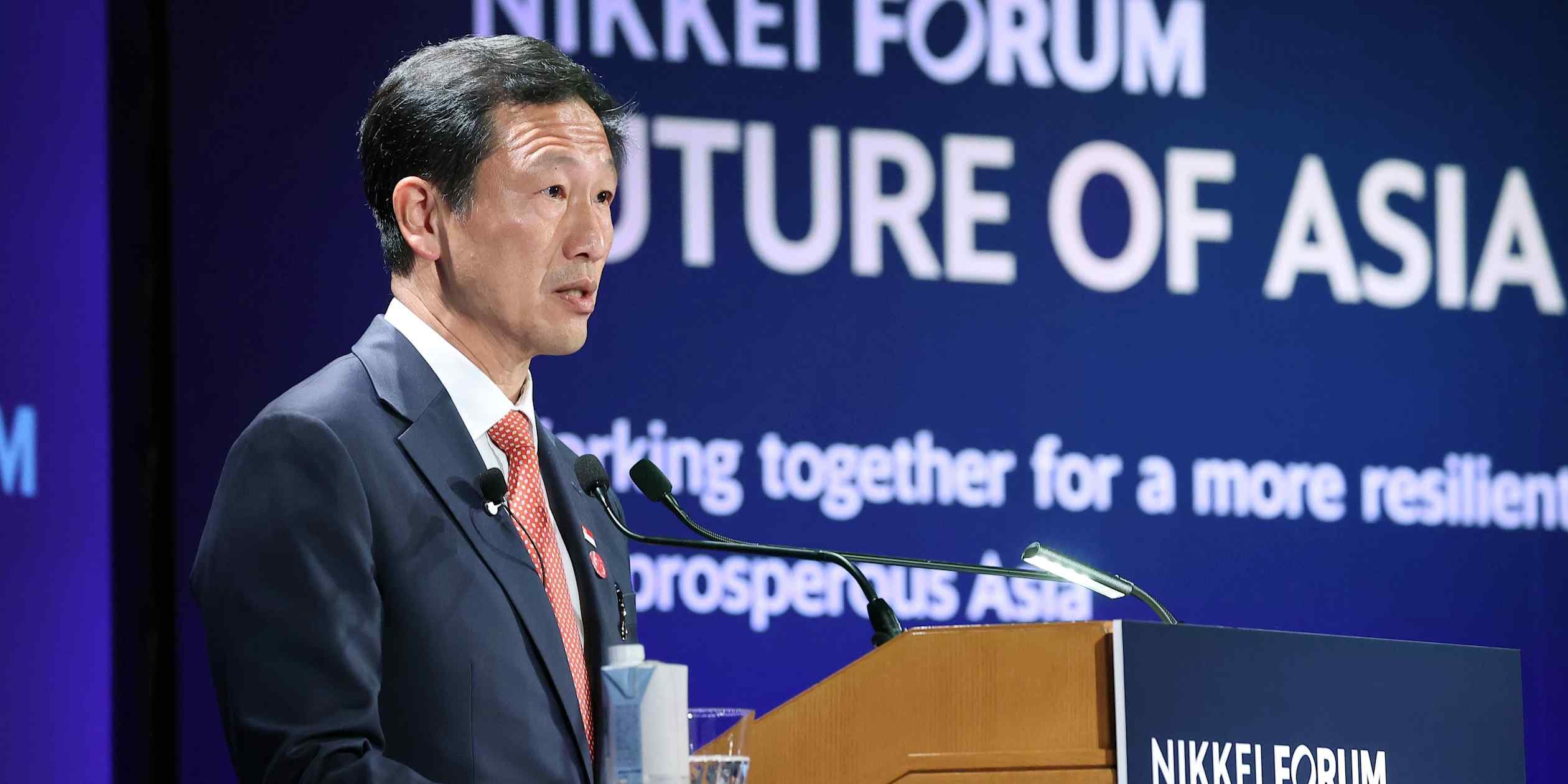
Singapore Health Minister Ong Ye Kung used Nikkei Asia’s Future of Asia forum in Tokyo on June 11 to argue that governments responding to public anxiety by retreating from globalization may weaken the resilience they are trying to build. His case was straightforward: supply chains become less fragile when companies and countries have more routes, more partners and more fallback capacity, not fewer.
That argument is especially relevant to the technology sector, where the AI buildout depends on a cross-border production system that no single country can cheaply recreate. Advanced chips may be designed in the U.S., fabricated in Taiwan or South Korea, packaged in Southeast Asia, shipped through major logistics hubs and installed in data centers that depend on power equipment, cooling systems, networking gear and software from several regions.
For Singapore, this is not abstract policy language. The city-state sits inside the plumbing of global trade, finance, cloud operations and semiconductor supply chains. World Bank trade data shows why Singapore tends to frame openness as an operating model rather than a slogan: its economy is far more exposed to cross-border flows than large domestic markets such as the U.S., China or India.
Market Context
The timing matters because global trade is being pulled in two directions at once. Tariffs, export controls, sanctions risk and energy insecurity are pushing companies to regionalize parts of production, while the AI investment cycle is pulling demand back toward global specialization. According to recent reporting on the WTO goods trade barometer, the indicator stood at 101.7 in April, still above its long-run trend, with electronic components among the strongest categories because of AI infrastructure spending.
The same WTO-linked figures put the tension in numerical terms. Global goods trade grew 4.6% in 2025 and is forecast to slow to about 2.5% in 2026, with a downside case near 1.4% if energy and shipping disruptions persist. That is not a collapse, but it is a warning that trade growth is increasingly dependent on a narrow set of technology-linked flows.
Semiconductors make the point even more clearly. Reporting based on Semiconductor Industry Association and WSTS data said the chip industry reached $791.7 billion in sales in 2025 and could approach $1 trillion in 2026, driven by AI accelerators, high-bandwidth memory, networking silicon and storage demand. That scale turns supply chain architecture into a financial variable: small changes in lead times, export rules or energy costs can move billions of dollars across foundries, cloud providers and equipment makers.
The globalization debate is therefore becoming less about low-cost labor and more about capital efficiency. A fully duplicated technology stack is expensive because the most advanced pieces have steep learning curves, limited supplier bases and enormous fixed costs. A leading-edge fab can cost tens of billions of dollars, while the broader data center buildout requires chips, transformers, turbines, fiber, cooling systems, land and grid interconnection.
That is why Ong’s message lands beyond Singapore’s diplomatic audience. For cloud providers and AI labs, resilience does not mean bringing every input onshore. It means mapping where concentration risk is dangerous, then adding redundancy where it changes the risk profile without wasting capital.
What It Means
The first implication is that companies will keep shifting from just-in-time supply chains to optionality-based supply chains. That means more dual sourcing, more inventory for critical components, more regional assembly capacity and more contractual flexibility with logistics providers. It also means higher working capital needs, which will show up in margins before it shows up in crisis performance.
The second implication is that governments will compete less on simple manufacturing incentives and more on trusted-network status. Countries that can offer stable rules, export-control alignment, port capacity, power availability, data governance and skilled workers will attract higher-value nodes of the AI supply chain. Singapore’s pitch is that integration itself is a form of insurance because it gives firms more commercial paths when one route is blocked.
The third implication is that investors should separate real resilience spending from political theater. Building a second supplier for advanced packaging, qualifying another substrate vendor or securing long-term power capacity can protect revenue. Building uneconomic duplication for every input can trap capital in lower-return assets while still failing to solve the hardest bottlenecks.
For the tech industry, the strategic question is no longer whether globalization survives in its old form. It is whether the next version is organized enough to keep AI infrastructure, cybersecurity tools, cloud services and semiconductor capacity scaling under geopolitical stress. Ong’s argument is that more connected systems can absorb shocks better than isolated ones, provided the connections are diversified and governed by credible rules.
That view is likely to gain traction because the economics are becoming visible. If AI capex continues rising while trade slows, the winning regions will be those that sit at the intersection of capital, logistics, energy and policy trust. Singapore is making the case that openness is not nostalgia for the pre-tariff era; it is a balance-sheet strategy for a technology cycle that cannot afford single points of failure.
Comments
Please log in or register to join the discussion