
AMD is turning Strix Halo into a desktop AI workstation with a supply-chain-aware price move: 128GB of unified LPDDR5X, Windows 11 support, and a $700 gap below Nvidia's DGX Spark.
Announcement
AMD's Ryzen AI Halo Developer Platform has moved from CES 2026 reveal to U.S. preorder, with Micro Center listing the compact Strix Halo desktop at $3,999 and local pickup expected July 10. The timing matters because Nvidia's DGX Spark has moved from its original $3,999 level to $4,699, creating a clean $700 pricing gap between two 128GB unified-memory desktop AI systems.
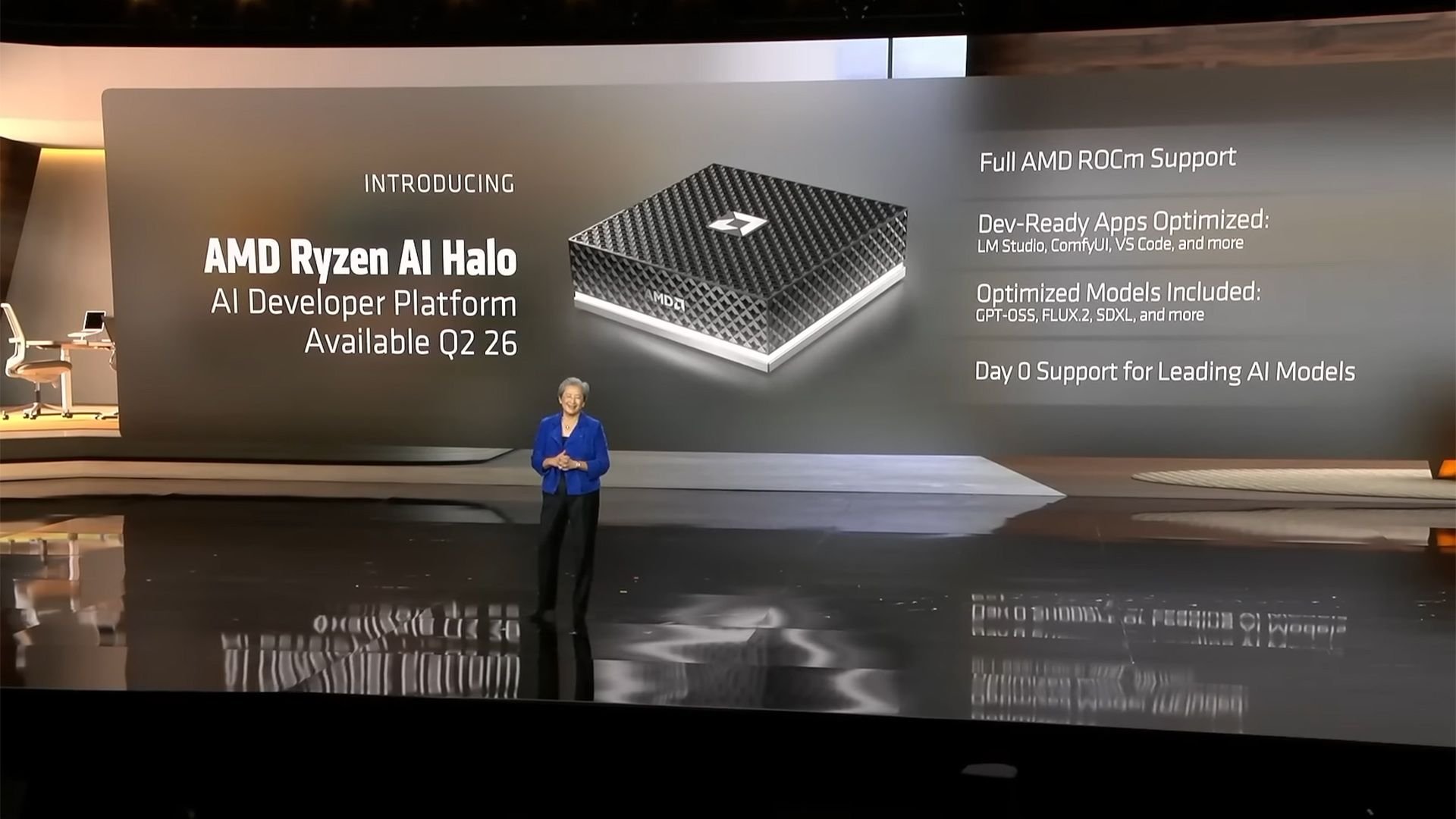
AMD is positioning the system as a local AI development box rather than a conventional mini PC. The platform ships in Linux and Windows 11 Pro variants with the same hardware, which gives AMD a software access point Nvidia does not match on DGX Spark, whose official platform is DGX OS. For AI developers who live in Linux containers, the difference may be modest. For enterprise Windows teams, ISVs, university labs, and developers building local AI features for Windows applications, native Windows support changes procurement and workflow assumptions.
Technical Specs
The Ryzen AI Halo system is built around AMD's Ryzen AI Max+ 395, the flagship Strix Halo APU. It combines 16 Zen 5 CPU cores and 32 threads, a 3.0 GHz base clock, up to 5.1 GHz boost, 16MB of L2 cache, and 64MB of L3 cache. The chip sits in AMD's high-end 4nm-class client silicon family and pairs those CPU cores with Radeon 8060S integrated graphics using 40 RDNA 3.5 compute units. The dedicated XDNA 2 NPU is rated at 50 TOPS, while full-platform AI throughput is commonly discussed around 126 TOPS when CPU, GPU, and NPU resources are counted together.
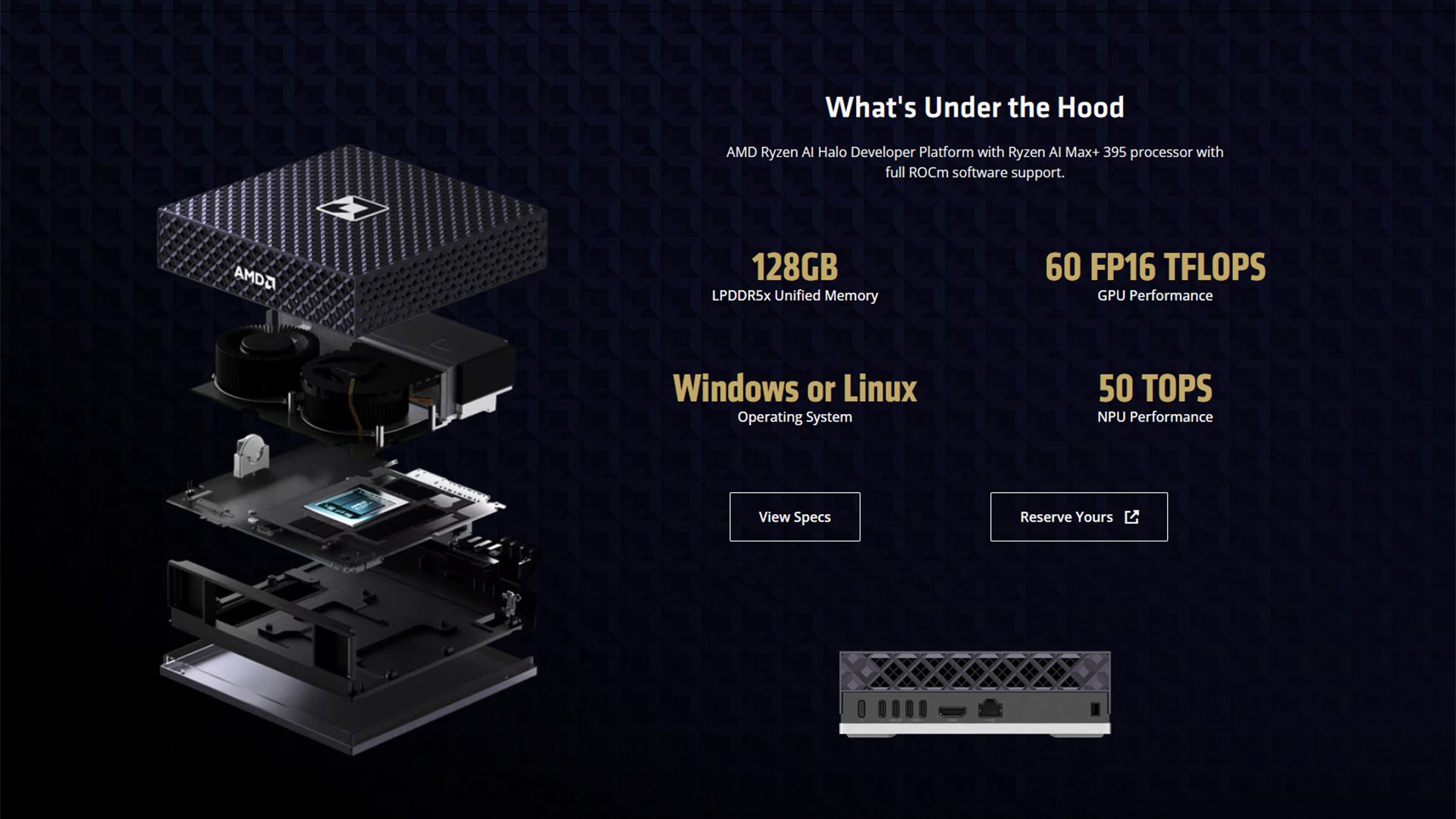
The headline component is memory. AMD is using 128GB of unified LPDDR5X-8000, giving the CPU and GPU access to the same pool instead of splitting system DRAM from discrete GPU VRAM. That design is central to local LLM work because model size is often gated first by memory capacity, then by memory bandwidth, then by compute. A quantized 70B-class model can push past the comfort zone of 16GB or 24GB discrete GPUs, while 128GB unified memory gives developers more room for weights, context, embeddings, and application overhead.
Nvidia's DGX Spark counters with its GB10 Grace Blackwell Superchip, 128GB of coherent LPDDR5X unified memory, 273 GB/s of memory bandwidth, 4TB NVMe storage, and up to 1 PFLOP of FP4 AI performance, according to Nvidia's official specifications. AMD's system ships with a smaller 2TB M.2 SSD, which likely helps the $3,999 bill of materials. That storage delta is meaningful, since NAND pricing has been one of the pressure points in 2026 client and workstation systems.
The chassis is close to DGX Spark in footprint: AMD's box measures 149 x 149 x 43.18 mm, while Nvidia lists DGX Spark at 150 x 150 x 50.5 mm. AMD includes Wi-Fi 7, Bluetooth 5.4, 10 GbE LAN, four USB-C ports with one used for power input, and HDMI 2.1b. Cooling uses a baseplate, direct-touch flat heatpipes, an aluminum channel heatsink, and two lateral blower-style fans, a necessary design choice for a compact enclosure expected to sustain workstation-class APU loads.
The largest architectural omission is scale-out. Nvidia lists ConnectX networking on DGX Spark and markets two-system pairing for models up to 405 billion parameters. AMD's listed configuration does not show an equivalent dual-box path. That does not reduce the value of Ryzen AI Halo for single-node inference, testing, and application development, but it does draw a boundary around the system's intended role.
Market Implications
The $700 gap is a supply-chain signal as much as a product signal. Both machines depend on dense LPDDR5X packages, and Nvidia has explicitly tied its DGX Spark price increase to memory constraints. LPDDR5X is being pulled by premium notebooks, AI PCs, handhelds, smartphones, embedded systems, and compact AI workstations at the same time that NAND pricing has tightened. In that context, AMD holding $3,999 for a 128GB unified-memory configuration suggests either earlier memory allocation, a sharper margin strategy, lower storage cost, or a deliberate move to seed Strix Halo among developers before Nvidia's CUDA advantage hardens further in this class.
AMD's strongest opening is not raw AI software maturity. Nvidia still has the deeper stack with CUDA, TensorRT, NIM, DGX OS, and partner workflows that many AI teams already use. AMD's counter is platform breadth: x86 CPU cores, Windows 11 Pro support, Linux support, Radeon graphics, and the open ROCm software stack. That makes Ryzen AI Halo less like a miniature DGX and more like a high-memory desktop workstation aimed at developers who want to prototype local inference inside normal PC environments.
The Windows angle should not be dismissed. A large share of commercial client software, engineering tools, creative applications, and internal enterprise workflows still runs on Windows. If developers are building AI assistants, document-processing tools, code agents, local retrieval systems, or media pipelines for those users, validating on a Windows AI workstation has value. Nvidia can still win Linux-first AI labs, but AMD can compete for mixed OS shops where the target deployment is a Windows PC rather than a CUDA server.
Process and packaging choices also shape the economics. Strix Halo is not a socketed desktop CPU with replaceable DIMMs. It is a tightly integrated APU platform with soldered high-speed LPDDR5X, a wide memory interface, and graphics large enough to behave more like an entry workstation GPU than conventional integrated graphics. That reduces upgrade flexibility, but it improves density, bandwidth per watt, and board complexity. For a local LLM box, that trade-off is defensible because the first purchase decision is usually fixed memory capacity.
Competition below $4,000 will still matter. Systems such as the Corsair AI Workstation 300, listed with the same Ryzen AI Max+ 395 family and lower starting prices depending on storage, show that AMD's chip can reach more than one form factor and price band. If OEMs can build Strix Halo systems at $2,699 to $3,399 while AMD's own developer platform sits at $3,999, Nvidia faces pressure not only from AMD, but from a broader x86 mini-workstation channel.
The practical buyer decision comes down to software risk versus platform flexibility. DGX Spark offers Nvidia's AI stack, FP4 throughput claims, and a clearer path for teams already deploying on Nvidia infrastructure. Ryzen AI Halo offers 16 x86 cores, 128GB unified memory, Windows 11 Pro, Linux, 10 GbE, and a lower entry price. In a year when memory supply is shaping workstation pricing, AMD has chosen the most direct pressure point available: matching the 128GB headline while undercutting Nvidia by $700.
Comments
Please log in or register to join the discussion