
South Korea's National Tax Service accidentally exposed a cryptocurrency wallet's recovery phrase in public photos, enabling thieves to steal $4.8 million in digital assets. The incident highlights the critical importance of protecting seed phrases and the severe consequences of basic security oversights.
The South Korean National Tax Service (NTS) has suffered a major security failure that resulted in the theft of approximately $4.8 million in cryptocurrency assets, after inadvertently exposing the recovery phrase for a seized digital wallet in publicly released photographs.
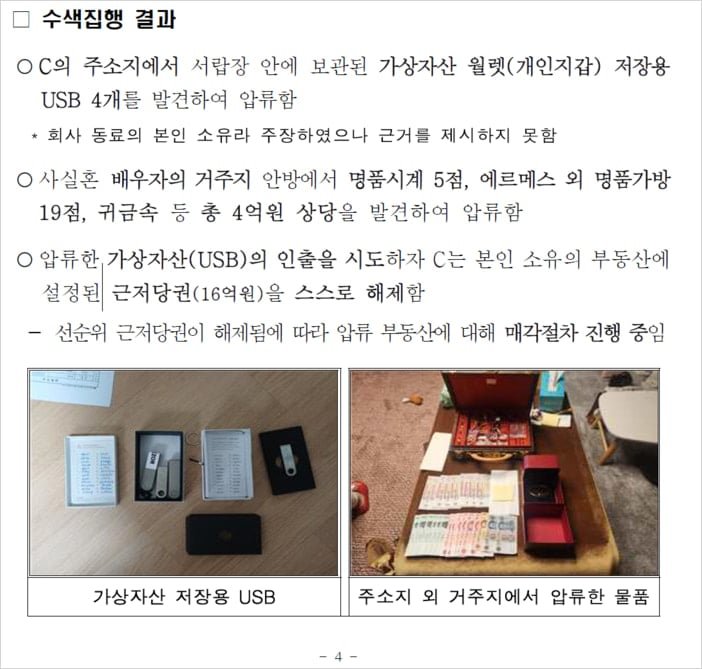
Images released by the South Korean tax authority Source: mk.co.kr
The incident occurred following law enforcement raids targeting 124 high-value tax evaders, which led to the confiscation of digital assets worth 8.1 billion won (approximately $5.6 million). As part of their announcement celebrating the successful operation, the NTS published photos of a Ledger hardware wallet used to store the seized cryptocurrency.
However, the images revealed a critical security oversight: a handwritten note containing the wallet's recovery phrase was clearly visible. This 12-24 word sequence serves as the master key for cryptocurrency wallets, allowing complete access to all funds stored within, regardless of physical security measures.
How the theft unfolded
Blockchain analysis shows the attacker executed a methodical operation. First, they deposited a small amount of Ethereum into the compromised wallet to cover transaction fees, known as "gas fees." Then, in three separate transactions, the thief transferred 4 million Pre-Retogeum (PRTG) tokens worth approximately $4.8 million at the time to their own wallet address.
"On-chain data (Etherscan) analysis shows that the attacker first deposited a small amount of Ethereum (ETH) into the wallet to pay transaction fees (gas fees), and then meticulously transferred the 4 million PRTG tokens to their own wallet in three separate transactions," reported Korean media outlets.
Expert analysis of the security failure
Cho Jae-woo, a blockchain data analysis expert and professor at Hansung University in Seoul, characterized the NTS's mistake as akin to "leaving a wallet open and advertising it to the entire nation for people to take the money."
The professor attributed the costly error to the tax authorities' "lack of basic understanding of virtual assets," which effectively cost the national treasury tens of billions of won that had been successfully confiscated through legitimate law enforcement action.
This incident serves as a stark reminder that even government agencies tasked with enforcing financial regulations can fall victim to basic security oversights when dealing with cryptocurrency technology.
Why seed phrases are so critical
Hardware wallets like Ledger devices are designed to provide robust security for cryptocurrency storage. They keep private keys isolated from internet-connected devices and require physical confirmation for transactions. However, this security architecture has one critical vulnerability: the recovery phrase.
A seed phrase, typically consisting of 12, 18, or 24 randomly generated words, is created when setting up a hardware wallet. This phrase can recreate the entire wallet, including all private keys and access to funds, on any compatible device. Unlike PIN codes or passwords, seed phrases bypass all other security measures.
Anyone who obtains a wallet's seed phrase can:
- Recreate the wallet on any device
- Access all funds without needing the original hardware
- Bypass PIN codes and other security features
- Transfer assets to any address without authorization
Best practices for seed phrase security
The NTS incident underscores several critical security practices that all cryptocurrency users should follow:
Never digitize seed phrases: Avoid storing recovery phrases in electronic notes, photos, email messages, cloud storage services, or messaging applications. Digital storage creates multiple attack vectors for potential thieves.
Use physical storage methods: Write seed phrases on paper or metal backup devices designed for cryptocurrency storage. Store these in secure, physically protected locations like safes or safety deposit boxes.
Maintain multiple backups: Create several copies of your seed phrase and store them in different secure locations to protect against loss from fire, flood, or other disasters.
Never share seed phrases: Legitimate services, including wallet manufacturers and cryptocurrency exchanges, will never ask for your recovery phrase. Any request for this information is almost certainly a scam.
Act immediately if exposed: If a seed phrase becomes compromised or potentially exposed, move all funds to a new wallet with a fresh seed phrase as quickly as possible. The NTS incident demonstrates how rapidly assets can be stolen once a seed phrase is public.
Government response and accountability
The NTS has removed the press release from its website following the theft, but it remains unclear whether authorities have launched an investigation to track the stolen funds or identify the perpetrator. The incident raises questions about government competency in handling seized digital assets and the protocols for public communications about cryptocurrency seizures.
This security failure represents not just a financial loss but also a significant blow to public confidence in the government's ability to manage digital assets and enforce tax compliance in the cryptocurrency space.
Broader implications for cryptocurrency security
The NTS incident is part of a growing pattern of high-profile cryptocurrency thefts and security failures. Recent reports include:
- Snail mail campaigns targeting Trezor and Ledger users with crypto-theft attempts
- Ledger customers affected by third-party Global-e data breach
- New GlassWorm malware targeting Mac users with trojanized crypto wallets
- Arrest of a hacker responsible for KMSAuto malware with 2.8 million downloads
- Record low ransomware payment rates despite increasing attack volumes
These incidents collectively highlight the ongoing challenges in securing digital assets and the need for both individual users and institutions to maintain rigorous security practices.
Lessons learned
The $4.8 million loss resulting from the NTS's security failure provides several important lessons for the cryptocurrency community:
Human error remains the weakest link: Even sophisticated security systems can be compromised by basic operational mistakes.
Government agencies need specialized training: Law enforcement and regulatory bodies must develop expertise in cryptocurrency security to avoid costly mistakes.
Transparency requires security awareness: Public communications about cryptocurrency operations must be carefully reviewed to prevent accidental exposure of sensitive information.
Recovery phrases demand extreme protection: The NTS incident demonstrates that seed phrases should be treated with the same level of security as the assets they protect.
As cryptocurrency adoption continues to grow, incidents like this serve as costly reminders that security fundamentals cannot be overlooked, regardless of the sophistication of the technology or the authority of the organization handling digital assets.
Comments
Please log in or register to join the discussion