An examination of ezlime, a minimalist Rust-based link shortener that demonstrates how purpose-built solutions can outperform generic services through architectural efficiency and thoughtful design.
In the sprawling landscape of web infrastructure, where services often grow to accommodate every conceivable use case, the ezlime project presents a refreshing counterpoint. This small Rust service powering ezli.me embodies a philosophy that resonates deeply with those who believe in the power of focused, efficient software. What began as a practical solution to avoid escalating costs with TinyURL evolved into an elegant demonstration of how minimalism and performance can coexist in modern web applications.
The Genesis of Necessity
The motivation behind ezlime is refreshingly pragmatic. When Live-Ask.com faced the prospect of outgrowing TinyURL's free tier, the team confronted a familiar dilemma: pay for another SaaS plan or build their own solution. Their choice to build was not driven by technical bravado but by a simple calculation of resources. With spare capacity already available in their K3s cluster, the question became not whether they could afford to build, but how little software they actually needed to redirect a URL.
This decision reflects a growing trend among organizations reevaluating their relationship with third-party services. As cloud costs continue to rise and operational complexity accumulates, many are finding that purpose-built solutions can offer significant advantages in both performance and cost efficiency. The ezlime project exemplifies this shift, demonstrating that sometimes the most innovative approach is the simplest one.
Architectural Elegance in the Details
At its core, ezlime implements a sophisticated yet straightforward architecture that prioritizes performance and simplicity. The service follows a cache-first pattern, checking an in-memory quick_cache before falling back to PostgreSQL. This approach ensures that popular links—those most likely to be accessed—benefit from sub-millisecond response times, while still maintaining persistence for all links through the database.
The redirect handler, shown in the article, is remarkably concise, containing only the essential logic for URL resolution. What's particularly noteworthy is what's absent: there are no complex authentication flows, no expensive database writes on every request, no intricate error handling that might add latency. The handler focuses exclusively on its primary function: finding the target URL and returning it to the client.
Perhaps the most clever aspect of the design is the write path optimization. Rather than updating the database on every click, the service accumulates click counts in memory and flushes them to PostgreSQL in bulk via a background task. This approach dramatically reduces database load while still maintaining accurate statistics. The implementation uses a single bulk UPDATE query that can handle thousands of clicks with just one database roundtrip, a technique that becomes increasingly valuable as traffic scales.
The deterministic short ID generation algorithm further demonstrates thoughtful design. By hashing the original URL and base62-encoding it, the system ensures that the same URL always receives the same short code. Collision resolution is handled gracefully by retrying with an offset in the hash input, maintaining the system's predictability without sacrificing functionality.
Performance Through Constraint
ezlime's performance characteristics are not accidental but the result of deliberate architectural decisions. By keeping the hot path extremely focused—cache check, database lookup if needed, return URL—the service minimizes latency at every opportunity. The in-memory cache ensures that frequently accessed links require no database interaction at all, while the write batching strategy prevents the database from becoming a bottleneck even under high load.
The resource requirements tell a compelling story about efficiency. Running as two replicas with just 10m CPU and 32Mi memory requests, the service demonstrates that even a link shortener—one might assume a trivial problem—can benefit from careful optimization. These constraints are not arbitrary but the result of understanding what the system truly needs to accomplish and eliminating everything else.
Operational Simplicity as a Feature
What makes ezlime particularly interesting is its operational footprint. The service consists of just one Rust binary, one PostgreSQL database, and a minimal K3s deployment. There is no Redis, no message queue, no analytics pipeline, and no admin backend. This simplicity reduces the cognitive load required to operate and maintain the service, making it more reliable and easier to debug.
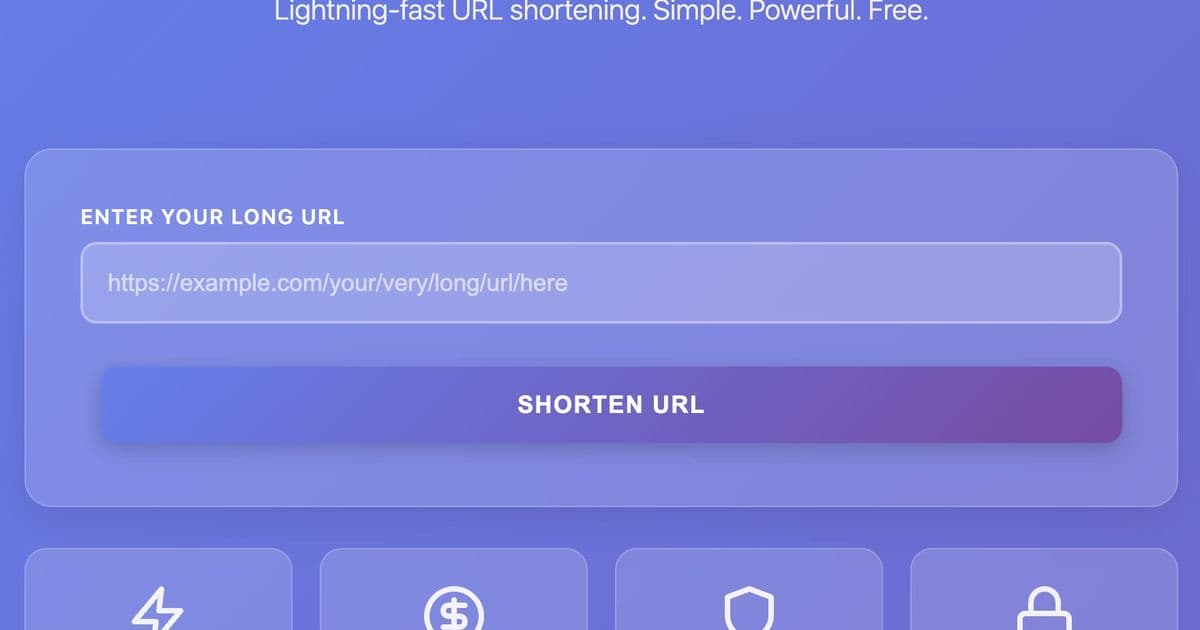
The landing page, implemented as plain static HTML/CSS, further reinforces this philosophy. While many modern services would reach for a JavaScript framework to create even the simplest web presence, ezlime opts for the most straightforward solution possible. This consistency in approach—choosing simplicity across all components—creates a system that is greater than the sum of its parts.
The value of such simplicity becomes apparent when considering the total cost of ownership. With fewer moving parts, there are fewer things that can go wrong, fewer updates to manage, and less specialized knowledge required to keep the system running. For organizations with limited DevOps resources, this operational simplicity can be a significant advantage.
Technical Trade-offs and Design Philosophy
Every design decision involves trade-offs, and ezlime is no exception. The service intentionally sacrifices certain features—detailed analytics, user accounts, comprehensive tracking—in favor of simplicity and performance. This focus on the core functionality means that ezlime will not be the right solution for every use case, but for those who need reliable URL shortening with minimal overhead, it may be perfect.
The authentication approach reflects this philosophy. Rather than implementing a full account system, the service offers API keys for authenticated clients while using Cloudflare Turnstile for public link creation. This hybrid approach provides security without the complexity of user management, striking a balance between functionality and operational simplicity.
The code itself exemplifies the "small is beautiful" principle. The redirect handler, at just a few lines of code, demonstrates how much functionality can be packed into a small, focused function. This readability and maintainability are often casualties in more complex systems, but here they are central to the design.
Broader Implications for Software Development
ezlime represents more than just a link shortener; it embodies a set of principles that are increasingly relevant in today's software development landscape. As organizations grapple with rising cloud costs and operational complexity, the project offers a compelling alternative to the "buy versus build" dilemma.
The success of ezlime challenges the assumption that more features equal more value. By focusing on doing one thing exceptionally well, the service creates a solution that is not only performant but also reliable and easy to operate. This approach stands in contrast to many modern services that attempt to be all things to all users, often at the cost of complexity and performance.
The project also highlights the value of open source in solving common problems. By dual-licensing the code under MIT and Apache-2.0, the creators enable others to benefit from their work while maintaining the ability to use it in proprietary projects. This model fosters innovation while giving back to the community, creating a virtuous cycle of shared knowledge and improvement.
Conclusion: The Enduring Value of Focused Solutions
ezlime demonstrates that sometimes the most innovative solutions are the simplest ones. By carefully considering what functionality is truly necessary and eliminating everything else, the project creates a system that is fast, reliable, and easy to operate. In an era where software complexity often seems to grow without bound, ezlime offers a refreshing reminder that elegance and efficiency remain valuable virtues.
The project's success lies in its understanding that the best solutions are often those that are purpose-built rather than generic. By focusing on the specific needs of their use case and leveraging their existing infrastructure effectively, the creators built a solution that is not only technically sound but also economically sensible.
For organizations considering similar projects, ezlime provides a blueprint for building efficient, focused services that deliver value without unnecessary complexity. It stands as a testament to the power of thoughtful design and the enduring value of doing one thing exceptionally well.
Those interested in exploring the code can find the ezlime project on GitHub, where it's dual-licensed under MIT and Apache-2.0. For organizations looking to run their own instance, the project offers a straightforward path to deployment with minimal infrastructure requirements. The ezli.me service itself is available for public use, with API keys available through the project's Discord server.
Comments
Please log in or register to join the discussion