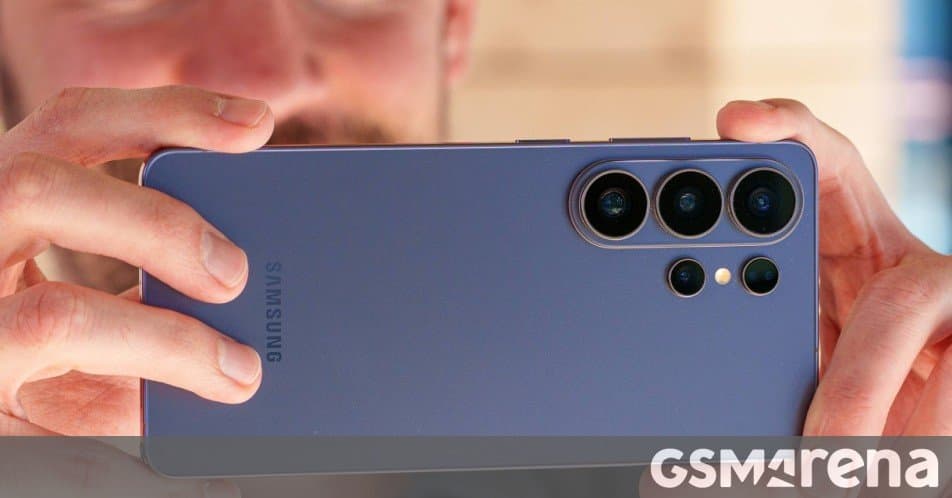
Samsung's Galaxy S26 Ultra trades its periscope telephoto lens for a traditional design, affecting minimum focus distance and bokeh patterns while potentially improving low-light performance.
Samsung's Galaxy S26 Ultra represents a subtle but significant shift in camera design philosophy, particularly in how it handles telephoto photography. The company has moved away from the periscope lens design that has dominated flagship smartphones for years, opting instead for a traditional lens assembly in its 5x telephoto camera.
The most immediate practical impact of this change is the minimum focus distance. The S26 Ultra's 5x camera now requires subjects to be at least 52cm away to achieve sharp focus, double the 26cm minimum of the S25 Ultra's periscope lens. For users who frequently use telephoto lenses for close-up shots—whether capturing detailed product photos or creative portraits—this represents a tangible limitation.
However, the lens swap isn't purely a downgrade. The new design creates noticeably different bokeh patterns compared to periscope lenses. Traditional lenses produce round bokeh shapes in the center of the frame that gradually transition to more polygonal, cat's-eye-like shapes toward the edges. Periscope lenses, by contrast, create rectangular bokeh shapes that many photographers find less aesthetically pleasing.
This difference becomes apparent when shooting scenes with point light sources in the background. The S26 Ultra's traditional lens renders these lights with more organic, circular shapes, while the S25 Ultra's periscope lens produces distinctly rectangular highlights.
Samsung has also widened the aperture of the new 5x camera from f/3.4 to f/2.9. This change should theoretically improve low-light performance by allowing more light to reach the sensor. The company's marketing materials emphasize enhanced low-light capabilities, though comprehensive image quality comparisons will have to wait for full review testing.
Interestingly, Samsung's official product pages reflect this design change—the S26 Ultra's camera section makes no mention of periscope technology, while the S25 Ultra's page does. This suggests the change was intentional and part of a broader design strategy rather than a cost-cutting measure.
The switch to a traditional lens design likely relates to the S26 Ultra's other major camera upgrade: the significantly wider aperture on the main 200MP sensor (f/1.7 to f/1.4). Accommodating this larger lens assembly may have necessitated changes to the overall camera module layout, making the traditional telephoto design a more practical fit.
For most users, the impact of this change will depend on shooting habits. Those who primarily use telephoto lenses for distant subjects—wildlife, sports, or architectural photography—may never notice the increased minimum focus distance. Portrait photographers and those who enjoy creative close-up work with telephoto compression will feel the limitation more acutely.
What's clear is that Samsung is refining rather than revolutionizing its camera approach with the S26 Ultra. The company is making calculated trade-offs between different photographic capabilities, prioritizing certain aspects of image quality while accepting compromises in others. As smartphone cameras continue to evolve, these nuanced engineering decisions will increasingly determine which devices best match individual photographic needs.
[Featured image: The Galaxy S26 Ultra's traditional 5x lens assembly compared to the S25 Ultra's periscope design]
[Social preview: Bokeh comparison showing round vs. rectangular background highlights between the two lens types]
Comments
Please log in or register to join the discussion