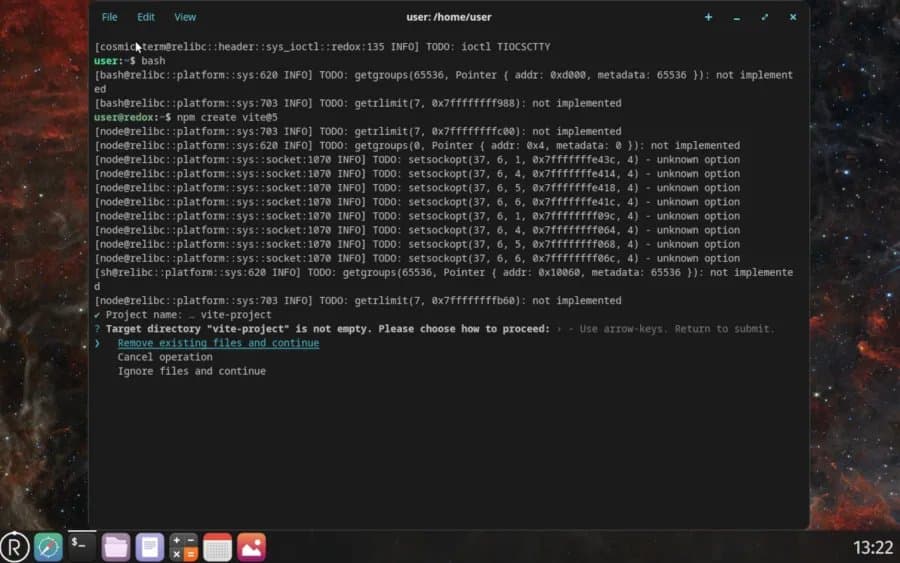
Redox OS achieves significant milestones in February 2026, including first-time Vulkan support via Lavapipe, Node.js compatibility, and progress on COSMIC desktop environment integration.
The Redox OS project has achieved several significant milestones in February 2026, marking important progress for this ambitious Rust-based operating system. The development team has successfully implemented Vulkan API support, achieved Node.js compatibility, and made substantial progress toward running the COSMIC desktop environment on their platform.
Vulkan Support Arrives Through Software Rendering
Perhaps the most technically impressive achievement is the implementation of Vulkan support on Redox OS. The team has successfully integrated the CPU-based Lavapipe driver, providing software rendering capabilities for the first time on this operating system. While hardware acceleration isn't yet available, this represents a crucial foundation for future graphics development.
Lavapipe, developed by Valve, serves as a CPU-based implementation of the Vulkan API, allowing developers to test Vulkan applications without requiring GPU drivers. This approach is particularly valuable for an operating system like Redox that's still in early development stages and doesn't yet have comprehensive graphics driver support.
The Vulkan implementation opens up new possibilities for graphics-intensive applications and games on Redox OS, though performance will naturally be limited by the software rendering approach until hardware drivers are developed.
Node.js Now Runs on Redox OS
In another significant milestone, the Redox development team has successfully ported Node.js to run on their operating system. This achievement demonstrates the growing maturity of Redox's system libraries and compatibility layers, as Node.js requires a robust POSIX-like environment to function properly.
Node.js support is particularly important because it enables JavaScript-based server applications, build tools, and development workflows to run natively on Redox OS. This could prove valuable for developers working on Redox itself, as well as for any future server applications targeting this platform.
COSMIC Desktop Environment Progress
The Redox team has made notable progress in bringing the COSMIC desktop environment to their operating system. The COSMIC compositor, known as "cosmic-comp," is now able to run on Redox OS as a Winit window for proof of concept purposes. While input processing functionality isn't yet working, this achievement represents a significant step toward achieving a fully functional desktop environment.
Additionally, COSMIC Settings is now operational on Redox OS, providing users with system configuration capabilities through the COSMIC interface. These developments suggest that Redox OS is moving closer to offering a complete desktop computing experience, rather than just a command-line environment.
System Stability and Performance Improvements
Beyond these headline features, the Redox development team has implemented several important system improvements. Multi-threading functionality has become more reliable, addressing one of the critical challenges in operating system development. The team is also working on an on-screen display performance monitor, which will help users and developers track system resource usage in real-time.
Various package manager improvements have been implemented, making software installation and management more robust. The kernel and driver components have received numerous enhancements, and ongoing work continues on the Relibc libc implementation, which provides the C standard library functionality required by many applications.
Looking Forward
These February 2026 achievements represent significant progress for Redox OS, which aims to create a fully Rust-based operating system with modern security and performance characteristics. The successful implementation of Vulkan support, Node.js compatibility, and COSMIC desktop components demonstrates that Redox is maturing beyond its experimental roots.
The combination of these features suggests that Redox OS is positioning itself as a viable platform for both development work and potentially desktop computing in the future. While hardware graphics acceleration remains a future goal, the software rendering foundation provided by Lavapipe ensures that graphics capabilities will continue to evolve.
For developers interested in following Redox OS development or contributing to the project, more details about February's changes can be found on the official Redox-OS.org blog. The project continues to attract attention from the open-source community due to its unique approach of building an entire operating system in Rust, a language designed with security and concurrency in mind.
The progress made in February 2026 suggests that Redox OS is steadily advancing toward its goal of becoming a production-ready operating system, with each month bringing new capabilities and improved stability.
Comments
Please log in or register to join the discussion