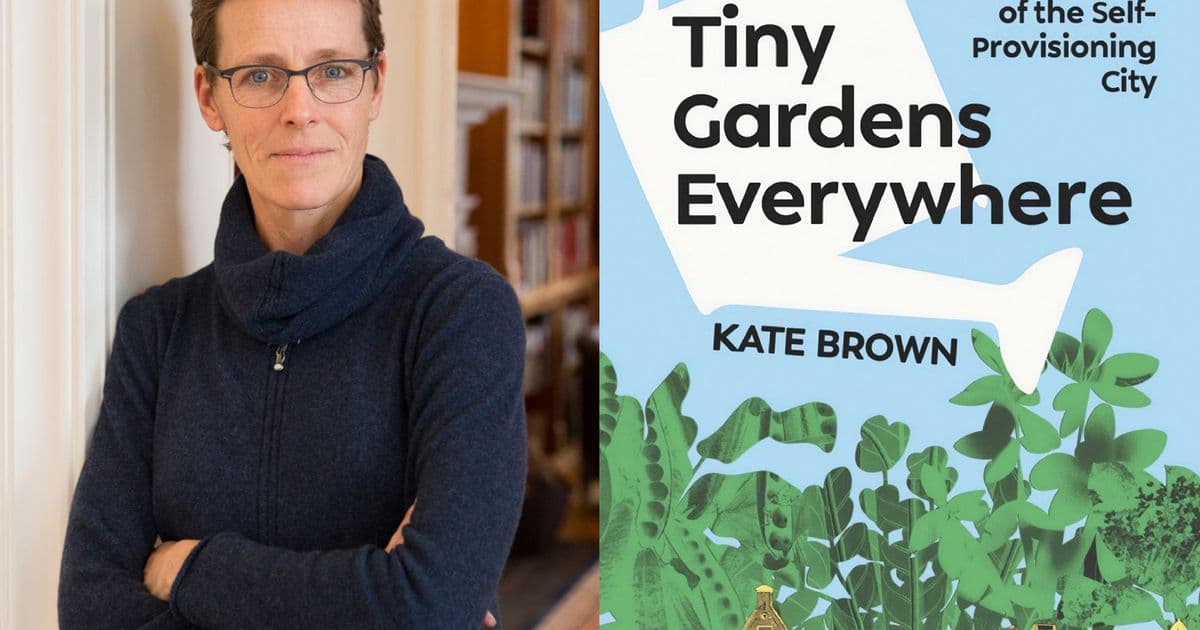
MIT historian Kate Brown's new book "Tiny Gardens Everywhere" reveals how urban gardening has been a site of political struggle, from 19th-century Berlin's "Barackia" to 20th-century Washington's Black communities, showing how the right to grow food intersects with questions of land ownership, labor control, and community autonomy.
In the early 1870s, tourists flocked to a Berlin neighborhood called Barackia—not for museums or palaces, but to witness something far more radical: working-class people growing their own food, living in small dwellings, and establishing communal arrangements outside government control. The experiment was short-lived; authorities cleared out Barackia in 1872. But the concept of small urban farming had taken root. By 1900, approximately 50,000 Berlin households were growing food in so-called arbor colonies, and the practice remains embedded in German law today, which guarantees residents the right to garden.
This historical episode opens MIT Professor Kate Brown's new book, "Tiny Gardens Everywhere: The Past, Present, and Future of the Self-Provisioning City," published by W.W. Norton. Brown, the Thomas M. Siebel Distinguished Professor in History of Science within MIT's Program in Science, Technology, and Society, argues that urban gardening is far more than a hobby—it's a political act that challenges fundamental questions about land ownership, labor control, and community autonomy.
The Enclosure Movement and the Control of Labor
Brown traces the roots of modern conflicts over urban gardening to England's enclosure movement in the late 18th century. Before enclosures privatized common land for wealthy landowners, peasants lived with a communal sense of land ownership that allowed them to be largely self-sufficient. "Private property is largely an English invention of the late 18th century," Brown explains. "Before that, and in many parts of the world to this day, people live with a communal sense of the ownership of the land."
But the enclosure movement did more than transfer land ownership—it served as a mechanism for controlling labor in an industrializing society. By forcing peasants off common lands and into factories, whether in cities or rural mills, the wealthy could ensure a steady supply of workers for the emerging industrial economy. "Really what they were doing when they were enclosing land was trying to control labor, as much as controlling land," Brown says. "Because of their reliance on the commons, peasants were self-sufficient. Who wants to go work in a factory when you could be out having fun in the forest? Expelling people was a way to force them to become homeless, the landless proletariat, with nothing to sell but their labor, for 10 or 18 hours a day."
This historical pattern—where the right to grow food becomes a site of political struggle—repeats itself throughout Brown's global examination of urban gardening.
Washington's Hidden Agricultural History
One of the most compelling sections of "Tiny Gardens Everywhere" focuses on Washington, D.C., during the Great Migration of the 20th century. As African Americans moved north from the South, they brought extensive agricultural knowledge with them. In neighborhoods east of the Anacostia River, Black communities relied heavily on local gardening, establishing workers' cooperatives and food cooperatives that allowed them to address multiple community needs simultaneously.
"I think it's very interesting that people found really smart ways to adapt," Brown observes. "If the neighborhood had no garbage collection, they'll compost. No sewers, they'll compost."
However, as these communities became more self-sufficient through gardening, authorities began claiming more land, designating homes to be torn down, and restricting residents' ability to garden. Brown documents how local officials used restrictions on urban gardening as a form of social control, with one outcome being a homogenized social and physical landscape characterized by grass lawns for the affluent.
The Surprising Productivity of Urban Gardens
A natural question arises: How much food can urban gardening actually provide? Brown's research reveals that the answer is more substantial than many might expect. During World War II, victory gardens provided about 40 percent of all produce grown in the United States. In 1996, 91 percent of the potatoes Russians ate came from urban allotment gardens that occupied just 1.5 percent of the country's arable land.
Even more striking is how inefficiently the United States uses its agricultural land. Only 2 percent of agricultural land in the U.S. is used to produce fruits and vegetables. The majority of American farmland is devoted to corn and soybeans, primarily yielding corn-based products like ethanol, corn syrup, chips, and cookies. "They're really inefficiently [working] to produce ethanol, corn syrup, chips, and cookies," Brown notes.
This inefficiency suggests that urban spaces could indeed grow a significant portion of the fruits and vegetables people need. Brown points to the fact that Florida, Illinois, and Maine—three politically diverse states—all have laws providing the right to garden, with Oklahoma considering similar legislation.
Beyond Food Production: Community and Resilience
For Brown, the significance of urban gardening extends far beyond food production. "Community after community, people work together to create food provisioning practices," she says. "And after people come together for food and gardening, then they start to solve other problems they have."
This observation points to the broader social and environmental benefits of urban gardening: health improvements, environmental sustainability, and community-building. When people garden together, they develop networks of mutual support that can address various community challenges.
A Unifying Political Issue
In an era of political polarization, Brown sees the right to garden as a potentially unifying issue. "I think this approach to looking at our right to grow food, to self-provision, to step outside of markets for our most essential needs, is something that represents a unifying set of desires in our hyperpolarized political landscape," she says.
Yale historian Sunil Amrith has praised Brown's work, noting that she uses "enviable skill, craft, and insight" to show "that the past of small-scale urban provisioning contains the seeds of a more resilient future for us all."
The Future of Urban Gardening
Brown hopes her book will not only inform readers but also inspire action. Whether as gardeners, local policy advocates, or both, she believes people can work to secure and expand the right to grow food in urban areas. "One of the drumbeats of this book is that people do—and maybe we all should—win the right to garden," Brown says.
The history of urban gardening, as Brown presents it, is ultimately a story about human resilience and the persistent struggle for autonomy over basic necessities. From Berlin's Barackia to Washington's Black communities, from victory gardens to modern allotment movements, the impulse to grow one's own food has repeatedly emerged as both a practical solution to food insecurity and a challenge to systems of control.
As cities face increasing pressures from climate change, food insecurity, and social fragmentation, Brown's work suggests that the humble act of gardening might offer more than just fresh vegetables—it might provide a pathway to more resilient, connected, and autonomous communities. The seeds of change, it seems, are already being planted in tiny gardens everywhere.
Comments
Please log in or register to join the discussion