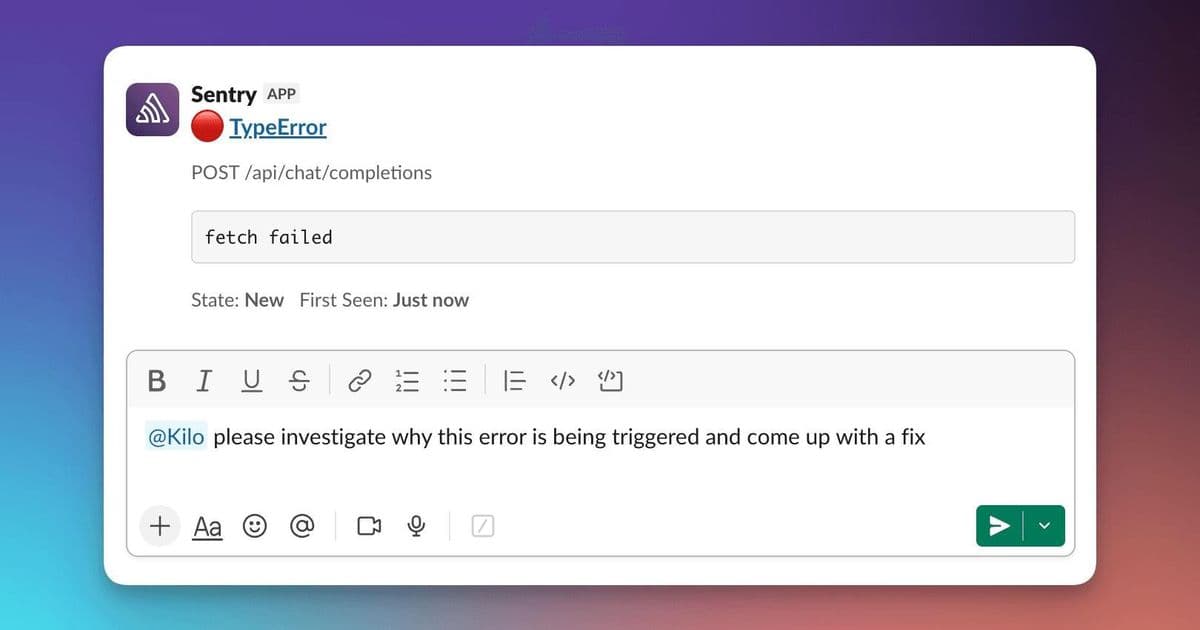
Kilo’s agentic engineering platform integrates AI coding assistants directly into Slack, solving the friction of context switching for developers. After a $45 million Series B led by Andreessen Horowitz, the startup is positioning itself as the go‑to “conversation‑centric” AI developer tool.
Your AI Coding Agent Should Live Where the Important Conversations Happen
Developers spend a surprising amount of time moving between IDEs, ticketing systems, and chat tools. The back‑and‑forth of copy‑pasting snippets, hunting for the latest design decision, or recreating a discussion thread in a pull‑request adds up to dozens of hours each month. Kilo, the all‑in‑one agentic engineering platform, argues that the real problem isn’t the code itself—it’s the loss of conversational context.
The problem Kilo is trying to solve
- Context fragmentation – When a teammate proposes a change on Slack, the relevant code often lives in a separate repository. By the time a developer opens the IDE, the original rationale may be buried under a dozen messages.
- Tool overload – Most AI‑assisted coding tools require a separate UI or browser extension. Switching to those tools interrupts the flow of a discussion that is already happening in a chat channel.
- Unreliable hand‑offs – Current bots can generate code, but they rarely persist the conversation history, making it hard to audit why a particular implementation was chosen.
Kilo’s answer is straightforward: embed the AI coding agent directly inside the chat platform where engineers already collaborate. The agent can read the thread, suggest code, run tests, and push commits without ever leaving the conversation.
How the platform works
- Thread‑aware AI – The bot monitors a designated Slack channel (or a private thread) and uses the full message history as prompt context. It parses requirements, design constraints, and even informal jokes that might hint at edge cases.
- Live execution sandbox – When a developer asks for a snippet, Kilo spins up an isolated container, runs the code, and returns the output or test results instantly. The sandbox supports Node.js, Python, Go, and Rust out of the box.
- Git integration – Upon approval, the bot creates a branch, commits the changes, and opens a pull request on GitHub, GitLab, or Bitbucket. The PR description automatically includes a link to the originating Slack thread for traceability.
- Extensible workflow hooks – Teams can attach custom actions (e.g., trigger a CI pipeline, update a Jira ticket, or notify a monitoring service) using Kilo’s webhook system.
The architecture is deliberately modular. The core language model runs on a managed inference service (currently OpenAI’s GPT‑4o and Anthropic’s Claude 3), while the orchestration layer lives on AWS Fargate. This separation lets enterprises swap out the LLM provider without rewriting the entire bot.
Funding and market positioning
Kilo announced a $45 million Series B round on May 22, 2026. The round was led by Andreessen Horowitz with participation from Sequoia Capital, Accel, and strategic investor Microsoft’s M12 venture fund. The company says the capital will fund:
- Expansion of the multi‑model inference stack to support on‑premise deployments for regulated industries.
- Hiring of additional AI safety engineers to tighten guardrails around code generation.
- Building deeper integrations with other collaboration platforms such as Microsoft Teams and Discord, while keeping Slack as the flagship.
In its pitch deck, Kilo positioned itself against two competing approaches:
| Approach | Where it lives | Typical friction |
|---|---|---|
| Stand‑alone AI IDE extensions (e.g., GitHub Copilot) | Inside the editor | Requires developers to leave the chat context |
| Dedicated bot services that only generate snippets | In chat, but no execution or version control | No persistence, limited to copy‑paste |
| Kilo | In chat plus integrated sandbox & Git workflow | Keeps conversation, code, and version history together |
Analysts at PitchBook estimate the market for AI‑augmented developer tools at $12 billion by 2028. Kilo’s focus on “conversation‑first” tooling carves a niche that addresses a pain point not fully covered by existing IDE‑centric products.
Early traction and roadmap
Since its beta launch in late 2025, Kilo reports:
- 3,200 active Slack workspaces, ranging from early‑stage startups to a handful of Fortune 500 engineering teams.
- An average 30 % reduction in time‑to‑merge for PRs that originated from a Slack thread.
- Over 1 million lines of code generated, with a commit‑acceptance rate of 78 %.
The product roadmap highlights two major releases:
- Kilo for Teams – a Microsoft Teams version slated for Q4 2026, aiming to capture the enterprise segment that has standardized on Teams.
- Self‑hosted inference – a containerized offering that lets large organizations run the language model behind their firewall, addressing data‑privacy concerns.
What this means for developers
If the platform lives up to its promises, the everyday workflow could look like this:
- A product manager drops a feature request into a Slack channel.
- An engineer asks the Kilo bot, “Can you scaffold the API endpoint for this?”
- The bot replies with a code snippet, runs unit tests in the sandbox, and posts the results.
- The engineer reviews, says “👍”, and the bot opens a PR linked back to the original thread.
- Reviewers comment directly in Slack, and any follow‑up changes are automatically rebased.
The loop stays inside a single conversation, eliminating the need to toggle between multiple tools. For teams already deep‑into Slack, that could translate into measurable productivity gains.
A cautious note
While the concept is compelling, the success of any AI‑driven coding assistant hinges on the quality of its guardrails. Early adopters have reported occasional hallucinations where the bot suggests APIs that don’t exist or overlooks security best practices. Kilo’s recent hiring spree of safety engineers is a promising sign, but developers should still treat generated code as a draft, not production‑ready.
Bottom line
Kilo’s conversation‑centric AI coding agent tackles a real friction point: the loss of context when developers move between chat and code. Backed by a sizable Series B and a clear roadmap, the startup is positioning itself as the bridge between informal discussion and formal version control. If the platform can keep its output reliable while staying embedded in the tools engineers already use, it may become a staple of the modern dev stack.
Comments
Please log in or register to join the discussion