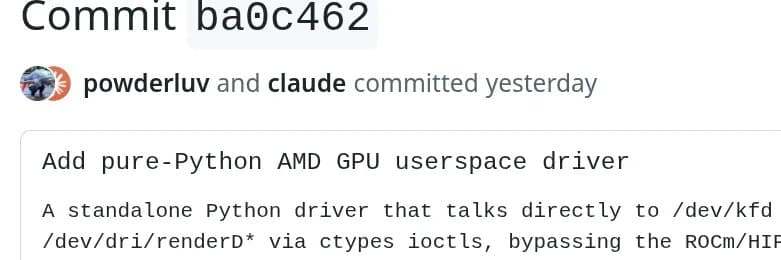
AMD's VP of AI Software has developed a pure-Python AMD GPU user-space driver using Claude Code, demonstrating how AI can accelerate low-level systems programming and potentially democratize GPU driver development.
An AMD engineer has leveraged AI to create a pure-Python AMD GPU user-space driver, showcasing how artificial intelligence can accelerate systems programming and potentially democratize GPU driver development.
AI-Assisted Driver Development
AMD's VP of AI Software, Anush Elangovan, has used Claude Code to craft a pure-Python AMD GPU user-space driver that communicates directly with kernel interfaces. The project demonstrates how AI agents can assist in creating complex low-level software without traditional manual coding.
Elangovan's approach was inspired by Tinygrad's user-space AMD GPU driver implementation. Using Claude AI, he created a driver specifically designed for stress testing SDMA (System Direct Memory Access) and debugging compute/communications overlap scenarios.
Technical Implementation
The Python driver bypasses the traditional ROCm/HIP user-space stack entirely, communicating directly with /dev/kfd and /dev/dri/renderD* devices through ctypes-based ioctl calls. This standalone implementation features:
- KFD ioctl bindings for queue management, memory operations, and event handling
- GPU family registry supporting RDNA2/3/4 and CDNA2/3 architectures
- SDMA copy engine with linear copy operations and fence packet support
- PM4 compute packet builder for dispatch operations and release_mem commands
- Timeline semaphore implementation for GPU-CPU synchronization
- Topology parser for
/sys/devices/virtual/kfd/kfddevice information - ELF code object parser for kernel loading functionality
Development Progress and Features
As of the initial commit, the driver includes 130 passing tests covering both unit and integration scenarios on MI300X/gfx942 hardware. The implementation features a pluggable architecture supporting both KFD backend and future bare-metal PCI (AM) backend capabilities.
Over just two days of development, the driver has been extended to include multi-GPU support and compute-bound kernel functionality. This rapid development timeline highlights the potential productivity gains from AI-assisted programming in systems-level software.
Industry Implications
Elangovan's experience underscores a broader shift in software development practices. His statement on social media - "I didn't open the editor once. [AI] Agents are the great equalizer in software. And Speed is the moat" - suggests that AI tools may democratize access to complex programming tasks that traditionally required deep expertise.
The project raises interesting questions about the future of GPU driver development. While Python-based drivers may not match the performance of traditional C/C++ implementations, they offer advantages in terms of development speed, debugging ease, and accessibility for researchers and developers.
Current Status and Availability
The pure-Python AMD GPU user-space driver is actively being developed and is available on GitHub for those interested in examining the implementation or contributing to its development. The project represents an experimental approach to GPU programming that could influence how developers interact with AMD hardware in research, debugging, and educational contexts.
This development comes at a time when AMD continues to expand its ROCm ecosystem and compete in the AI accelerator market. While traditional ROCm drivers remain the primary interface for production workloads, experimental projects like this one may help accelerate innovation and lower barriers to entry for GPU programming.
The success of this AI-assisted development effort could encourage more engineers to explore Python for systems programming tasks, particularly in prototyping, testing, and educational scenarios where development speed and code readability are prioritized over raw performance.
Comments
Please log in or register to join the discussion