AMD's latest Ryzen 7 9850X3D establishes dominance in gaming performance while Intel's Core i9-14900K maintains productivity leadership in this comprehensive face-off between 2026's top desktop processors.
The desktop CPU market continues to evolve as AMD's Ryzen 7 9850X3D and Intel's Core i9-14900K represent the pinnacle of their respective architectures. This detailed comparison examines how these processors stack up across gaming performance, productivity workloads, efficiency, and platform costs.
Technical Specifications: Architectural Divergence
The Ryzen 7 9850X3D and Core i9-14900D represent fundamentally different approaches to high-performance computing. AMD's latest gaming processor builds upon the Zen 5 architecture with 8 cores and 16 threads, operating at base clock speeds of 4.7 GHz and boosting up to 5.6 GHz. The chip's standout feature is its 104MB total cache, with 96MB vertically stacked 3D V-Cache that significantly enhances gaming performance.
Intel's Core i9-14900K utilizes a hybrid architecture with 24 cores (8 Performance cores and 16 Efficiency cores) and 32 threads. The P-cores operate at 3.2 GHz base and can reach up to 6.0 GHz on boost, while E-cores run at 2.4 GHz base and boost to 4.4 GHz. The processor offers 68MB total cache (36MB L3 plus 32MB L2).
Manufacturing processes also differ significantly, with AMD using TSMC's 4nm node for the Ryzen 7 9850X3D, while Intel employs its 10nm Intel 7 process for the Core i9-14900K.
Gaming Performance: 3D V-Cache Dominance
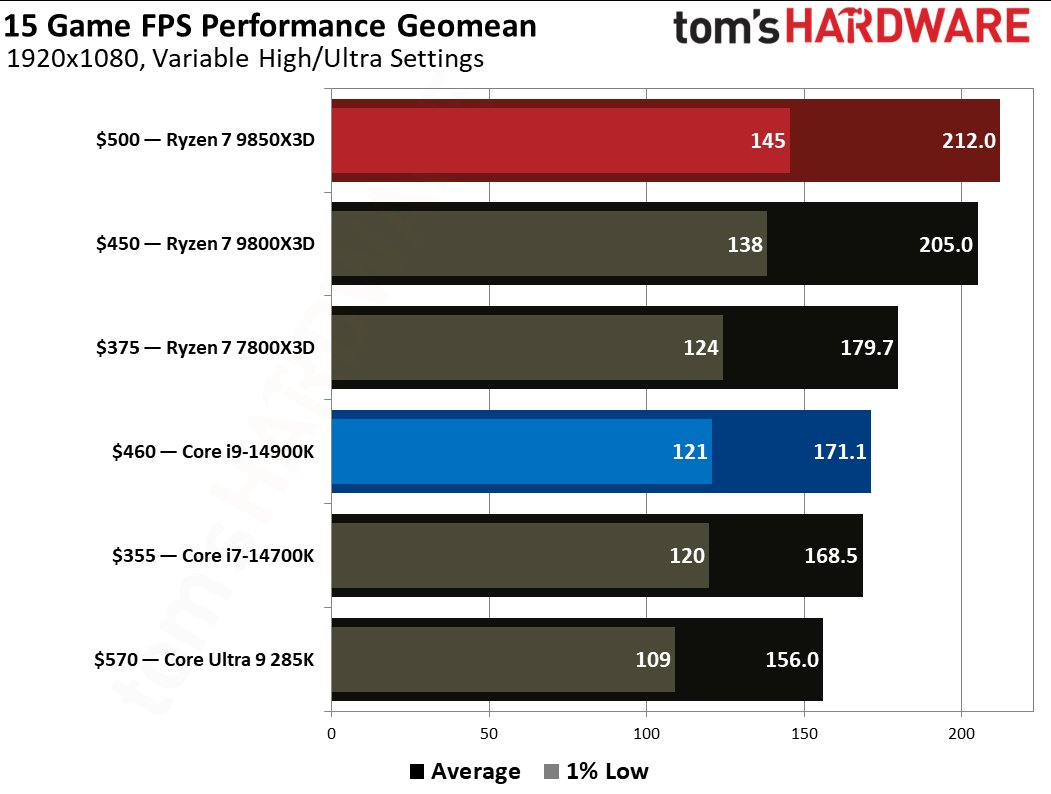
In gaming benchmarks, the Ryzen 7 9850X3D demonstrates clear superiority, particularly at 1080p resolution where CPU performance becomes the limiting factor. Across 15 modern games tested with an Nvidia RTX 5090, AMD's processor achieved an average of 209.8 FPS, outperforming the Core i9-14900K's 171.1 FPS by a substantial 23.9% margin.
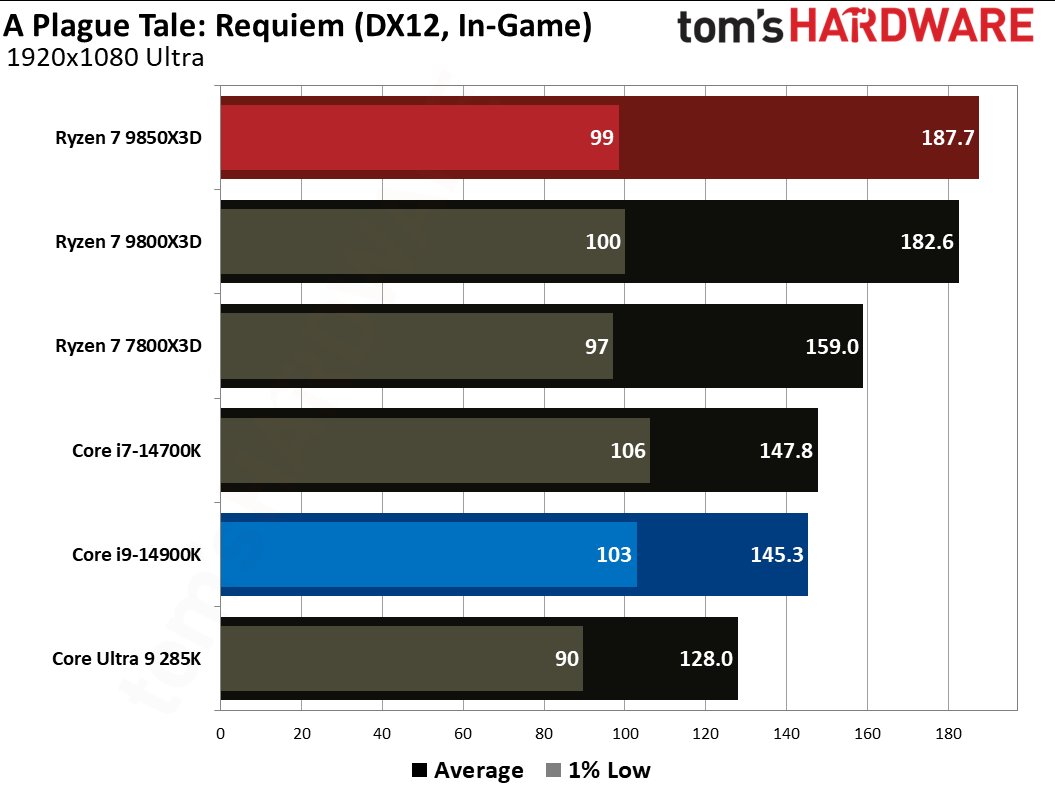
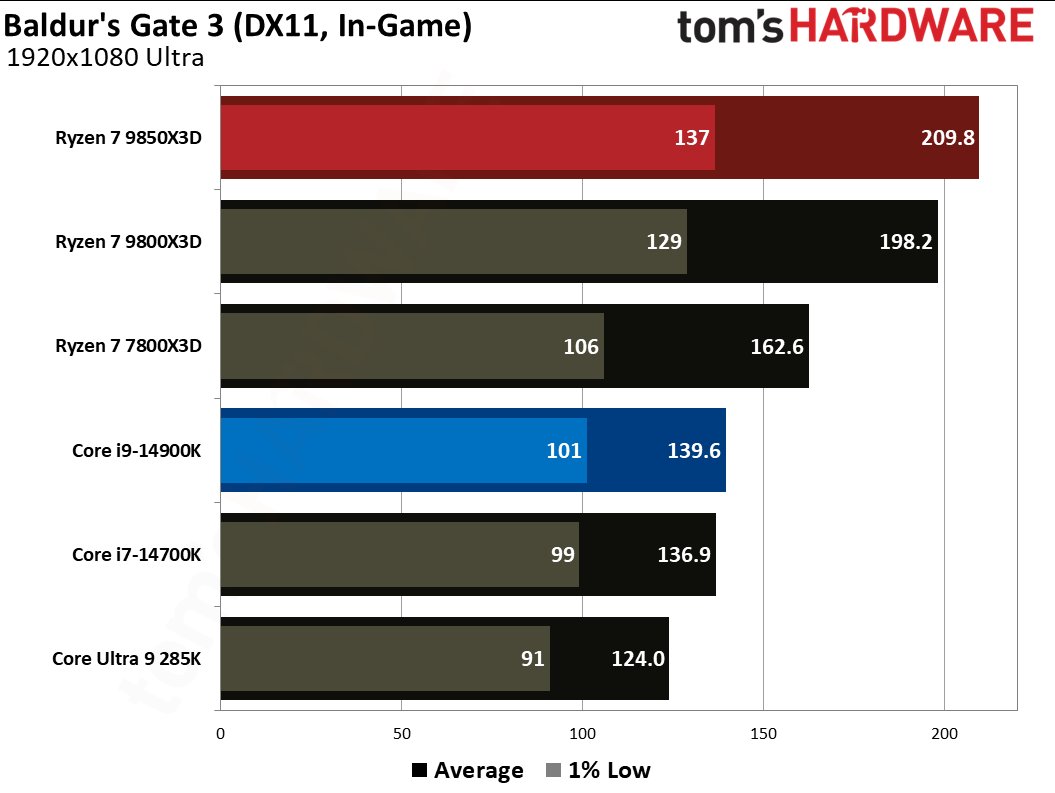
The performance gap varies by title, with AMD showing advantages of:
- 50.28% in Baldur's Gate 3 (209.8 vs 139.6 FPS)
- 49.48% in F1 2024
- 48.43% in Final Fantasy XIV
- 42.38% in Far Cry 6
- 30.99% in Hitman 3
Only Monster Hunter Wilds showed Intel leading with a 7.17% advantage. Even in more CPU-bound scenarios like 1% lows, the Ryzen 7 9850X3D maintained a 21.49% lead on average.
The 3D V-Cache technology provides substantial benefits by reducing memory access latency, allowing the AMD chip to sustain higher average clock speeds of 5.45 GHz compared to Intel's 4.87 GHz during gaming sessions.
Productivity Workloads: Intel's Core Count Advantage
When shifting focus to productivity applications, the Core i9-14900K's architecture reveals its strengths. In multi-threaded benchmarks, Intel's processor demonstrates a commanding 49% advantage over the Ryzen 7 9850X3D:
- Cinebench R23 multi-core: 38,131 (Intel) vs 23,362 (AMD)
- Cinebench 2024: 2,210 (Intel) vs 1,393 (AMD)
- POV-Ray multi-core: 13,262 PPS (Intel) vs 7,632 PPS (AMD)
- SVT-HEVC video encoding: 159 FPS (Intel) vs 104 FPS (AMD)
- Blender Classroom render: 110 samples/min (Intel) vs 73 samples/min (AMD)
In single-threaded productivity tasks, the CPUs perform similarly, with Intel holding a slight 2.7% advantage in the geomean benchmark. This indicates that while AMD's architecture offers competitive single-thread performance, Intel's hybrid design with more cores provides superior multi-threaded throughput for productivity workloads.
Power Efficiency and Thermal Management
Power consumption reveals a stark contrast between the two processors. The Ryzen 7 9850X3D demonstrates significantly better efficiency across workloads:
- Gaming: 106.1W (AMD) vs 133.9W (Intel)
- y-cruncher multi-threaded AVX: 173W (AMD) vs 309W (Intel)
- Cinebench 2024 multi-core: 155W (AMD) vs 309W (Intel)
- HandBrake x265 encoding: Variable, but Intel consumed 105-119% more power
These efficiency differences translate directly into cooling requirements. The Ryzen 7 9850X3D, with peak power draw between 160-180W, can be adequately cooled with quality air coolers ($40-100) or mid-range 240-280mm AIOs ($60-150). In contrast, the Core i9-14900K, capable of exceeding 300-350W under sustained loads, requires high-end air coolers ($80-130) or 280-360mm AIOs ($100-200) to prevent thermal throttling.
Idle power consumption shows Intel with a slight advantage (25W vs 22W), but this benefit is negated by AMD's superior efficiency under load.
Platform Costs and Ecosystem Considerations
When evaluating total system cost, several factors beyond the CPU price must be considered. The Ryzen 7 9850X3D carries an MSRP of $499, while the Core i9-14900K typically sells for around $450. However, platform costs can significantly impact the total investment:
- Motherboards: Intel LGA 1700 platform offers broader options from $130-500, while AMD AM5 ranges from $150-500
- Memory: Both support DDR5-5600, but Intel's DDR4 compatibility provides cost savings in current market conditions
- Cooling: As noted, Intel's higher power demands increase cooling costs
Considering these factors, an Intel-based system can potentially be $100-200 cheaper than an equivalent AMD configuration, especially when utilizing DDR4 memory.
Overclocking Potential
Both processors offer overclocking capabilities, but with different approaches. The Core i9-14900K provides extensive manual controls through Intel Extreme Tuning Utility, including per-core ratio adjustments and AI-assisted optimization suggestions. This makes it the preferred choice for enthusiasts seeking maximum clock speeds.
The Ryzen 7 9850X3D supports multiplier changes and voltage adjustments, with AMD's PBO 2 technology handling dynamic boost optimization. However, the 3D V-Cache design limits memory overclocking benefits to less than 2% gains, reducing headroom for enthusiasts who enjoy detailed manual tuning.
Market Implications and Consumer Guidance
This comparison reveals an interesting market dynamic where Intel's previous-generation processor remains highly competitive against AMD's latest gaming-focused offering. The Ryzen 7 9850X3D emerges as the superior choice for gamers prioritizing frame rates and efficiency, while the Core i9-14900K maintains advantages for productivity-focused users and budget-conscious builders.
For consumers making purchasing decisions in 2026, the choice ultimately depends on primary use case:
- Gaming-focused systems benefit from the Ryzen 7 9850X3D's 3D V-Cache and efficiency
- Productivity workloads favor the Core i9-14900K's core count and multi-threaded performance
- Budget considerations may tip the balance toward Intel's platform cost advantages
As the semiconductor industry continues to evolve, this face-off demonstrates that both companies have developed complementary strengths rather than clear dominance across all workloads, benefiting consumers with competitive options tailored to different needs.
Comments
Please log in or register to join the discussion