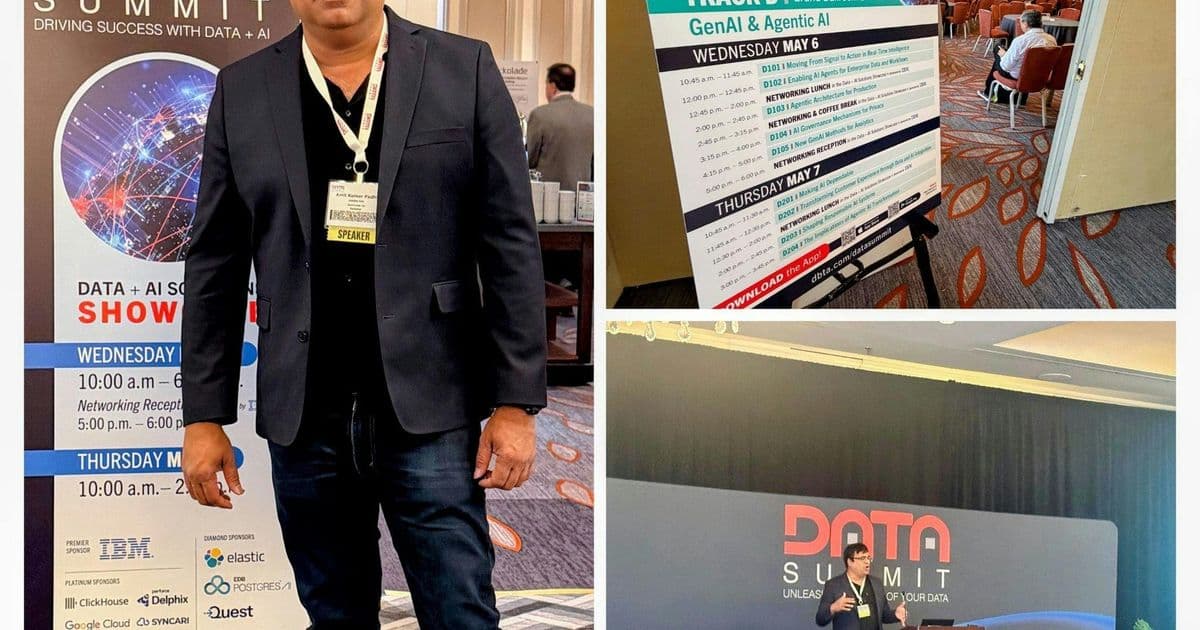
At Data Summit 2026, Amit Kumar Padhy laid out a blueprint for running agentic AI in production, where multiple coordinated agents handle digital commerce workflows under enterprise governance rather than acting as a single unsupervised model.
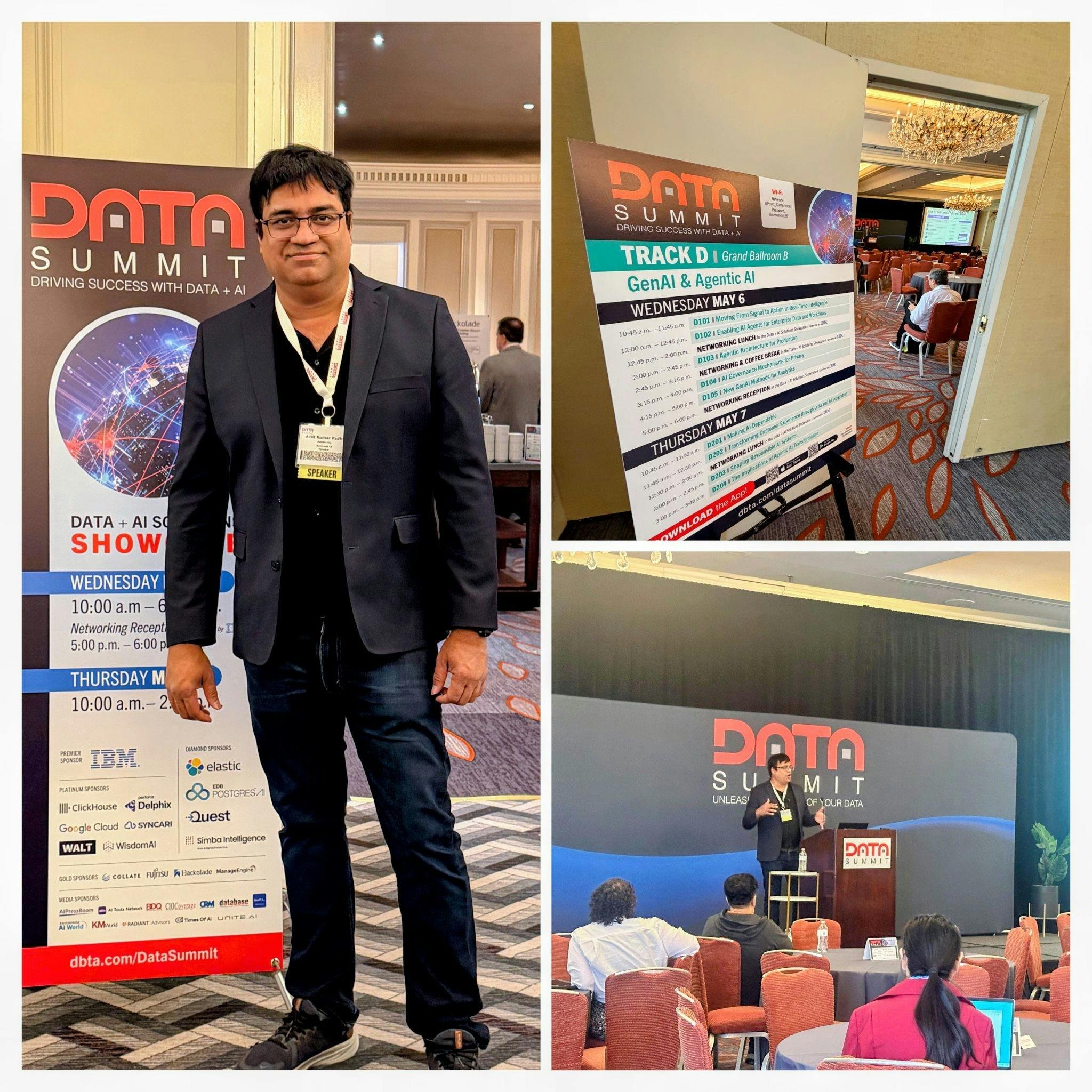
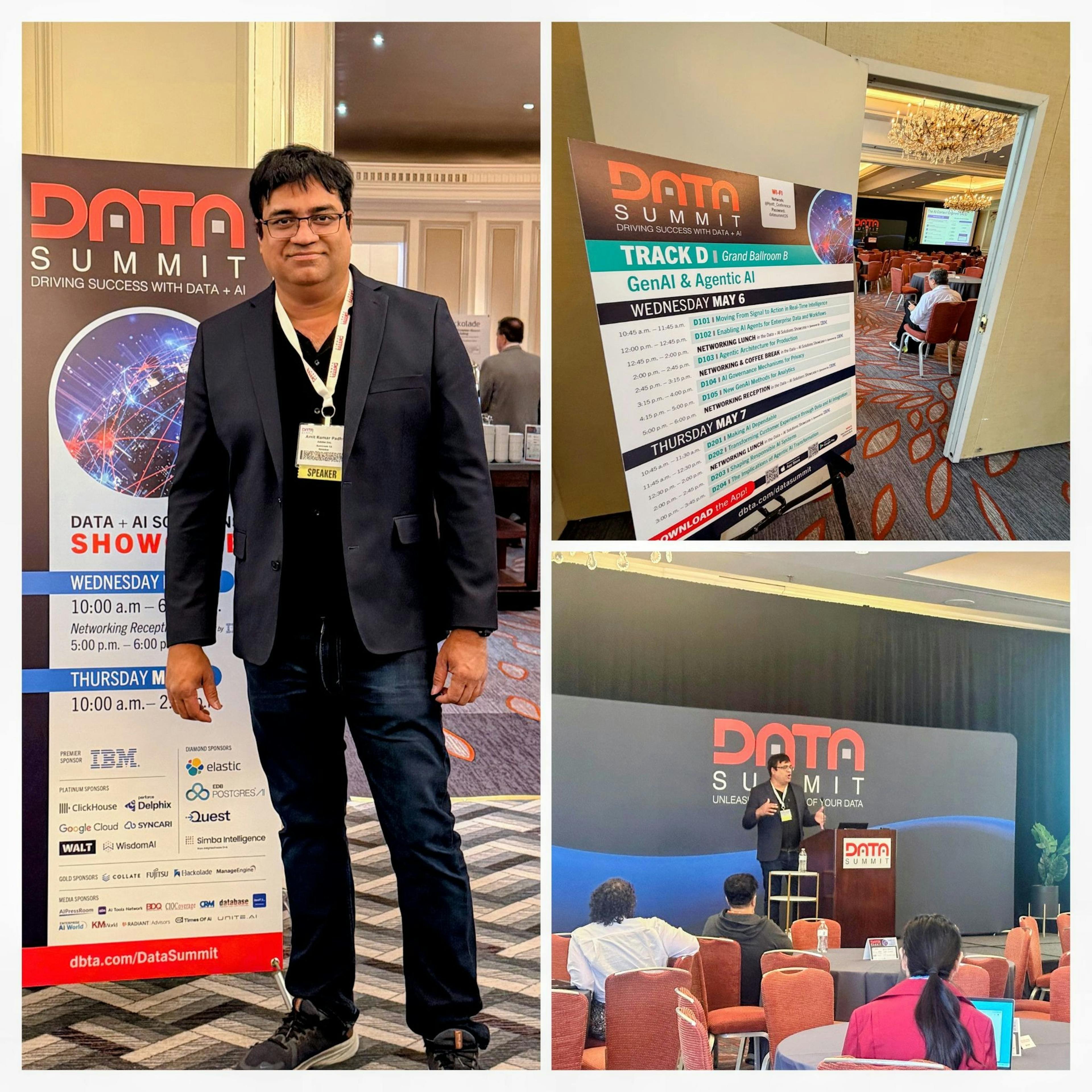
Most enterprise AI demos look impressive on stage and fall apart the moment they touch real traffic, real compliance teams, and real money. That gap between a polished prototype and a system that survives production is exactly what Amit Kumar Padhy set out to address at Data Summit 2026, where he presented an architecture for deploying agentic AI inside large commerce organizations.
The presentation focused on a specific and increasingly urgent problem. Companies have spent the last two years experimenting with large language models, but few have managed to put autonomous agents into workflows that affect revenue without introducing unacceptable risk. Padhy's talk centered on how multi-agent systems can be structured so they remain useful, auditable, and controllable at scale.
The problem of agents at production scale
A single AI agent answering questions in a sandbox is a manageable thing. A fleet of agents making decisions about pricing, inventory, customer interactions, and content generation across a commerce platform is a different animal entirely. Each agent introduces its own failure modes, and when they coordinate, those failures can compound in ways that are hard to predict.
Padhy framed the challenge around three pressures that pull against each other. Agents need enough autonomy to be worth deploying, enough oversight to satisfy governance and compliance requirements, and enough performance to handle production load. Optimize too hard for any one of these and the other two suffer. Give agents broad freedom and you lose auditability. Lock them down with approval gates everywhere and you lose the speed advantage that justified using them at all.
His answer was an architecture that treats agents less like a monolithic intelligence and more like a structured organization, with defined roles, escalation paths, and boundaries on what each component is allowed to do on its own.
How the multi-agent design works
The model Padhy described breaks workflows into specialized agents rather than asking one general-purpose agent to do everything. One agent might handle product data enrichment, another customer-facing responses, another the orchestration logic that decides which agent acts when. This separation matters for reasons beyond tidiness. When each agent has a narrow scope, its behavior becomes easier to test, easier to monitor, and easier to roll back when something goes wrong.
Governance is built into the structure rather than bolted on afterward. Padhy emphasized that enterprise adoption stalls when AI systems cannot explain their decisions or when they operate outside the controls that regulated industries require. In his architecture, agent actions pass through policy layers that log decisions, enforce limits, and flag anything that needs human review. The goal is to make the system observable enough that a compliance team can trust it without slowing it to a crawl.
This connects to work happening across the AI tooling ecosystem. Frameworks like LangChain and orchestration tools such as LangGraph have made multi-agent coordination more accessible, while the broader industry has converged on patterns for tool use and agent communication, including efforts like the Model Context Protocol. Padhy's contribution sits in the application layer, addressing what it actually takes to make these patterns hold up inside a commerce business with real governance constraints.
The Adobe commerce angle
Much of the architecture draws on experience with AI in digital commerce, including Adobe's commerce stack. Commerce is a useful proving ground for agentic systems because the workflows are concrete and the consequences are measurable. An agent that generates product descriptions, adjusts merchandising, or routes customer queries produces outcomes you can track against conversion, revenue, and error rates. There is no hiding behind vague claims of productivity when the numbers are tied directly to sales.
That measurability cuts both ways. It makes the value of working agents obvious, and it makes the cost of broken ones obvious too. Padhy's emphasis on production-scale reliability reflects an understanding that commerce teams will not tolerate a system that hallucinates a price or misroutes a high-value customer, no matter how clever the underlying model is.
Why this matters for the wider market
The agentic AI conversation has been heavy on ambition and light on operational detail. Vendors promise autonomous systems that run entire business functions, but the practical question of how you govern, monitor, and trust those systems in a regulated enterprise has lagged behind the marketing. Presentations like Padhy's are part of a corrective shift toward the unglamorous engineering work that determines whether agentic AI becomes infrastructure or stays a demo.
What stands out is the framing. Rather than treating governance as a tax on innovation, the architecture treats it as a precondition for deployment. Enterprises are not going to hand revenue-affecting decisions to systems they cannot audit. The companies that figure out how to make agents both capable and controllable are the ones that will actually ship, and the ones still chasing maximum autonomy without oversight will keep getting stuck at the pilot stage.
Data Summit 2026 gathered a range of practitioners working through these same questions, and Padhy's session added a grounded, commerce-tested perspective to a field that badly needs fewer promises and more working systems. The proof, as always, will be in how many of these architectures move from conference slides into production without the wheels coming off.
Comments
Please log in or register to join the discussion