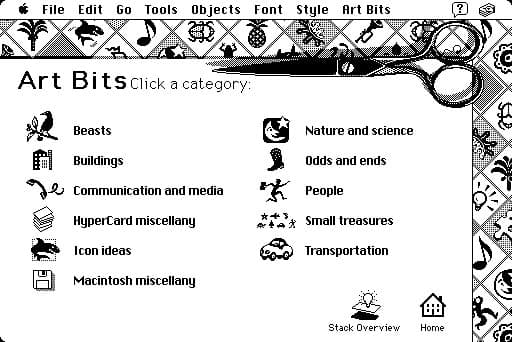
A comprehensive collection of over 700 vintage Macintosh clip art images from Apple's HyperCard Art Bits stack, showcasing the creative possibilities of early 90s two-color graphics.
The Macintosh ecosystem of the early 1990s was a playground for creative experimentation, and few artifacts capture that spirit better than Apple's HyperCard software. This hypermedia system, which blended elements of index cards, interactive web pages, and educational software, left an indelible mark on computing history. Its influence stretched far beyond its immediate purpose, shaping everything from JavaScript's development to wiki concepts, the ubiquitous pointing finger cursor for hyperlinks, and even the groundbreaking game Myst.
Among the many sample stacks Apple included with HyperCard was "Art Bits," a treasure trove of clip art designed to help users create their own stacks. This collection is remarkable not just for its utility, but for what it reveals about the creative constraints and possibilities of early 90s Macintosh graphics. Working within the limitations of two-color displays, Apple's designers crafted an impressive array of imagery that remains surprisingly versatile even today.
A Labor of Digital Archaeology
One dedicated enthusiast has undertaken the painstaking task of extracting over 700 individual images from the Art Bits stack, preserving them at their original size for modern use. The entire collection, despite extensive PNG optimization, remains under 300kb—a testament to the efficiency of early digital graphics. This digital archaeology project offers a fascinating glimpse into the visual vocabulary of early Macintosh computing.
Organized by Theme
The collection spans numerous categories, each reflecting different aspects of 90s digital culture and design sensibilities:
Beasts
From dinosaurs to lizards, the animal kingdom is well-represented in Art Bits. These illustrations capture a whimsical, slightly cartoonish aesthetic that was characteristic of the era's educational software and children's applications.
Buildings
Architectural elements range from simple houses to more complex structures, providing building blocks for creating virtual environments or illustrating concepts in educational stacks.
Communication and Media
Icons representing telephones, televisions, and other communication devices reflect the technological landscape of the early 90s, when these technologies were rapidly evolving and becoming more integrated into daily life.
HyperCard Miscellany
Some images are specifically designed for use within HyperCard itself, including buttons, arrows, and other interface elements that help users understand how to structure their own stacks.
Icon Ideas
Small, versatile graphics that could serve as application icons or visual indicators within stacks, showcasing the minimalist design approach necessary for the limited screen resolutions of the time.
Macintosh Miscellany
Images that celebrate the Macintosh platform itself, including stylized representations of hardware and software elements unique to Apple's ecosystem.
Nature and Science
From botanical illustrations to scientific diagrams, this category demonstrates how HyperCard was used in educational contexts, helping students visualize complex concepts.
Odds and Ends
A catch-all category for miscellaneous images that don't fit neatly into other classifications, but still showcase the creative range of the Art Bits collection.
People
Human figures rendered in the distinctive two-color style, useful for creating characters or illustrating social scenarios in educational or entertainment stacks.
Small Treasures
Tiny, intricate designs that demonstrate the level of detail possible even within the constraints of early Macintosh graphics.
Transportation
Vehicles and transportation-related imagery, from cars to airplanes, reflecting the mobility and connectivity themes that were becoming increasingly important in the early 90s.
Historical Significance
This collection is more than just a nostalgic trip down memory lane. It represents a crucial moment in the evolution of digital design, when creators were learning to work within severe technical limitations while still producing engaging, useful graphics. The Art Bits stack demonstrates how constraint can breed creativity, with designers finding clever ways to suggest depth, texture, and meaning using only two colors.
For modern designers, developers, and historians, these images offer valuable insights into the visual language of early digital interfaces. They also serve as a reminder of how far we've come in terms of graphical capabilities, while perhaps suggesting that some of the simplicity and directness of early digital design has been lost in the pursuit of photorealism and complexity.
Practical Applications
The images are available for use and enjoyment, providing a unique resource for:
- Retro-themed design projects
- Educational materials about computing history
- Pixel art and low-resolution game development
- Understanding the evolution of user interface design
- Creating authentic 90s aesthetic in modern applications
The collection's small file size makes it particularly practical for web use, where loading speed remains a consideration even in our current era of high-bandwidth connections.
Conclusion
Art Bits from HyperCard stands as a digital time capsule, preserving the visual culture of early Macintosh computing in a way that's both historically significant and practically useful. It reminds us that creativity often flourishes within constraints, and that the limitations of early technology sometimes led to design solutions that were elegant in their simplicity. For anyone interested in the history of computing, graphic design, or just the charming aesthetic of 90s digital art, this collection offers hours of exploration and inspiration.
Comments
Please log in or register to join the discussion