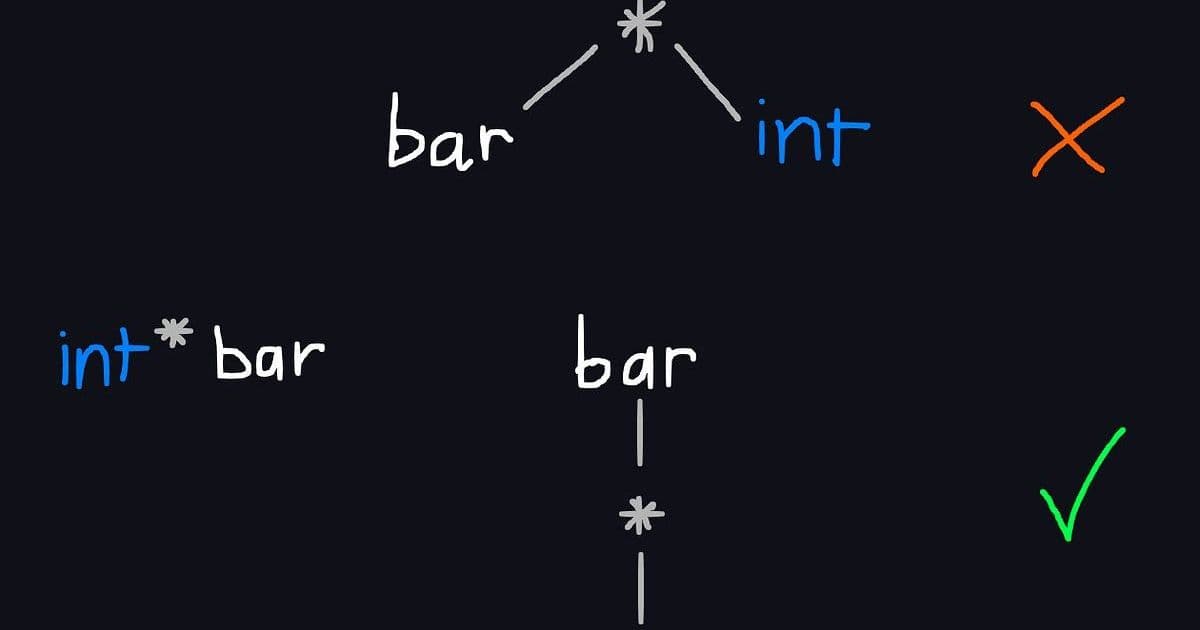
An exploration of C's persistent grammatical ambiguities, their historical roots, and what they reveal about programming language design trade-offs.
Trần Thành Long's article on ambiguity in C's grammar strikes at a fundamental tension in programming language design: the balance between expressiveness and clarity. The author's frustration with parsing challenges in C resonates with anyone who has attempted to build tools for this influential yet notoriously difficult language. Beyond mere technical complaints, these ambiguities reveal deeper questions about how language design decisions continue to shape our programming experiences decades later.
The Nature of C's Ambiguities
C's grammatical challenges aren't mere quirks but fundamental consequences of design choices made when the language emerged in the early 1970s. The pointer declaration syntax foo * bar; exemplifies this historical baggage—what once seemed elegant now creates parsing nightmares. As Long points out, without a type table, we cannot distinguish between a declaration and a multiplication operation, forcing parser implementations into heuristic guesswork.
The parentheses ambiguity presents an even more fascinating case. The expression foo(bar); could represent either a function call or a variable declaration, depending on context. This duality extends to more complex constructs like foo(*bar)();, which might declare a function pointer or represent a function call returning another function. Such constructs demonstrate how C's declaration syntax, designed to mirror usage patterns, creates parsing challenges that would be unacceptable in modern language design.
Historical Context and Design Trade-offs
To fully appreciate these ambiguities, we must consider the technological constraints under which C was developed. In the 1970s, memory was severely limited, and parsing efficiency was paramount. The famous "declaration reflects usage" principle, while confusing for humans, served a purpose: it reduced the conceptual distance between how variables were declared and how they were used in expressions.
The inclusion of anonymous function parameters (int func(int)) and their shorthand notation (int func(int)) further exemplifies these historical compromises. Features that seem odd today made sense when considering the limited tooling and manual coding practices of the era. As Kernighan and Ritchie explained in various interviews, many of C's syntactic choices were pragmatic responses to the computing environment of the time.
Approaches to Resolving Ambiguity
Long presents three approaches to handling these ambiguities, each with distinct implications:
Operator precedence: Establishing clear precedence rules can resolve some ambiguities, but this approach becomes unwieldy with complex declarations.
Prioritized choice: Making heuristic decisions based on context (e.g., treating
foo * baras a declaration at statement start) works for common cases but fails in edge scenarios.Semantic predicates: Building a type table during parsing provides complete accuracy but violates the principle of separating parsing from semantic analysis.
The author's rejection of the semantic predicate approach reveals an important insight about language tooling. For compiler implementations, a type table might be acceptable, but for editors and IDEs that must handle incomplete code, such approaches create unacceptable performance and complexity burdens.
Alternative Declaration Syntaxes
Long's exploration of different declaration syntax styles—qualifier-focused, type-focused, and name-focused—highlights how language designers have grappled with these issues across different paradigms. The C family's type-focused approach (int x) contrasts with Pascal's qualifier-focused style (var x: integer) and modern languages like Odin that adopt name-focused syntax (x := 123).
Each approach has merits and drawbacks. The qualifier-focused style uses explicit keywords but can become verbose. Type-focused syntax aligns with mathematical notation but creates the parsing ambiguities we've discussed. Name-focused syntax often improves readability but can struggle with complex types. The most interesting observation is that the specific symbols used (* and []) matter less than the underlying grammatical structure—both bar: *foo and foo*:bar remain unambiguous despite using similar constructs.
Cast Syntax Evolution
The cast operator ambiguity presents another fascinating design challenge. C's approach of using parentheses for both function calls and casts (foo)bar creates parsing difficulties that alternative approaches might avoid. The type-focused alternative foo(bar) resembles function calls but struggles with pointer types. Qualifier-focused approaches using explicit keywords like cast(foo)bar sacrifice brevity for clarity.
These variations reveal something important about language design: there's often no perfect solution, only tradeoffs between different dimensions of usability. The ideal syntax depends on the language's overall design goals, the expected usage patterns, and the technological constraints of its implementation.
Tooling Implications
Long's rejection of building type tables for editor parsing highlights a crucial distinction between compiler and editor requirements. Compilers process complete, syntactically valid code and can afford to build complex symbol tables. Editors, however, must handle incomplete code, provide immediate feedback, and maintain performance despite constant modifications.
This distinction explains why Language Server Protocol (LSP) implementations often struggle. They attempt to use compiler-style parsing techniques in environments where such approaches are fundamentally mismatched to the requirements. The author's preference for a "name table" over a full type table reflects a more appropriate approach for editor tooling—focusing on identifiers rather than complete semantic analysis.
Broader Implications for Language Design
C's parsing challenges offer several lessons for language designers:
Separation of concerns: Parsing should ideally be context-free, with semantic analysis handled in later phases. This separation simplifies tooling and improves performance.
Explicitness over cleverness: Features that "obviously" mean one thing to humans often create parsing ambiguities. Explicit syntax, while more verbose, generally reduces cognitive load for both humans and machines.
Tooling as first-class concern: Language design should consider not just compilation but also editor support, static analysis, and other tooling from the outset.
Historical baggage: Features that made sense in one technological context often become problematic as environments evolve. Languages must balance compatibility with the ability to improve.
The Path Forward
Modern languages have largely addressed C's parsing ambiguities through more explicit syntax and better separation of parsing and semantic analysis. However, C's persistence in systems programming, embedded systems, and legacy codebases means these parsing challenges remain relevant for anyone working with these domains.
The most interesting development is the emergence of languages like Rust and Zig that attempt to maintain C's low-level capabilities while providing more regular syntax. These languages demonstrate that it's possible to have both power and clarity—that the tradeoffs C made were not inevitable but rather products of their specific historical context.
Trần Thành Long's article reminds us that programming languages are not merely technical artifacts but living systems shaped by history, constrained by technology, and evaluated by human usability. The ambiguities in C's grammar are not bugs in the modern sense but fossils of an earlier era of computing—fossils that continue to influence how we program and think about programming today.
Comments
Please log in or register to join the discussion