
New York Fed survey reveals sharp cost increases across industries, with health insurance and utilities leading the way, while firms brace for moderating inflation in 2026.
After a period of moderating cost increases, businesses faced mounting cost pressures in 2025, according to new data from the Federal Reserve Bank of New York's regional business surveys. While tariffs played a role in driving up the costs of many inputs—especially among manufacturers—they represent only part of the story. Indeed, firms grappled with substantial cost increases across many categories in the past year.
This analysis is the first in a three-part series examining cost and price dynamics among businesses in the New York-Northern New Jersey region.
Cost Increases Accelerate After Two Years of Moderation
As shown in the chart below, businesses reported that the pace of cost increases picked up significantly in 2025 compared to the previous two years, especially among manufacturers. Indeed, cost increases were reported to be about 5 percent in 2024, on average, among both types of firms in our surveys. However, costs rose by about 7 percent among service firms in 2025—an increase of 1.7 percentage points—and by 8.5 percent among manufacturers—an increase of 3.6 percentage points.
These increases were meaningfully higher than what was expected last year, when service firms predicted 2025 would bring a nearly 6 percent increase and manufacturers expected about a 7 percent increase.
Cost Increases Picked Up Noticeably in 2025, But Are Expected to Moderate Source: New York Fed Regional Business Surveys: December 2025, February 2025, February 2024, December 2022. Note: These averages represent a trimmed mean; the highest 5 percent and the lowest 5 percent of responses are excluded.
Health Insurance and Utilities See Sharpest Cost Increases
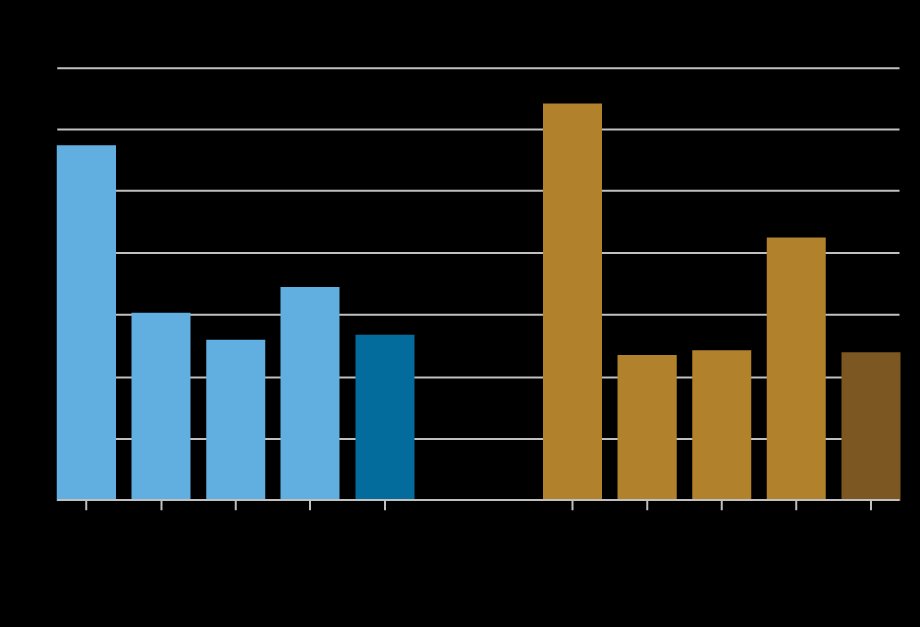
Firms reported that the sharpest cost increases over the past year were for employee health insurance and utilities, followed by business insurance, and goods and materials inputs. Our survey asked firms for their estimates of cost increases for several categories of inputs over the past twelve months, with average increases shown in the chart below.
Notably, cost increases were generally larger among manufacturers than service firms. The largest increase by a wide margin was for employee health insurance, which saw an average increase of 14.2 percent among manufacturers and 12.9 percent for service firms. Though not common, some firms reported increases of between 25 percent and 50 percent when they renewed their coverage.

The next largest cost increase was for utilities, which climbed by 8.5 percent over the past year for both types of firms, with about 15 percent of all respondents reporting increases of 20 percent or more. Indeed, sharply rising utilities costs in some areas have been tied to the explosive growth of AI-related data centers.
Business insurance—which includes liability, property, auto, and workers' compensation, among other things—climbed by about 7 percent, on average, for service firms and by 7.5 percent for manufacturers. Here too, a significant number of firms reported large increases—close to one in ten reported business insurance hikes of 20 percent or more.
At the other end of the spectrum, wage increases came in at a more modest 3.4 percent and rent increases were relatively small, at around 2 percent.
Goods and Materials Costs Rise Sharply for Manufacturers
Goods and materials costs climbed by 8 percent, on average, among manufacturers, but rose by a more modest yet still significant 5.5 percent among service firms. A greater exposure to tariffs may be part of the reason manufacturing firms faced a sharper increase in goods and materials costs.
Indeed, a number of firms in our surveys have told us about significant increases in the costs of tariffed inputs over the past year, on products such as aluminum, steel, equipment, electrical supplies, auto parts, coffee, and cocoa, among others.
Looking Ahead: Cost Growth Expected to Moderate in 2026
As shown in the first chart, cost increases are expected to slow to 5.4 percent for service firms and 4.8 percent for manufacturers in 2026—a decline from 2025, and a pace similar to what was reported in 2024. Still, these are significant cost increases for many businesses to manage.
Our second post will examine the sharp rise in employee health insurance costs and the effects it has had on the wages firms pay, and our third post will analyze firms' pricing behavior and inflation expectations.

Featured image: Cost increases across business sectors in 2025
Jaison R. Abel is head of Microeconomics in the Federal Reserve Bank of New York's Research and Statistics Group. Richard Deitz is an economic policy advisor in the Federal Reserve Bank of New York's Research and Statistics Group. Nick Montalbano is a data analytics specialist in the Federal Reserve Bank of New York's Research and Statistics Group.
How to cite this post: Jaison R. Abel, Richard Deitz, and Nick Montalbano, "What's Driving Rising Business Costs?," Federal Reserve Bank of New York Liberty Street Economics, March 4, 2026, https://doi.org/10.59576/lse.20260304a
Comments
Please log in or register to join the discussion