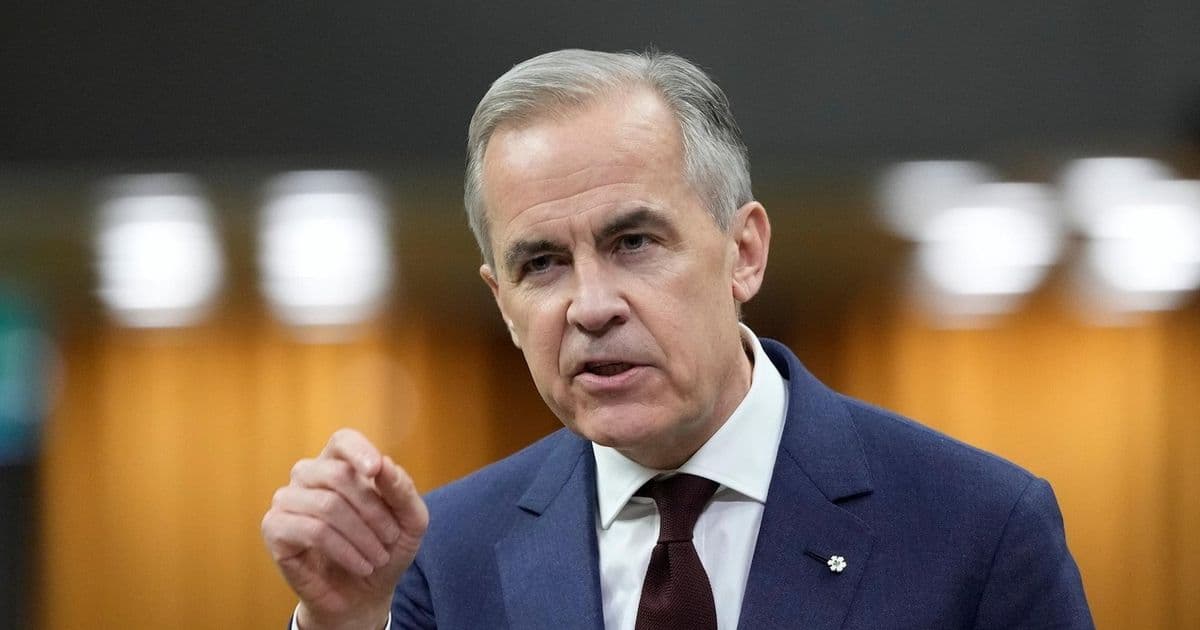
Canadian Prime Minister Mark Carney has declared the country's traditionally strong economic ties with the United States a weakness that must be corrected, citing new US tariffs and shifting trade policies as threats to Canadian economic security.
Canadian Prime Minister Mark Carney has delivered a stark assessment of Canada's economic relationship with the United States, declaring that what was once a strategic advantage has become a vulnerability that requires immediate correction.
In a 10-minute video address released Sunday, Carney outlined his government's efforts to strengthen Canada's economy by attracting new investments and forging trade relationships beyond North America. The prime minister's comments come amid escalating trade tensions and a fundamental shift in US trade policy under President Donald Trump.
The Shift from Strength to Weakness
"The world is more dangerous and divided," Carney stated. "The U.S. has fundamentally changed its approach to trade, raising its tariffs to levels last seen during the Great Depression."
Carney emphasized that Canada's historically close economic ties to America have transformed from a competitive advantage into a strategic liability. This assessment follows the implementation of new tariffs by the Trump administration, which Carney said have particularly impacted workers in the auto and steel industries.
Economic Uncertainty and Investment Hesitation
The prime minister noted that businesses are holding back investments, "restrained by the pall of uncertainty that's hanging over all of us." This investment hesitation reflects broader concerns about Canada's economic future in an increasingly unpredictable trade environment.
Carney's address also addressed the political dimension of US-Canada relations, referencing President Trump's controversial suggestion that Canada become the 51st state. The prime minister indicated that such comments have contributed to a growing sense of urgency about economic independence.
A Central Banker's Perspective
Carney brings unique credibility to this economic reassessment, having served as central bank governor for both Canada and the United Kingdom. His experience in monetary policy and international finance informs his analysis of the shifting global economic landscape.
During the World Economic Forum in Davos in January, Carney received widespread praise for condemning economic coercion by great powers against smaller nations. Trump responded directly to those remarks, stating: "Canada lives because of the United States. Remember that, Mark, the next time you make your statements."
Strategic Response and Economic Diversification
Carney outlined several key initiatives to reduce Canada's economic dependence on the United States:
- Attracting new foreign investments into Canada
- Doubling clean energy capacity
- Reducing internal trade barriers within Canada
- Increasing defense spending
- Implementing tax reductions
- Making housing more affordable
"We have to take care of ourselves because we can't rely on one foreign partner," Carney emphasized. "We can't control the disruption coming from our neighbors. We can't control our future on the hope it will suddenly stop."
Rejecting Hope as Strategy
The prime minister was particularly blunt about the futility of waiting for a return to previous trade norms. "Hope isn't a plan and nostalgia is not a strategy," he declared, dismissing the idea that the United States will simply revert to its former trade policies.
Carney acknowledged Canada's historical partnership with the United States, noting the country's support during conflicts including Afghanistan and both World Wars. However, he maintained that the fundamental nature of the relationship has changed.
"The U.S. has changed and we must respond," Carney stated. "It's about taking back control of our security, our borders and our future."
Political Context and Timing
The address comes at a politically significant moment for Carney, who recently secured a majority government following special election wins. The opposition Conservatives have been pressuring him to deliver a US trade deal, which was among his promises during last year's election campaign.
A review of the current North American Free Trade Agreement between Canada, the US, and Mexico is scheduled for July, adding urgency to Carney's diversification efforts. The prime minister has pledged to provide Canadians with regular updates on his government's progress in reducing economic dependence on the United States.
Carney concluded his address with a commitment to transparency: "Security can't be achieved by ignoring the obvious or downplaying the very real threats that we Canadians face. I promise you I will never sugarcoat our challenges."
The prime minister's assessment represents a significant shift in Canadian economic thinking, moving from a strategy of deepening integration with the US economy to one of deliberate diversification and independence. Whether this approach will succeed in insulating Canada from US economic policy shifts remains to be seen, but Carney has made clear that maintaining the status quo is no longer an option.
Comments
Please log in or register to join the discussion