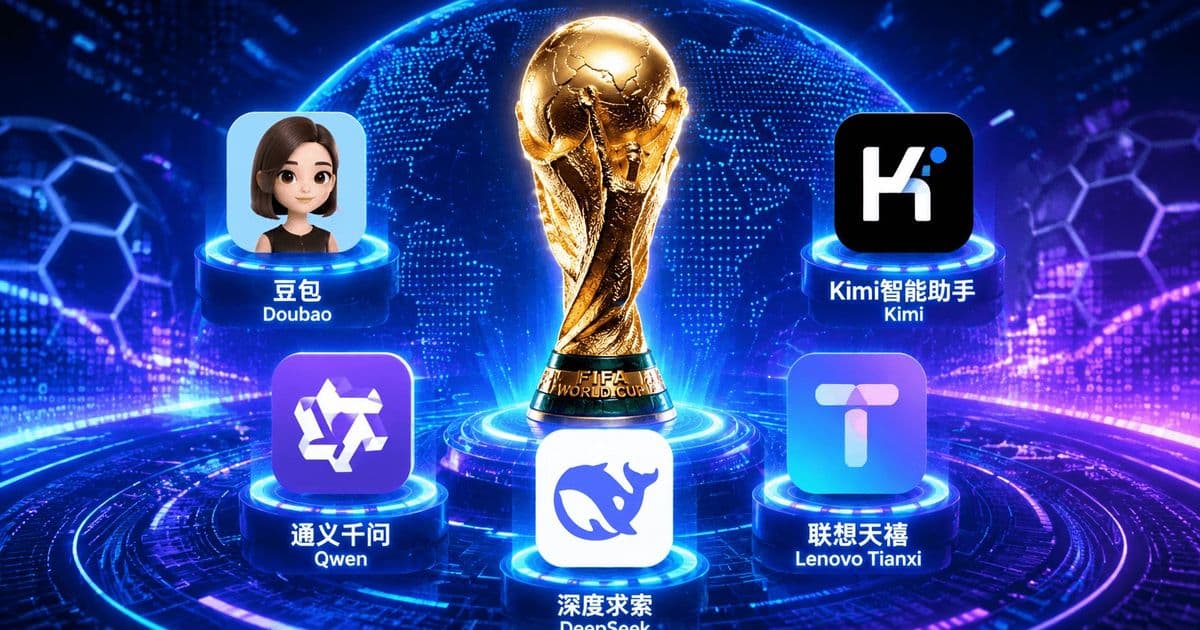
LeiTech assigned distinct 'fan personalities' to Doubao, Qwen, DeepSeek, Kimi, and Lenovo Tianxi, then asked them to call the 2026 World Cup. The interesting part isn't who they picked. It's what the different prompting strategies reveal about how these models reason when you point them at a problem nobody can actually solve.
A Chinese tech outlet called LeiTech ran five domestic AI assistants through a World Cup prediction exercise, and the results are getting passed around as a fun summer-tournament story. They are fun. But underneath the gimmick of giving each model a "fan personality" sits a reasonably clean demonstration of something practitioners already know: the framing you hand a model determines the answer far more than any latent forecasting skill the model has.
The lineup was Doubao (ByteDance), Qwen (Alibaba), DeepSeek, Kimi (Moonshot AI), and Lenovo Tianxi. The 2026 tournament they were asked to predict is itself unusual, with 48 teams, 104 matches, and three host nations in the United States, Canada, and Mexico. More matches and a longer schedule mean more variance, which is worth keeping in mind when anyone claims to have called it.
What was actually tested
This was not a benchmark. There is no ground truth yet, no scoring, no held-out set. What LeiTech really did was assign each model a different reasoning persona and observe how the outputs diverged. That makes it a prompt-engineering demo dressed as a sports prediction, and read that way it is genuinely informative.
Doubao got the "mysticism scholar" role and leaned into folklore: the defending-champion curse, continental rotation patterns, even jersey color theory. It called France to lose 0-1 to Senegal in the opener and picked Argentina as champion on "championship aura" and Messi-era momentum. None of that is analysis. It is the model faithfully executing a prompt that asked for pattern-matching against superstition, and it produced exactly the confident, narratively tidy nonsense you would expect. That is not a failure of the model. It is the model doing what it was told.
DeepSeek played "dark horse hunter," instructed to find teams the betting markets undervalue. It also predicted France 0-1 Senegal, but its stated reasoning was concrete: an aging French midfield pairing of N'Golo Kante and Aurelien Tchouameni, plus possible chemistry problems among the forwards. Its champion pick was Uruguay. Whether or not that pans out, the justification is the kind of thing a human contrarian would say, because the prompt pushed it toward contrarian framing.
Qwen drew the "data analyst" role and was the most interesting case. It folded in squad market value, Elo ratings, expected goals, recent form, and situational factors like high-altitude venues in Mexico. Notably, it was the only model that correctly identified France's current squad composition, and it predicted a pragmatic 1-0 French win over Senegal. Its champion pick was Spain, justified by system stability, a young talent pipeline, and tempo control over a longer tournament.
That one detail, Qwen getting France's actual roster right while others apparently did not, is the most telling line in the whole writeup. It is a small retrieval-and-grounding check, and it is the only place where the models were measurably distinguishable on a fact rather than on vibes. A model that hallucinates the personnel before reasoning about tactics is going to produce confident output built on a wrong foundation, and you would never know unless you checked the roster yourself.
Kimi took a different path entirely, running an agent cluster to simulate all 104 matches, while Lenovo Tianxi simply tracked betting-market odds and implied probabilities. Tianxi's approach is, ironically, the most defensible: market odds aggregate enormous amounts of information and are hard to beat. A model that just reads the odds is at least anchored to something calibrated.
What this does and doesn't show
The honest takeaway is narrow. The exercise shows that these five models can follow distinct reasoning instructions and generate internally coherent outputs in each style. It does not show that any of them can predict football, because that cannot be evaluated until matches are played, and even then five guesses against a high-variance tournament tell you almost nothing about forecasting ability. With this many models making divergent picks, someone will look prescient by chance.
The persona framing also quietly inflates the apparent diversity. France 0-1 Senegal showed up from both the mysticism model and the dark-horse model, arrived at through completely different stated logic. When two opposite reasoning styles converge on the same scoreline for opposite reasons, that is a hint the scoreline is being generated by the prompt's appetite for an upset rather than by anything in the data.
LeiTech's own closing line is the right note to end on: "If football could be decided by paper strength, fans wouldn't need to stay up all night watching." Elo ratings, xG, odds, and full Monte Carlo match simulations still cannot price an 89th-minute deflection or a goalkeeper's nerve in a shootout. The models can compute all of it and still miss everything that decides the game.
For anyone building with these tools, the practical lesson has nothing to do with soccer. Give a capable model a persona and a method, and it will produce a polished, plausible answer in that frame regardless of whether the frame has any predictive power. The mysticism model sounded as confident as the data analyst. The only way to tell them apart was to check a verifiable fact, the squad list, and watch most of them get it wrong. That gap between fluency and grounding is the thing to design around, whether you are forecasting a tournament or anything that matters more.
Comments
Please log in or register to join the discussion