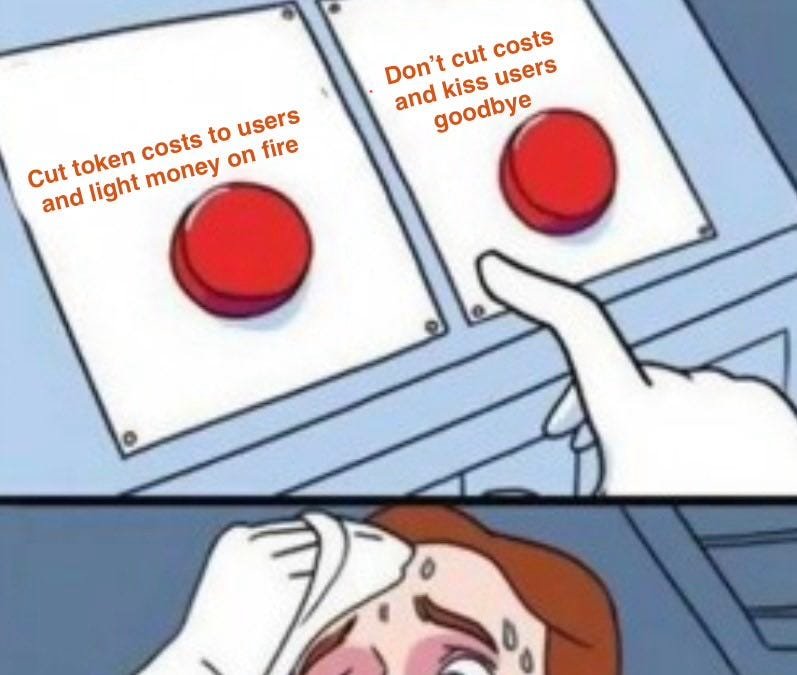
A WSJ report says OpenAI is considering steep price reductions, and critic Gary Marcus is calling it a sign of weakness. The reality is more interesting than either the cheerleading or the doom takes: API pricing has been in freefall across every vendor for two years, and OpenAI is responding to commodity pressure it helped create.
A Wall Street Journal report, amplified by longtime AI skeptic Gary Marcus, claims OpenAI is considering "drastic" price cuts on its models. Marcus frames this as vindication of a January 2024 prediction that the company would struggle to defend its margins, and reads the move as evidence of weakness rather than confidence.
The interpretation is worth examining, because both the triumphant and the dismissive readings miss what has actually been happening to large language model pricing since 2023.
What's being claimed
The claim, stripped of editorializing, is narrow: OpenAI is internally discussing significant reductions to what it charges for API access and possibly consumer subscriptions. The WSJ framing treats this as news. Marcus treats it as a symptom of a company under pressure, fitting a thesis he laid out more than two years ago about OpenAI's long-term position.
Neither claim comes with hard numbers in the public summary. There is no published schedule, no specific model named, no percentage attached to the word "drastic." That matters, because "drastic" is doing a lot of work in the headline, and a price cut on a flagship model is a different signal than a cut on a model the company already considers legacy.
What's actually new
Honestly, not much, and that is the most useful thing to say about it.
The cost of running a fixed unit of LLM capability has dropped by orders of magnitude since GPT-3.5 era pricing. OpenAI's own per-token prices for comparable capability have fallen repeatedly. The same pattern holds at Anthropic, Google, and across the open-weight ecosystem, where models you can run yourself keep closing the gap with hosted frontier systems. When the marginal cost of serving a token keeps falling and competitors keep shipping models that are good enough for most tasks, list prices follow. This is what commodity markets do.
So a report that OpenAI is considering cuts is less a plot twist than a continuation of a trend the company has been driving for years. The interesting question is not whether prices fall but which prices, and why now.
There are a few plausible drivers, and they point in different directions:
- Competitive pressure on the low end. Open-weight models and cheaper API offerings from rivals have made it hard to charge premium rates for everyday inference. Cutting prices here is defensive, but it is also rational. You do not hold share in a commoditizing segment by charging more than substitutes that are nearly as good.
- Volume economics. Inference costs scale with hardware efficiency, better serving stacks, and quantization. If your unit costs have dropped, passing some of that through buys you usage and lock-in. That is offense, not retreat.
- Margin defense at the top. If OpenAI is reserving premium pricing for its most capable reasoning models while cutting everything below, that is a deliberate tiering strategy, not capitulation.
The WSJ summary does not let us distinguish among these. That ambiguity is exactly why a single word like "drastic" should not carry an entire thesis.
The weakness reading
Marcus's argument is that price cuts signal a business that cannot defend its premium, and that this fits a broader prediction of OpenAI struggling to convert technical leads into durable advantage. The premortem he points to made a reasonable structural point: if the underlying capability commoditizes faster than a company can build a moat, pricing power erodes.
That structural point has largely held. What it does not establish is that cutting prices is itself the failure. Lowering prices in a commoditizing market is the correct response to commoditization, not a separate symptom of it. A company that refused to cut prices while competitors undercut it would be in worse shape, not better. The signal of weakness, if there is one, is the commoditization itself, and that was visible long before this report.
There is also a survivorship issue in the framing. Every major lab has cut prices. AWS, Azure, and Google cut prices on cloud services for two decades while growing into some of the most profitable businesses ever built. Falling prices and falling fortunes are not the same thing.
Limitations of the available information
A few things are genuinely unknown and should temper any strong read:
- No magnitudes. Without numbers, "drastic" is unfalsifiable. A 10 percent trim and a 70 percent cut tell completely different stories.
- No product scope. Consumer subscription pricing, enterprise contracts, and per-token API rates respond to different pressures. Lumping them together obscures more than it reveals.
- No cost data. If OpenAI's serving costs have fallen faster than its prices, a cut can expand margins even as headline prices drop. We cannot see the cost curve from the outside.
- Reporting is secondhand. This is a report about internal deliberation, not an announced policy. Companies consider many things they never ship.
For practitioners, the practical takeaway is mundane and useful. Budget for continued price declines across all vendors, keep your integration loosely coupled so you can switch models when the price-to-capability ratio shifts, and benchmark open-weight options against hosted APIs on your actual workload rather than on leaderboard scores. The economics favor buyers right now, and that is likely to continue regardless of which lab announces what.
The larger pattern is the one to watch. Frontier capability is becoming cheaper and more fungible, the gap between the best hosted model and a good open-weight model keeps narrowing on common tasks, and pricing power is migrating toward whoever owns the customer relationship and the surrounding product rather than the raw model. A price cut report is a small data point inside that shift. It is neither vindication nor catastrophe. It is what a maturing market looks like.
Comments
Please log in or register to join the discussion