
The underground DDoS market has transformed from scattered tools to polished platforms with tiered pricing, API access, and reseller options. Recent research reveals a 10x increase in advertised services between 2023 and 2026, making sophisticated attacks accessible to even low-skill users.

You've probably experienced this scenario yourself: a website suddenly stops loading, a login page times out, or an online service becomes unreachable at the worst possible moment. Sometimes the cause isn't an internal outage, but a Distributed Denial-of-Service (DDoS) attack designed to overwhelm the service from the outside.
DDoS attacks have long been one of the simplest ways to disrupt an online service—flooding it with enough traffic to exhaust its infrastructure and make it unreachable without breaking into the target's systems. What's changed dramatically is how these attacks are packaged, branded, and sold. The underground DDoS market has evolved from scattered tools and tutorials to polished platforms with subscription models, customer support, and enterprise-like features.
The real-world impact is well documented. Cloudflare reported blocking a 7.3 Tbps attack in 2025 and later mitigated a 31.4 Tbps attack in its Q4 2025 DDoS report. Microsoft also revealed that Azure mitigated a 15.72 Tbps attack in October 2025, attributing the activity to the Aisuru botnet. Behind these massive attacks, underground sellers are competing over buyers with increasingly sophisticated pitches.
Understanding the Evolution of DDoS Services
Flare researchers analyzed DDoS-related underground activity from two periods: the first five months of 2023 and the first five months of 2026. The findings reveal a dramatic transformation in how these services are marketed and delivered:
| Metric | 2023 | 2026 | Change |
|---|---|---|---|
| Volume of records | 4,403 | 4,964 | Slight increase |
| High-signal DDoS service ads | 38 | 364 | ~10x increase |
| Unique ad clusters | 31 | 123 | ~4x increase |
| Unique actors | 15 | 41 | ~3x increase |
| Sources observed | 22 | 43 | ~2x increase |
"What once appeared more frequently as scripts, tutorials, leaked tools, and scattered forum posts is now more often presented as a repeatable product that is easier to buy and operate," explains Flare's research team. "The market has matured from a collection of individual offerings to a structured ecosystem with clear business models."
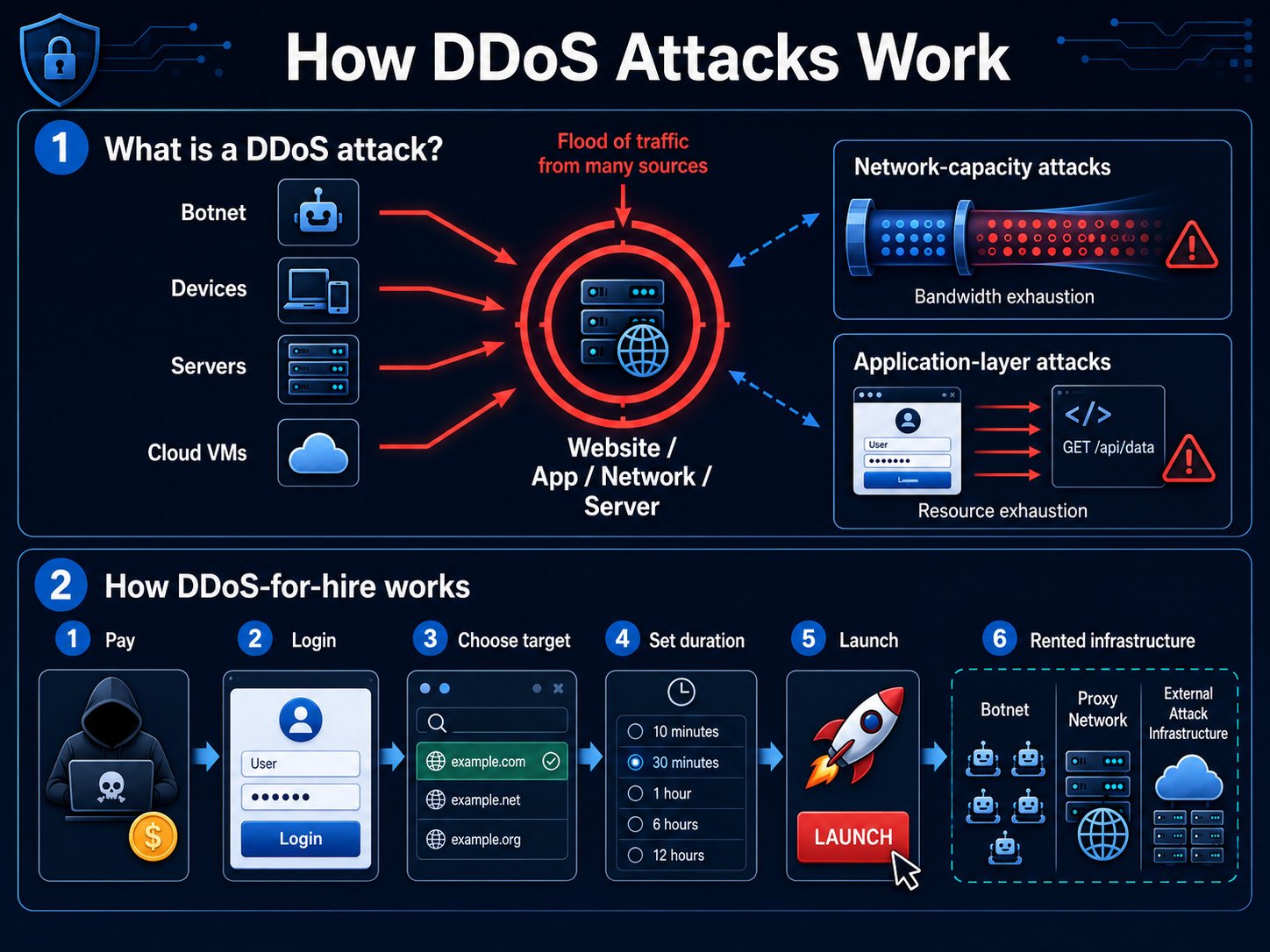
From Scattered Tools to Packaged Services
The content of DDoS offerings has shifted significantly between 2023 and 2026. In 2023, posts were more diverse, often promoting generic "botnet service" with claims about Layer 3, Layer 4, and Layer 7 capabilities, API access, and Cloudflare bypasses. These early offerings typically recycled the same marketing text across multiple sources, suggesting copying, reselling, or minimal customization.
By 2026, the focus has shifted to specific products with clear pricing and features. Consider these examples:
SatelliteStress: Marketed as an IP stresser with a user-friendly panel, API access, game-server support, and monthly plans starting at €20. The service emphasizes being "100% botnet-powered" to distinguish itself from resellers that depend on other providers' infrastructure.
Areshun: Offers a "Premium DDoS Service" with Layer 4 and Layer 7 attacks, monitoring, API integration, custom plans, 24/7 support, and promotional discount codes.
RebirthStress: Promoted as a botnet-powered IP and web stressing device with a free Layer 7 hub, more than 400 slots, reselling suitability, and plans starting at $15 per month.
"The 2026 posts are more focused on a product, with sellers competing against each other on customers," notes Flare's analysis. "They package everything nicely, offering shiny features: ease of use, fully automated, full support, privacy promised, reselling capacity, and reliability."
Technical Language Becomes Part of the Sales Pitch
While the technical details haven't disappeared, they've become integral to the marketing language. In 2026 ads, we commonly see:
- Bundled Layer 4 and Layer 7 claims (network-level and application-layer attacks)
- Terms like "panel," "API," "slots," "bypass," "monitoring," "uptime," and "support"
- Specific technical capabilities being highlighted as selling points
One THORCC-related advertisement claimed more than 7,000 active Layer 4 bots and promoted bandwidth analytics and attack-vector statistics. Another Russian and English post presented "professional stress testing" while claiming Cloudflare and DDoS-Guard bypasses, high concurrency, and long attack durations.
"Sellers are possibly exaggerating about their capabilities," the researchers caution. "However, the consistency of their marketing language remains important intelligence. It shows what buyers are being encouraged to value beyond raw traffic volume, including web panels, automation, bypass claims, and the ability to launch or resell attacks with minimal effort."
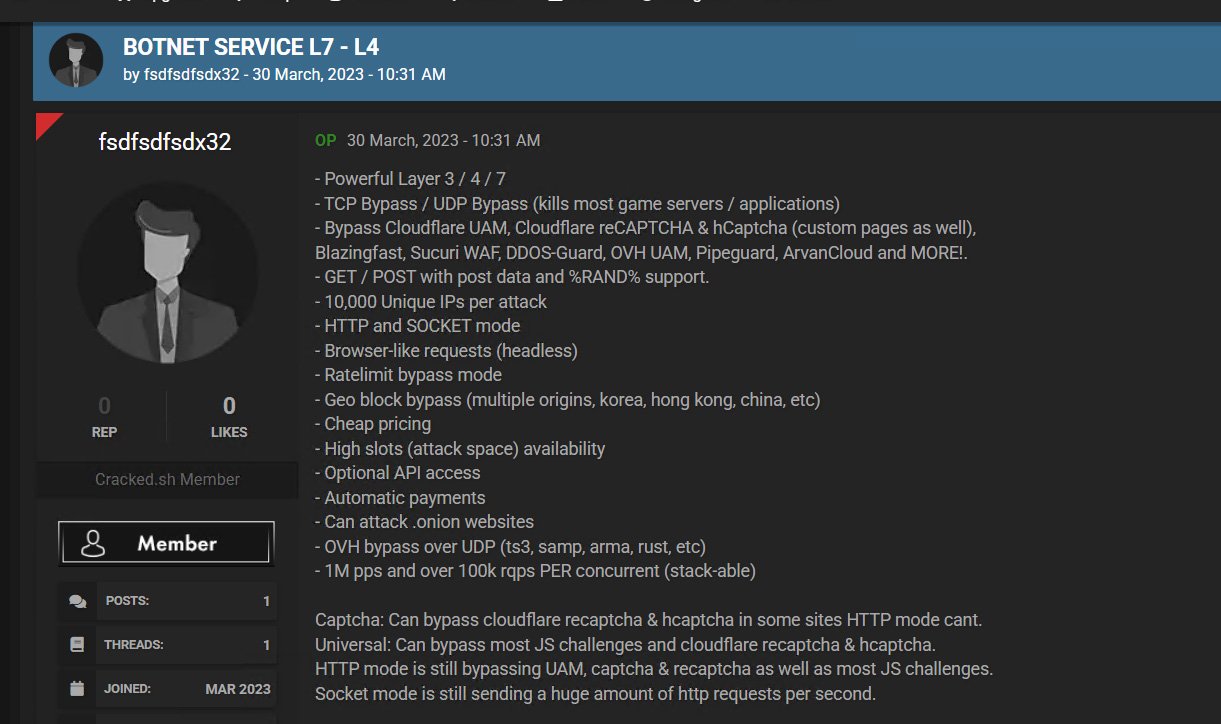
The Business Model: From $5 Tests to Premium Services
The pricing of DDoS attacks in 2026 reveals a market segmented by buyer type:
- Low-cost options: One-hour attacks advertised for $5, website attacks for $10, and 24-hour "home holder" attacks for $25
- Mid-tier options: SamuraiDD advertised attacks starting at $100 per day
- Tiered model: POWERDDOS used a pricing structure of $5 tests, $100 per day for "weak" targets, $200 per day for "medium" targets, and $500 per day for "strong" or protected targets
- Premium offerings: Infrastructure-style targeting, including a DDoS botnet attack network advertised for $2,000
"The pattern shows a market segmented by buyer type," explains Flare's research. "Cheap tests and short attacks for low-skill users, daily pricing for one-off disruption, private negotiation for longer campaigns, and higher-value infrastructure or reseller-style offers for more serious customers."
This low-cost access model aligns with public reporting on the "booter economy"—paid DDoS-for-hire services that let users launch attacks through someone else's infrastructure. Akamai has noted that some DDoS booter services can cost less than $25 per month and may offer limited trials.
Implications for Organizations
The evolution of DDoS-as-a-service has significant implications for organizations:
- Lower barrier to entry: What once required technical knowledge can now be accomplished through a user-friendly panel with minimal expertise
- Increased availability: With monthly plans starting at $5-$20, even small-scale actors can launch disruptive attacks
- Reseller ecosystem: The emphasis on reselling capabilities means attacks can be amplified through multiple channels
- Bypass claims: Sellers increasingly market their ability to circumvent common protection systems
"DDoS-as-a-service is no longer only about traffic volume," the researchers conclude. "The market is dropping down the entry bar, enabling easier purchase, easier operation, and easier to resell. What matters is not only how powerful an attack is, but how easy it is to launch an attack through a panel, various plans, full support, API access, and rented infrastructure."
Defensive Strategies
As the DDoS market becomes more accessible, organizations should consider these defensive approaches:
Multi-layered defense: No single solution can protect against all types of DDoS attacks. A combination of network-level and application-layer protection is essential.
Capacity planning: Understand your normal traffic patterns and have capacity to absorb unexpected spikes. Cloud providers like Cloudflare, AWS Shield, and Azure DDoS Protection offer scalable solutions.
Incident response planning: Have a clear plan for responding to DDoS incidents, including communication strategies and escalation procedures.
Threat intelligence monitoring: Services like Flare can help organizations detect their exposure in underground markets before attacks occur.
Regular testing: Conduct periodic DDoS testing to identify vulnerabilities in your defenses and response capabilities.
Looking Ahead
The DDoS-as-a-service market shows no signs of slowing down. As the researchers note, "In the near future, this market will likely continue moving toward more polished service models. As clearer pricing tiers, more automation, stronger reseller programs, and heavier branding around 'bypass' capabilities and attack reliability."
For organizations, the key takeaway is that DDoS attacks are no longer the exclusive domain of sophisticated threat actors. The commoditization of these services means that any organization could become a target, regardless of its size or industry. By understanding the evolving threat landscape and implementing robust defensive measures, organizations can better protect themselves against this increasingly accessible form of cyber attack.
Comments
Please log in or register to join the discussion