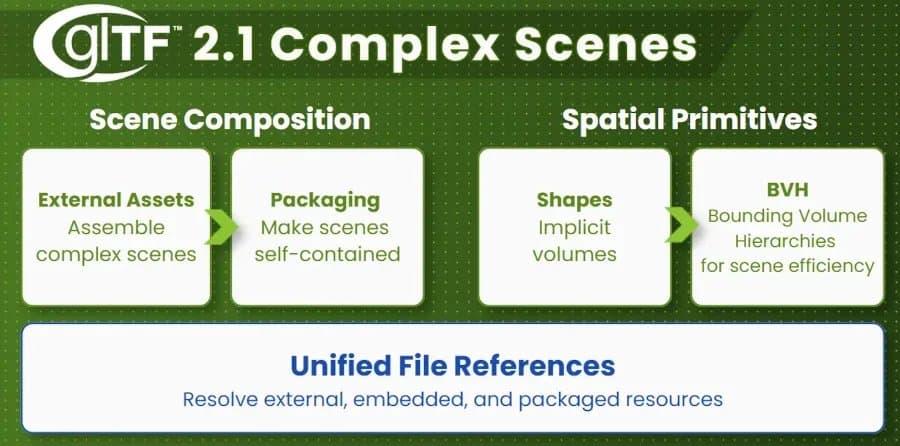
Khronos shipped glTF 2.1 today, a backward-compatible update that finally pushes the format past single-asset delivery and into large composed scenes. The 4GB GLB ceiling is gone, thumbnails embed directly into files, and multi-file scene graphs get a standardized path.
The Khronos Group released glTF 2.1 today, and after nine years of glTF 2.0 sitting as the de facto interchange format for 3D assets, the update is squarely aimed at the thing 2.0 was never really built for: big scenes made of many parts. If you have spent any time wrangling 3D assets for visualization, asset pipelines, or even local rendering experiments on a workstation, the gaps in 2.0 were obvious the moment you tried to push past a single glTF or GLB file.
This is a backward-compatible revision, which matters. Existing 2.0 assets remain valid, and existing loaders should keep working against the parts of the spec they already understand. Khronos is extending the format rather than forking it, the same way the 3D Formats Working Group has handled extensions for the past several years.
{{IMAGE:2}}
What actually changed
The headline items in glTF 2.1 are practical rather than flashy. Here is the short list of additions, then we will go through why each one matters in a real pipeline.
| Feature | What it solves |
|---|---|
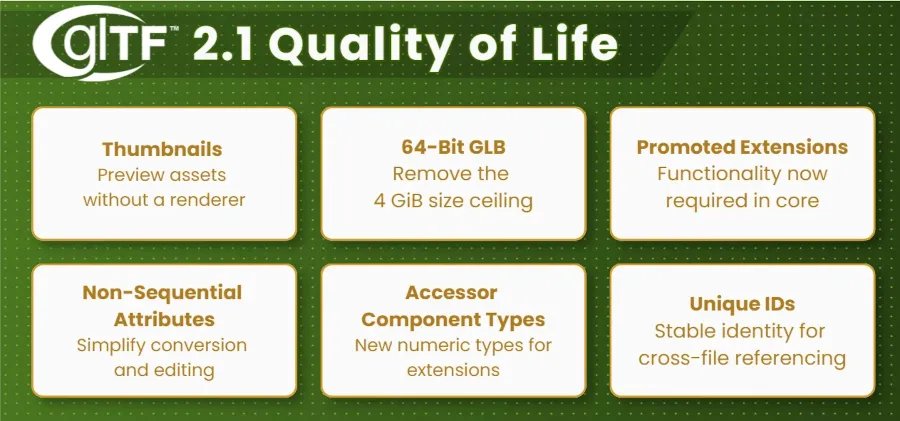
| 64-bit GLB | Removes the 4GB binary size ceiling |
| Embedded thumbnails | Preview without spinning up a renderer |
| Scene graph composition | Standardized multi-file scene assembly |
| New spatial primitives | Better geometry description for scenes |
| Progressive delivery | Stream large scenes instead of full downloads |
The 4GB GLB ceiling is gone
GLB is the binary container variant of glTF, packing JSON, buffers, and embedded textures into one file. The original GLB header used a 32-bit length field, which hard-capped a single GLB at 4GB. For a single character model or a product asset, 4GB is enormous and you never think about it. For a scanned environment, a photogrammetry capture of a building, or a composited scene with high-resolution texture sets, 4GB disappears faster than you would expect once you start stacking 8K texture maps and dense meshes.
The 64-bit GLB format in 2.1 lifts that ceiling. This is the kind of change that does not affect most users at all and completely unblocks a specific class of users who were previously splitting assets or abandoning GLB entirely for those workloads. If you have ever had a multi-gigabyte capture fail to pack into a single distributable file, this is the fix.
Embedded thumbnails
glTF 2.1 lets you embed a preview thumbnail directly inside the file, viewable without a renderer. On its face this sounds minor. In practice, anyone managing an asset library knows the pain: to show a grid of previews you either render every asset on demand or maintain a parallel sidecar image cache that drifts out of sync with the source files.
Embedding the thumbnail means a file browser, an asset manager, or a content delivery service can show a meaningful preview by reading bytes out of the file itself. No headless renderer, no GPU, no shader compilation. For a local asset server or a homelab media catalog indexing thousands of models, that is the difference between an instant thumbnail wall and a render farm job queue.
Scene composition and multi-file scene graphs
This is the structural heart of the release. glTF 2.0 was, in Khronos's own framing, focused on shipping single assets. You could put multiple meshes and nodes inside one file, but there was no standardized way to compose a scene out of many separately authored and separately stored files and have it reference and assemble cleanly.
glTF 2.1 adds a standardized mechanism for composing and delivering multi-file scene graphs. That means a large scene can be expressed as references to component assets, each maintained independently, rather than one monolithic file that has to be rebuilt every time a single prop changes. This is how production pipelines actually work, and it brings glTF closer to the role formats like USD have occupied for composed scenes. The two are not equivalent, but 2.1 narrows a real gap.
Progressive delivery and spatial primitives
The progressive delivery work pairs naturally with large scenes. Instead of downloading an entire multi-gigabyte scene before anything appears, progressive delivery lets a client pull and display content incrementally. For web-based viewers and bandwidth-constrained clients, that is the difference between a usable experience and a loading bar that never seems to move.
The new spatial primitives extend what geometry the format can describe natively, which feeds into the same large-scene goal. More expressive primitives mean less brute-force triangle data for shapes that have a cleaner mathematical description.
Why this matters beyond 3D artists
If your work touches asset hosting, model serving, or any pipeline that moves 3D data over a network, glTF 2.1 changes your storage and bandwidth math. Embedded thumbnails reduce the compute you need for catalog browsing. The 64-bit GLB format changes how you chunk and store large captures. Progressive delivery changes your CDN and caching strategy for scenes, because you can now serve partial content meaningfully.
There is also a longevity angle. glTF 2.0 lasting nine years as the dominant runtime delivery format tells you Khronos prioritizes stability, and shipping 2.1 as backward-compatible rather than a clean break signals the same intent for the next stretch. Tooling, importers, and engine support tend to follow Khronos releases on a lag, so expect engine and library support for the 2.1 features to roll out over the coming months rather than overnight.
The full specification details are available at Khronos.org, and the working group maintains the glTF GitHub repository where the specification, schema, and extension registry live. Anyone planning to support the new features in a custom loader or asset server will want to track the schema changes there directly rather than relying on summaries.
Comments
Please log in or register to join the discussion