The LIGO-Virgo-KAGRA Collaboration has more than doubled the number of known gravitational-wave events, revealing a diverse population of black hole mergers and providing new tests of Einstein's relativity.
The universe is echoing with a kaleidoscope of cosmic collisions, according to the latest gravitational-wave catalog that more than doubles the number of known space-time ripples detected by Earth's most sensitive listening posts.
When the densest objects in the universe—black holes and neutron stars—collide and merge, the violence sets off ripples in the fabric of space-time. These gravitational waves travel for hundreds of millions or even billions of years before passing through Earth, where they're barely discernible. Yet scientists can detect them thanks to a global network of observatories: the U.S.-based National Science Foundation Laser Interferometer Gravitational-Wave Observatory (NSF LIGO), the Virgo interferometer in Italy, and the Kamioka Gravitational Wave Detector (KAGRA) in Japan.
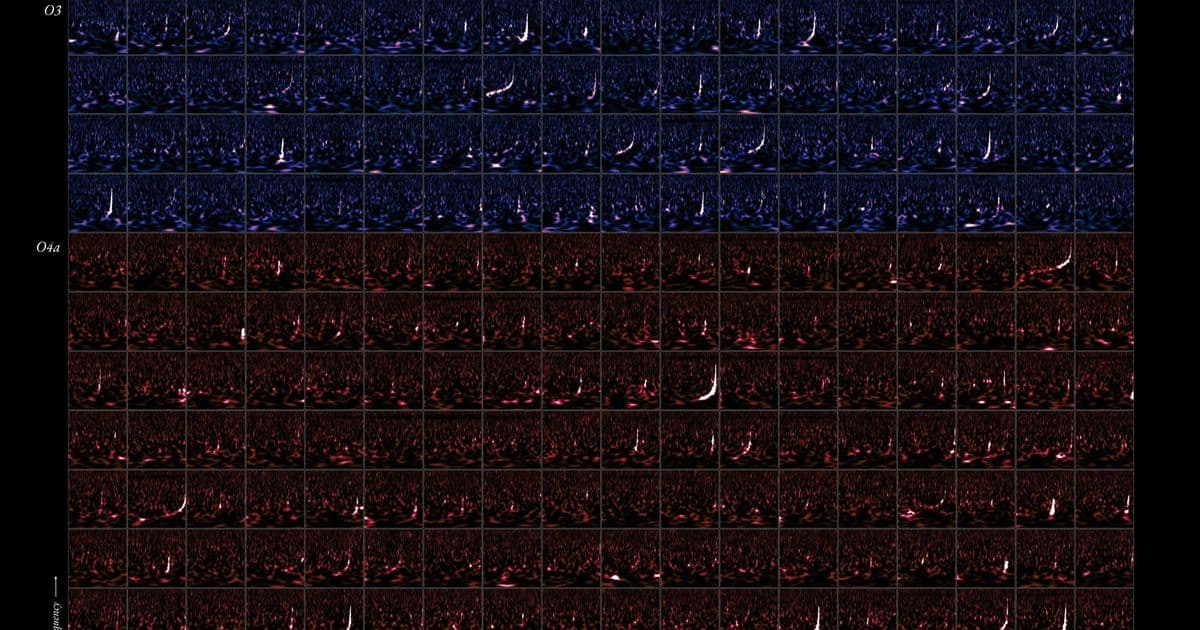
Now the LIGO-Virgo-KAGRA (LVK) Collaboration is publishing its latest compilation of gravitational-wave detections in a forthcoming special issue of Astrophysical Journal Letters. The Gravitational-Wave Transient Catalog-4.0 (GWTC-4) represents detections from the observatories' fourth observing run between May 2023 and January 2024, revealing 128 new gravitational-wave "candidates"—signals likely from extreme, far-off astrophysical sources.
This newest crop more than doubles the size of the gravitational-wave catalog, which previously contained 90 candidates from all three previous observing runs. "The beautiful science that we are able to do with this catalog is enabled by significant improvements in the sensitivity of the gravitational-wave detectors as well as more powerful analysis techniques," says Nergis Mavalvala, dean of the MIT School of Science and the Curtis and Kathleen Marble Professor of Astrophysics.
A Universe of Diversity The updated catalog reveals a greater variety of binaries that produce gravitational waves than ever before. Among the standout detections is GW231123_135430, the heaviest black hole binary detected to date. Scientists estimate this signal arose from the collision of two black holes, each roughly 130 times as massive as the sun—far heavier than the typical 30 solar mass black holes previously detected.
Another remarkable finding is GW231028_153006, a black hole binary with the highest inspiral spin ever observed. Both black holes appear to be spinning at about 40 percent the speed of light, suggesting they may be products of previous mergers that spun them up as they formed from smaller, inspiraling black holes.
The catalog also includes GW231118_005626—an unusually lopsided pair with one black hole twice as massive as the other. "One of the striking things about our collection of black holes is their broad range of properties," says Jack Heinzel, an MIT graduate student who contributed to the catalog's analysis. "Some of them are over 100 times the mass of our sun, others are as small as only a few times the mass of the sun."
Testing Einstein's Theory The new detections provide unprecedented opportunities to test Albert Einstein's general theory of relativity, which describes gravity as a geometric property of space and time. "Black holes are one of the most iconic and mind-bending predictions of general relativity," says Aaron Zimmerman, associate professor of physics at the University of Texas at Austin.
When black holes collide, they "shake up space and time more intensely than almost any other process we can imagine observing," Zimmerman explains. The surprisingly clear signal from GW230814_230901—one of the "loudest" gravitational-wave signals observed to date—pushed the limits of tests of general relativity, passing most with flying colors but illustrating how environmental noise can challenge others in such an extreme scenario.
Measuring the Expanding Universe Gravitational waves offer an alternative way to measure the Hubble constant—the rate at which the universe is expanding today. Scientists have tried to answer this fundamental question using various methods, but different approaches have given conflicting answers.
"Merging black holes have a really unique property: We can tell how far away they are from Earth just from analyzing their signals," says Rachel Gray, a lecturer at the University of Glasgow who was involved in the cosmological interpretations of the catalog's data. "So, every merging black hole gives us a measurement of the Hubble constant, and by combining all of the gravitational wave sources together, we can vastly improve how accurate this measurement is."
By analyzing all the gravitational-wave detections in the LVK's entire catalog, scientists have come up with a new, independent estimate of the Hubble constant: 76 kilometers per second per megaparsec. "It's still early days for this method, and we expect to significantly improve our precision as we detect more gravitational wave sources," Gray notes.
The Hunt Continues The LIGO, Virgo, and KAGRA observatories detect gravitational waves using L-shaped, kilometer-scale instruments called interferometers. Scientists send laser light down the length of each tunnel and precisely measure the time it takes each beam to return to its source. Any slight difference in their timing can mean that a gravitational wave passed through and minutely wobbled the laser's light.
For the first segment of the LVK's fourth observing run, gravitational-wave detections were made using only LIGO's identical interferometers—one located in Hanford, Washington, and the other in Livingston, Louisiana. Recent upgrades to LIGO's detectors enabled them to search for signals from binary neutron stars as far out as 360 megaparsecs, or about 1 billion light-years away.
"You can't ever predict when a gravitational wave is going to come into your detector," says Amanda Baylor, a graduate student at the University of Wisconsin at Milwaukee who was involved in the signal search process. "We could have five detections in one day, or one detection every 20 days. The universe is just so random."
The future of gravitational-wave astronomy looks bright, with scientists anticipating even more discoveries as detector sensitivity continues to improve. "Each new gravitational-wave detection allows us to unlock another piece of the universe's puzzle in ways we couldn't just a decade ago," says Lucy Thomas, who led part of the catalog's analysis and is a postdoc in the Caltech LIGO Lab. "It's incredibly exciting to think about what astrophysical mysteries and surprises we can uncover with future observing runs."
The catalog represents not just a numerical milestone but a qualitative leap in our understanding of the cosmos. From the heaviest black holes to the fastest-spinning binaries, from testing Einstein's relativity to measuring cosmic expansion, gravitational-wave astronomy continues to reveal the universe in ways previously unimaginable—proving that even the most subtle ripples in space-time can tell us profound stories about the cosmos.
Comments
Please log in or register to join the discussion