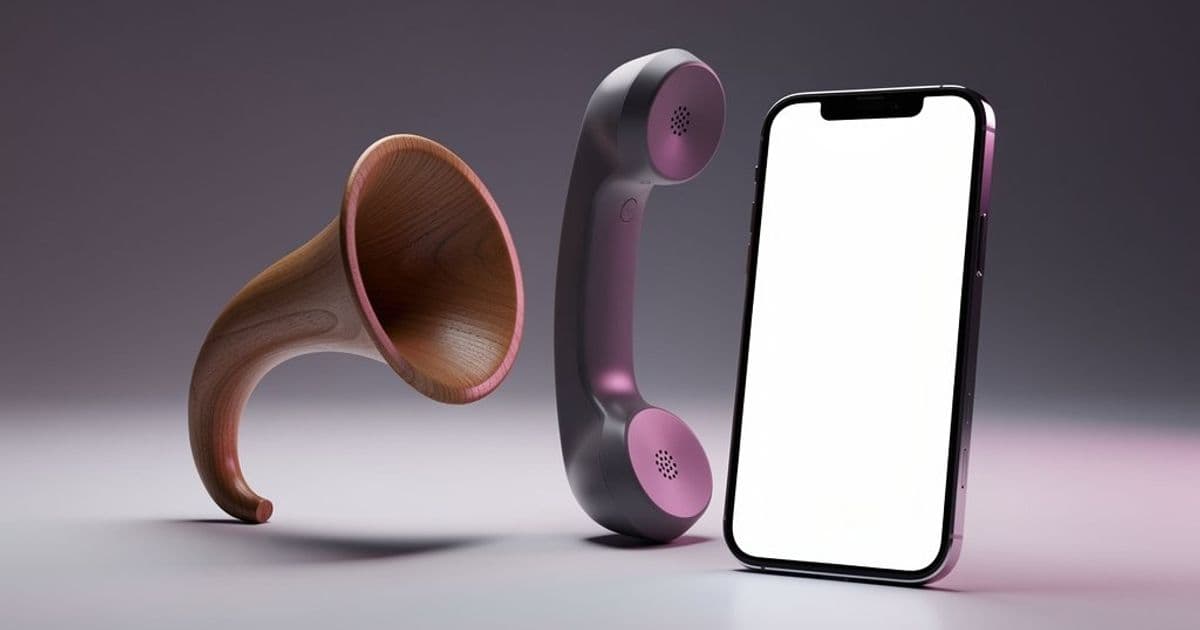
The word 'hello' first appeared in print on 18 January 1826 in a Connecticut newspaper, but its origins trace back to 15th-century shouts and calls. From Old German 'halâ' to French 'hol', the greeting's evolution reveals how language adapts to social needs—and how digital communication is now reshaping it once again.
It's been 200 years since the word "hello" was first used in print – though its beginnings date back to the 15th Century. How has the language of greetings evolved around the world – and what does it tell us about ourselves?
We use "hello" dozens of times a day without thinking – during phone calls, emails and face-to-face encounters. We sing it along with Adele and Lionel Richie, and we have watched it spun into moments of screen gold in Jerry Maguire ("You had me at hello"), and Scarface ("Say hello to my little friend!"). It's been used to sell everything from mobile phones (Motorola's "Hello, Moto") to lingerie (Wonderbra's iconic "Hello boys"), and it has been borrowed to name computer programs and celebrity magazines.

In print, this ubiquitous, friendly greeting has a surprisingly short history. Two centuries ago, on 18 January 1826, "hello" made what is thought to be its earliest recorded appearance on the page, in a Connecticut newspaper called The Norwich Courier. Hidden among the column inches, it was a modest in-ink debut for a word that would go on to greet much of the modern world. By the 1850s, it had crossed the Atlantic to Britain – appearing in publications such as the London Literary Gazette – and became increasingly common in print.
Like the go-to greetings in other languages, "hello" also says something about the English-speaking world – depending on which variation, abbreviation or inflection of the word we choose to use. It can be pronounced and inflected in many different ways, and these subtle intonational contours can change its meaning – Alessandro Duranti
There are plenty of such forms. Whether due to dialect or accent influences, or the brevity demanded by online communication, which "hello" you choose says a lot about you, and can indicate age, nationality, or even mood. According to linguists, elongated variations such as "heyyy" could be construed as flirtatious, "hellaw" might suggest you're from the southern US, "howdy" from western US, and the clipped "hi" may indicate a curt disposition.
"It can be pronounced and inflected in many different ways, and these subtle intonational contours can change its meaning," says Alessandro Duranti, professor of linguistic anthropology at the University of California, Los Angeles. "For example, when someone says 'hello' with a stretched final vowel, it can question what the other person just said, as in 'Hello, are you paying attention?' or 'Hello, you must be kidding.'"
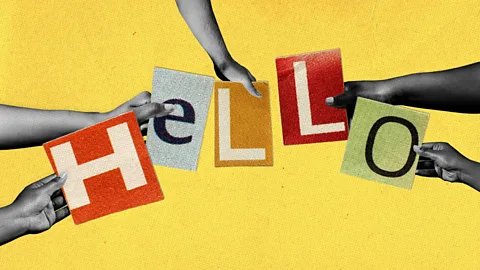
This capacity to convey nuance through tone and form is no modern invention; even in its first printed appearances, "hello" was a patchwork of influences, derivations and applications drawn from several languages.
The origins of hello
The pre-printed origins of the word "hello" are disputed. The most commonly cited etymology is the Old High German "halâ" – a cry historically used to hail a ferryman. The Oxford English Dictionary also points to "halloo" (a hunting call that urged hounds to run faster) as a possible linguistic root. It notes several early spellings, including "hullo", "hillo" and "holla" – the latter thought to have derived from the 15th-Century French "hol", an exclamation meaning "whoa!" or "stop!".
In English sources, the OED lists the earliest form as the late-16th-Century "hollo". Simon Horobin, professor of English language and literature at Magdelen College, Oxford, notes that such semantic shifts and spelling changes may also be explained by regional accents and differences in pronunciation.
"Especially in the example of 'ello' which shows the prevalent – though now stigmatised – feature of h-dropping," he tells the BBC, referring to the classist English stereotype of a dropped 'h' indicating a lack of education. "But for origins and early history," he adds, "we are dependent upon written evidence, which is patchy at the best of times. For a colloquial word like this, which would have appeared much earlier and more frequently in speech than in writing, it is especially tricky to establish a definite timeline."
The selection of a standardised word form, Horobin explains, usually falls to lexicographers – those who compile dictionaries. "They base their choice on the relative prevalence of a particular spelling, though it's necessarily somewhat provisional and arbitrary."
By the time the Oxford English Dictionary first went to press in 1884, "hello" was emerging as the dominant form of the greeting. Charles Dickens, however, spent the 19th Century using "hullo" in his writings, and Alexander Graham Bell (who once argued that "ahoy!" would make a superior telephone greeting) stuck with "halloo". Bell's rival, Thomas Edison, championed "hello", believing it would carry clearly over even the worst phone lines. Like that of The Norwich Courier before him, Edison's backing helped – and "hello" was established as the English-language greeting to beat.
Hello around the world
While the English language settled on "hello" as its customary greeting, other languages forged their own. Some were influenced by English, others developed independently – yet each carries a distinct cultural flavour, hinting at the social norms and stereotypes we have of the people who use it.
In Germanic and Scandinavian languages, for example, "hallo" and "hallå" are phonetically harder and feel more efficient and no-nonsense than the lyrical, almost poetic quality of "hola" and "olá", favoured by the Romance languages that are associated with more effusive stereotypes.
Elsewhere, some greetings carry traces of national history: from the Dutch-derived "hallo" of Afrikaans to "óla" in Tetum, a reminder of Portuguese influence in Timor-Leste. Many such words appear to function as both introduction and identity marker.
But, says Professor Duranti, it's not quite that simple. "It's hard to go straight from the use of a particular greeting to a national character, even though it is tempting," he tells the BBC. Alternative or secondary greetings, Duranti suggests, may offer better clues. "In English, given the common use of 'how are you?', there is an apparent interest in people's wellbeing."
In some Polynesian societies, he adds, greetings are less about a word-for-word "hello" than about checking in on someone's plans or movements – literally asking "where are you going?". Greek, meanwhile, uses "Γειά σου" (pronounced "yah-soo") as a typical informal greeting, offering a wish for health rather than a simple salutation. It is also usable for "goodbye".
Other languages also turn abstract concepts into multipurpose greetings that serve as both "hi" and "bye". "Ciao" comes from a Venetian dialect phrase meaning "at your service", and the French "salut" is an informal expression used for both greeting and parting company. Similarly, the Hawaiian "aloha" can express affection or compassion, and the Hebrew "shalom" peace or wholeness.
Yet, as Duranti cautions, even these evocative examples shouldn't be viewed as cut-and-dry indicators of national character. "I would be careful making that kind of correlation," he explains. "Especially about the semantics of it – health versus sympathy versus whereabouts. But there is one aspect of greetings that is sensitive to the social structure of a society, which is that equals greet each other in different ways from people of different statuses. In fact, greetings can be seen to define levels of intimacy or social distance."
In this sense, he adds, greetings are like magnets – confidently announcing who we are, and drawing in those we want to be associated with.
Hello in the digital age
If greetings act as social magnets, then technology has quietly altered their pull. Over the past few decades, the rise of email, texting and social media has reshaped not just how often we say "hello", but what we might replace it with – and whether we say it at all.
"If you think about WhatsApp, we're basically always in conversation – we're always online," says Christian Ilbury, senior lecturer in linguistics and English language at the University of Edinburgh. "When someone asks you how your day is or whether you're going to be on time for the meal, you don't always have to say 'hello' first, because it's unlikely the last message concluded with 'bye'."
Two centuries on from its print debut, the greeting is once again being stretched, clipped, replaced or ignored altogether
In a text-led, always-on world, greetings have proved especially susceptible to change and, as they are used so often, their evolution has accelerated dramatically. Ilbury has identified many non-standard and creative spellings of "hello" in his studies of digital language, from "hellooooo" and "hiiiiiii" to "heyyyyy". Yet, while tech has made it easier for us to elongate words in this way, Ilbury points out that most modern-day greetings are short, sharp and driven by brevity.
"The most obvious thing to say is that people now sometimes use an emoji – the wave – in place of the word 'hello'," says Ilbury. "But technology has always contributed to language change. We now 'Google' stuff and 'unfriend' people. Like any major invention – AI, for instance – we're bound to get some new vocabulary from that source."
In many ways, this mirrors the instability of "hello" in the early 19th Century, when the greeting may have sounded vaguely the same whenever spoken, but varied widely in spelling when written down. By shortening the established greeting, or replacing it with icons and abbreviations, it's made clear that such salutations remain as fluid as they were before The Norwich Courier made its landmark linguistic choice in 1826.
But for all its so-called standardisation, "hello" has never really stood still. It began as a shout, a summons, a way to hail attention, before settling – briefly – into an accepted spelling and usage. Two centuries on from its print debut, the greeting is once again being stretched, clipped, replaced or ignored altogether. Yet whether it's spoken aloud, typed hastily, or reduced to a small waving hand on a screen, the impulse behind it remains the same: an act of recognition, the announcing of one's presence and just asking – however casually – to be acknowledged in return.
Comments
Please log in or register to join the discussion