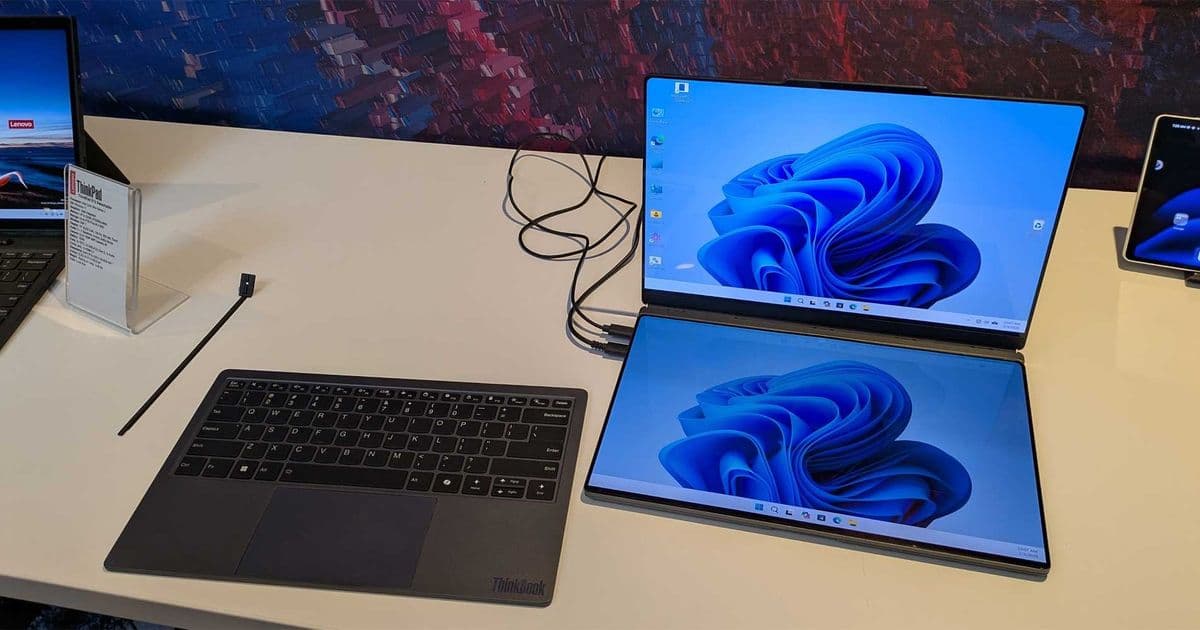
Lenovo unveils a groundbreaking ThinkBook Modular AI PC concept with removable screen, keyboard, and ports at Mobile World Congress, alongside new ThinkPad models featuring unprecedented repairability and a detachable X13 design.
At Mobile World Congress 2026 in Barcelona, Lenovo unveiled a revolutionary ThinkBook Modular AI PC concept that challenges traditional laptop design by introducing unprecedented modularity to mobile computing. The concept device allows users to remove and reconfigure key components including the screen, keyboard, and even entire blocks of ports, transforming the laptop experience much like desktop PC customization has been possible for years.
The ThinkBook Modular AI PC concept builds upon Lenovo's existing Magic Bay magnetic connector technology, which has previously appeared on shipping ThinkBooks like the ThinkBook 16p Gen 4. The system features two 11-pogo pin connectors - one on the back of the lid and another beneath the keyboard - enabling magnetic attachment of various accessories including lights, webcams, and 4G modems. Now, these connectors serve as the foundation for the laptop's modular architecture.
Central to the concept is a secondary display that can be attached to the back of the main lid via magnetic connection, used as a standalone monitor through wired connection, or snapped onto the deck to create a dual-screen laptop configuration similar to the Yoga Book 9i. The keyboard itself is completely removable, allowing users to free up deck space for the second panel. Even when physically disconnected, the keyboard remains functional via Bluetooth, enabling simultaneous use of both the dual-screen setup and the keyboard.
Perhaps most impressively, the laptop features removable port blocks. Users can pop off the HDMI port on the right side and the USB-C port on the left, with the potential for alternate port blocks to be swapped in their place. This level of customization extends to the device's stand functionality - a magnetic stand for the secondary screen can be attached to the bottom surface of the laptop when not in use, serving as a foot for the device.
Under the hood, the ThinkBook Modular packs respectable specifications including an Intel Core Ultra 7 255H "Arrow Lake" processor, 32 GB of RAM, a 1 TB PCIe SSD, an 8 MP camera, and a 33 Wh battery. The 14-inch device measures 12.3 x 9.2 inches with a 0.94-inch thickness, weighing 2.5 pounds with one display and 3.1 pounds with the second screen attached. The device runs on a 4K 120 Hz OLED touch panel that cannot be removed from the main assembly.
While this remains a concept device with no confirmed pricing or release date, Lenovo's demonstration suggests the company is seriously exploring modularity as a future direction for business laptops. Given that last year's ThinkBook with rolling screen debuted at $3,500, the Modular AI PC would likely command a premium price, especially considering current memory market conditions.
Alongside the modular concept, Lenovo announced significant updates to its mainstream ThinkPad lineup. The T14 (Gen 7), T14s (Gen 7), and T16 (Gen 5) models are receiving their first major refresh, with the 14-inch models now available in Cosmic Blue - a dark blue colorway never before used on ThinkPads. The shade is so subtle that it's nearly indistinguishable from black except in direct lighting.
These new ThinkPads offer impressive hardware flexibility, with the T14s available with Intel Core Ultra Series 3, AMD Ryzen AI PRO 400, or Qualcomm Snapdragon X2 SoC processors. The T14 and T16 come in either Intel or AMD configurations. Notably, the Intel-powered T14 and T16 models use LPCAMM2 RAM that's screwed onto the motherboard but can be easily replaced, allowing for future memory upgrades.
The most significant advancement for these ThinkPads is their repairability. Both the T14 and T16 have achieved perfect iFixit repairability scores of 10 out of 10, a dramatic improvement over previous models. During demonstrations, Lenovo representatives showed how easily users can remove the back plate, battery, SSD, keyboard, and even USB-C ports for replacement without having to disassemble large portions of the laptop.
Specifications for the new ThinkPads include the T14s weighing between 2.45 to 2.66 pounds at 0.7 inches thick, the T14 being slightly heavier and thicker, and the T16 at 3.62 pounds and nearly an inch thick. All three models will be available in Q2, with the T14s starting at $1,899 and the T14 and T16 both starting at $1,799.
Lenovo also introduced the ThinkPad X13 Detachable, a 13-inch system that directly challenges the Microsoft Surface Pro in business environments. This device features a magnetically attached keyboard that uses Lenovo's renowned ThinkPad keyboard technology, including tactile feedback, smile-shaped keys, and 1.5 mm of key travel - matching the ThinkPad X1 Carbon. The system includes a Lenovo Slim Pen that charges in the keyboard.
Powered by an Intel Core Ultra Series 3 (Panther Lake) processor, the X13 Detachable supports up to 64 GB of LPDDR5x RAM and 2 TB of SSD storage. Its 13-inch display operates at 2880 x 1920 resolution and covers 100 percent of the sRGB color gamut. The device will be available in Q3 starting at $1,999.
Completing Lenovo's showcase was the Workmate AI robot concept, a table-top automaton reminiscent of the Pixar lamp. This dark gray robot can rotate and bend its screen to interact with users, performing local AI processing for tasks like presentations, note-taking, and meeting summarization. It also features a projector for displaying slides to room audiences. While still a concept, the Workmate demonstrates Lenovo's exploration of AI-powered productivity tools beyond traditional computing devices.
These announcements collectively showcase Lenovo's vision for the future of business computing - one that emphasizes customization, repairability, and AI integration. Whether through modular laptops that can be reconfigured on the fly, ultra-repairable ThinkPads that reduce electronic waste, or AI-powered robotic assistants, Lenovo is positioning itself at the forefront of the next generation of workplace technology.
Comments
Please log in or register to join the discussion