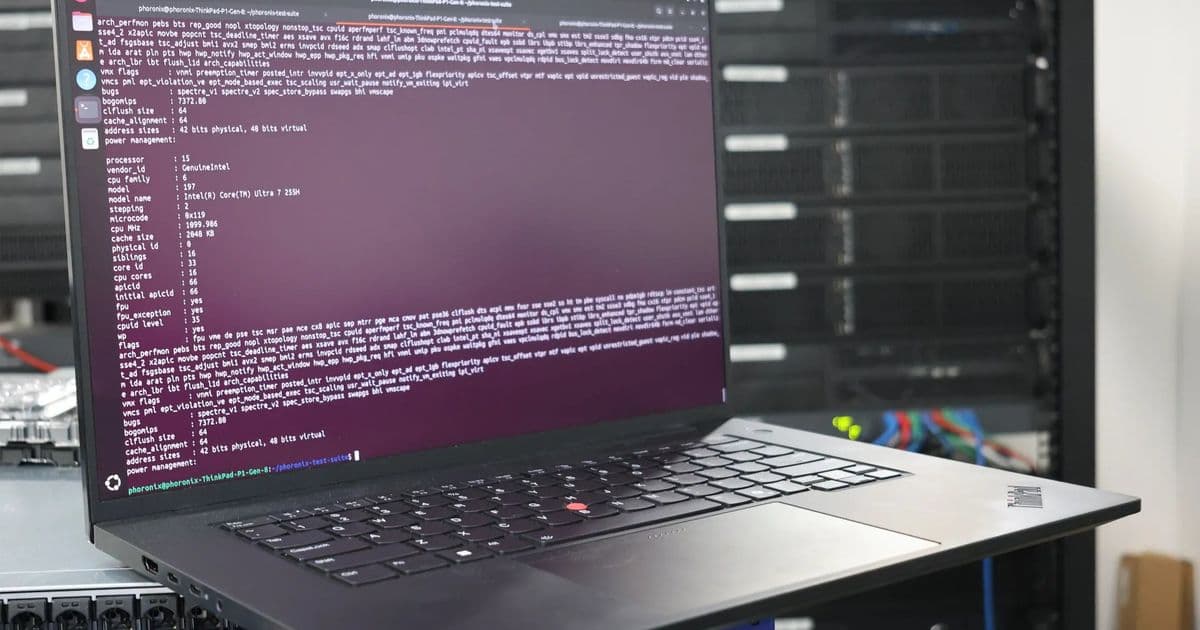
The Lenovo ThinkPad P1 Gen 8 is a high-end mobile workstation built for professional workloads, featuring Intel's Arrow Lake H processors and NVIDIA RTX PRO Blackwell graphics. In extensive Linux testing, it proves to be a capable, well-built machine for developers, AI researchers, and content creators, though it faces trade-offs against AMD's Ryzen AI Max in raw CPU performance.
For professionals demanding a mobile workstation that can handle AI development, complex simulations, and content creation without compromising on Linux compatibility, the Lenovo ThinkPad P1 Gen 8 presents a compelling package. This latest iteration of the P-Series combines Intel's new Arrow Lake H platform with NVIDIA's RTX PRO Blackwell graphics, creating a balanced system for workloads that rely on CUDA, while offering the robust build quality ThinkPad is known for.
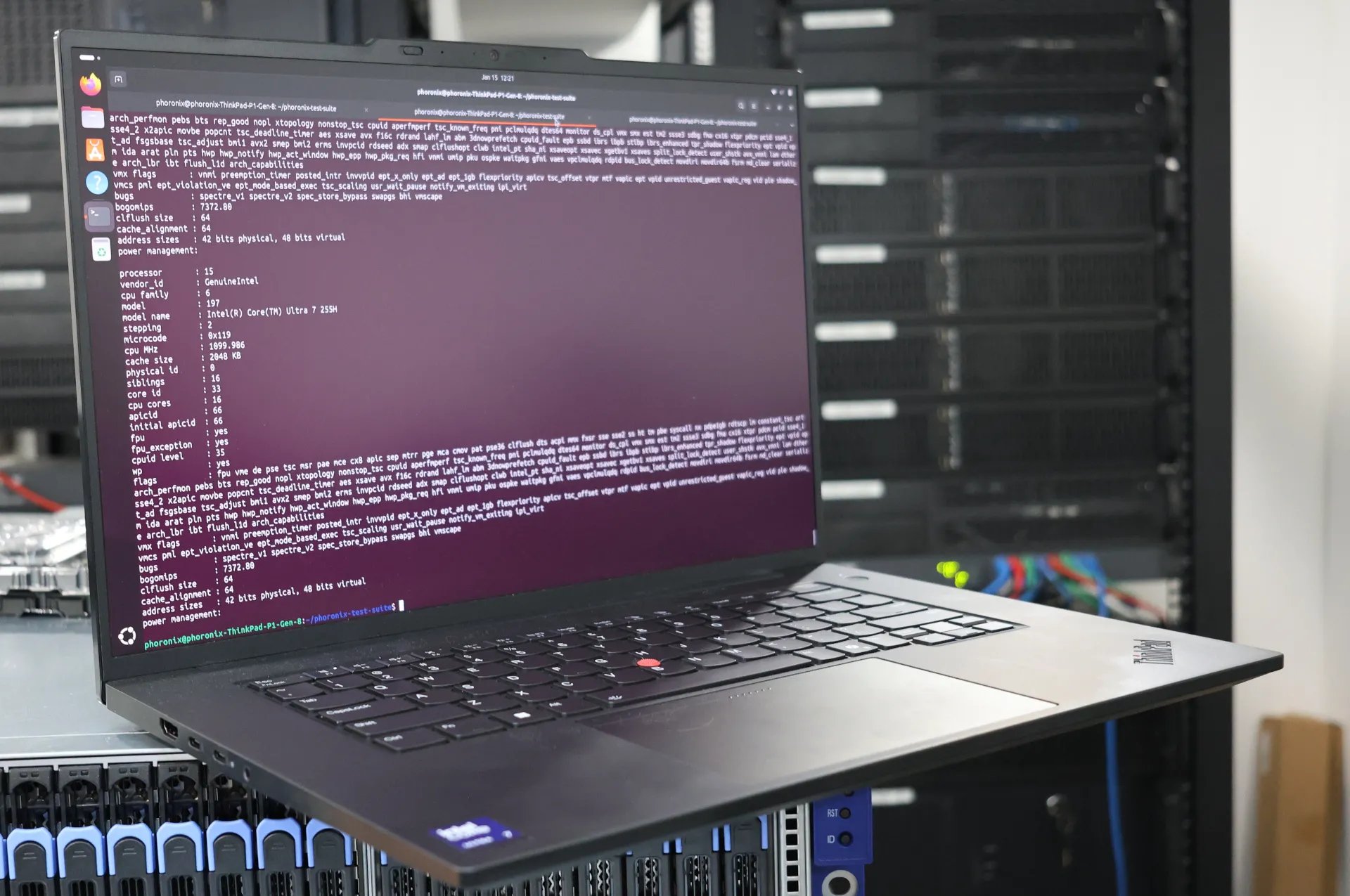
The review unit, configured with an Intel Core Ultra 7 255H, 64GB of RAM, a 2TB NVMe SSD, and an NVIDIA RTX PRO 1000 Blackwell GPU, was tested extensively on both Ubuntu Linux and Fedora Workstation. Throughout the testing period, the system demonstrated excellent stability and performance, with all hardware components functioning correctly under Linux. This is a significant point for developers and researchers who often find themselves at odds with hardware that prioritizes Windows-specific features.
Core Components and Performance Trade-offs
At the heart of the P1 Gen 8 are Intel's Arrow Lake H SoCs, available in Core Ultra 7 255H, 265H, or Core Ultra 9 285H configurations. These chips provide a solid foundation for multi-threaded workloads and offer integrated Intel Arc 140T graphics, which are enabled and functional in Linux. However, when placed side-by-side with AMD's Ryzen AI Max (Strix Halo) platform, the Arrow Lake H CPUs can show a performance deficit in certain CPU-bound benchmarks. This is a critical consideration for users whose primary tasks are heavily CPU-dependent and don't require NVIDIA's ecosystem.
The trade-off becomes clear when considering the GPU. The P1 Gen 8's NVIDIA RTX PRO 1000 and 2000 Blackwell options unlock the vast CUDA, cuDNN, and TensorRT libraries essential for AI training, inference, and many scientific computing applications. For a machine learning engineer or a 3D artist using GPU-accelerated renderers, this NVIDIA advantage can outweigh a moderate CPU performance gap. The integrated Intel Arc graphics are also capable for lighter tasks and can be used for display output to save power, while the discrete GPU handles the heavy lifting.
Memory and Storage: A Key Differentiator
One of the most significant advantages of the Arrow Lake H platform in this chassis is the support for a CAMM2 memory slot. The review unit came with 64GB of LPDDR5x-7467 RAM, which is user-upgradeable. This is a major win for a mobile workstation. In contrast, competing platforms like AMD Strix Halo or Intel Lunar Lake often feature soldered memory, limiting maximum capacity to 32GB. For developers running multiple virtual machines, compiling large codebases, or working with massive datasets in memory, the ability to upgrade to 64GB (and potentially more in the future) is a critical feature that adds long-term value to the system.
Storage is equally flexible, with the P1 Gen 8 supporting up to 8TB of NVMe SSD storage across its slots. The review unit's 2TB drive provided ample space and fast access times, crucial for loading large project files, datasets, and application libraries. The user-replaceable nature of both the storage and the 90Whr battery further enhances the system's serviceability, a hallmark of the ThinkPad P-Series.
Build, Ports, and Usability
The ThinkPad P1 Gen 8 maintains the signature P-Series build quality. It's a sturdy, professional-looking machine measuring 15.8mm x 354.4mm x 241.2mm and starting at 1.84kg. While not an ultrabook, it's a reasonable weight for a workstation-class laptop. The 3840 x 2400 display on the review unit was a standout feature, offering exceptional clarity and color reproduction, ideal for detailed visual work.
Port selection is comprehensive, catering to modern connectivity needs:
- Thunderbolt 5 (USB-C): Two ports for ultra-high-speed data transfer, external GPUs, and multiple high-resolution displays.
- Thunderbolt 4 (USB-C): One port for legacy compatibility.
- USB-A 10 Gbps: A single port for legacy peripherals like mice, keyboards, or external storage.
- HDMI 2.1: Capable of driving an 8K@60 or 4K@120 external display.
- SD Express 7.0 Card Reader: Essential for photographers and videographers transferring files from high-speed memory cards.
- Headphone/Microphone Combo Jack: Standard audio connectivity.
One notable omission is a built-in Ethernet port. While many professionals use a docking station for wired networking, the lack of an integrated RJ-45 port means users who frequently connect to wired networks without a dock will need to carry a USB-C to Ethernet adapter. This is a minor inconvenience but worth noting for those in environments where Wi-Fi is unreliable.
Linux Experience and Final Verdict
The Linux compatibility of this machine is its strongest selling point for the open-source community. The review unit worked flawlessly with both Ubuntu and Fedora. The NVIDIA drivers installed without issue, allowing full access to the RTX PRO GPU's capabilities. The Intel hardware, from the Wi-Fi 6E adapter to the touchpad and keyboard, functioned correctly. This level of out-of-the-box support is not guaranteed with all high-end laptops, making the P1 Gen 8 a reliable choice for Linux-based development and research environments.
In conclusion, the Lenovo ThinkPad P1 Gen 8 is a meticulously crafted mobile workstation that excels in its target domain. It is not the absolute fastest in raw CPU throughput compared to some AMD alternatives, but it offers a balanced, upgradeable, and Linux-friendly platform. The combination of user-serviceable memory and storage, a stellar display, a robust port selection, and the critical NVIDIA RTX PRO Blackwell graphics makes it an excellent tool for AI developers, 3D artists, engineers, and researchers who need a portable powerhouse that can be relied upon for years to come. For those whose workflows are deeply embedded in the CUDA ecosystem, the P1 Gen 8 is a top-tier contender that delivers on its professional promises.
For more detailed specifications and configuration options, visit the official Lenovo ThinkPad P1 Gen 8 product page.
Comments
Please log in or register to join the discussion