Mesa's RADV driver gains VK_EXT_descriptor_heap support, enabling better performance and stability for Steam Play through DXVK and VKD3D-Proton.
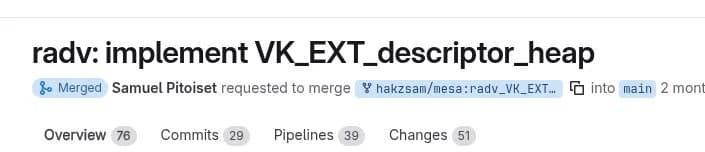
After two months of review, the Mesa Radeon Vulkan driver "RADV" has merged its initial support for the VK_EXT_descriptor_heap Vulkan extension, marking a significant milestone for Linux gaming through Steam Play. Samuel Pitoiset of Valve's Linux graphics team, a prolific RADV contributor, authored this support that's now ready for Mesa 26.1.
The VK_EXT_descriptor_heap extension, introduced with Vulkan 1.4.340 in January, represents a collaborative effort between Valve, NVIDIA, AMD, Google, and other industry players. This extension enables explicit management of descriptors and the memory used to store them, addressing limitations discovered with the earlier VK_EXT_descriptor_buffer extension. The result promises more portable guarantees and more predictable performance characteristics across different hardware implementations.
NVIDIA already implemented descriptor heap support in their R595 Linux driver, and now AMD Radeon is catching up with this Mesa 26.1 integration. However, the feature isn't enabled by default yet. Pitoiset explained in the merge request that "It's not yet enabled by default because it's quite a big extension and I expect bugs because test coverage isn't very good. It will be enabled by default in one or two Mesa releases when it's more stable."
For enthusiasts wanting to test the feature immediately, Mesa 26.1-devel as of today allows enabling descriptor heap support using the RADV_EXPERIMENTAL=heap environment variable. This experimental flag gives early adopters and developers the opportunity to test and provide feedback before the feature becomes stable.
The timing of this integration aligns well with ongoing work in the Steam Play ecosystem. DXVK merged its VK_EXT_descriptor_heap usage back in February specifically to address small performance regressions. Meanwhile, VKD3D-Proton has a draft pull request for descriptor heap usage, indicating that the entire Linux gaming translation stack is moving toward this more efficient descriptor management approach.
RADV's implementation has already been tested against both DXVK and VKD3D-Proton codebases, ensuring compatibility with the two primary translation layers that enable Windows games to run on Linux through Steam Play. This testing is crucial since descriptor heap support affects how these translation layers interact with the GPU driver at a fundamental level.
The significance of this development extends beyond just technical improvements. Descriptor heaps represent a more efficient way to manage GPU resources, which can translate directly into better frame rates and reduced stuttering in games running through Steam Play. For Linux gamers who have long contended with performance gaps compared to native Windows gaming, these incremental improvements in the graphics stack add up to meaningful real-world benefits.
As Mesa 26.1 approaches its release, the descriptor heap support will likely see increased testing from the community. The experimental flag provides a safe way for interested users to participate in this testing without affecting the default driver behavior for those who prefer stability. This staged rollout approach is typical for significant driver features, allowing developers to gather real-world usage data before enabling the feature by default.
The collaboration between hardware vendors, middleware developers, and the open-source community exemplified by this work demonstrates the maturing Linux gaming ecosystem. With major players like Valve, AMD, and NVIDIA all contributing to and benefiting from these improvements, Linux gaming continues to close the gap with other platforms while maintaining the stability and flexibility that open-source development provides.
For Steam Play users, this development represents another step toward parity with native gaming performance. While the feature remains experimental for now, its eventual stabilization and default enablement will provide a foundation for more efficient game execution on Linux systems using AMD Radeon hardware.
Comments
Please log in or register to join the discussion