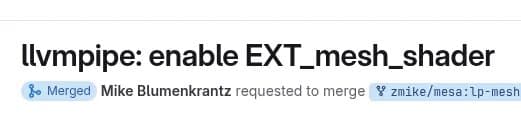
Mesa's LLVMpipe software driver now supports mesh shaders and task shaders through the EXT_mesh_shader extension, bringing CPU-based OpenGL implementations up to par with hardware drivers.
Mesa's LLVMpipe software driver has gained support for mesh shaders and task shaders through the EXT_mesh_shader extension, marking a significant milestone for CPU-based OpenGL implementations. The feature, which landed in Mesa 26.1 after five months of development, brings LLVMpipe's capabilities closer to those of hardware-accelerated drivers.
Mesh shaders represent a fundamental shift in how geometry processing works in modern graphics pipelines. Rather than relying on the traditional vertex processing pipeline, mesh shaders allow developers to create and manipulate geometry directly on the GPU using programmable shaders. This approach offers greater flexibility and can lead to more efficient rendering for certain types of scenes and effects.
Mike Blumenkrantz of Valve's Linux graphics driver team spearheaded the implementation, which began as non-working code in a merge request five months ago. The extension, EXT_mesh_shader, was added to the OpenGL Registry in October 2025 as a cross-vendor solution, providing a standardized way for developers to access mesh shader functionality across different implementations.
The timing of this addition is noteworthy, as Mesa 26.0 already saw RadeonSI, AMD's OpenGL driver for their hardware, gain mesh shader support. Now with LLVMpipe catching up in version 26.1, both software and hardware implementations within Mesa offer comparable feature sets for developers working with mesh shaders.
In addition to the mesh shader functionality, the merge also addressed an oversight in LLVMpipe's GLSL version reporting. The software driver now exposes GLSL 4.60, whereas previously it only advertised GLSL 4.50. Blumenkrantz noted in the commit message, "not sure why this was missing," suggesting the version bump was an unintentional gap that has now been corrected.
For developers and users working with CPU-based graphics rendering, this update means LLVMpipe can now handle applications and games that rely on mesh shader functionality. While software rendering will never match the performance of hardware acceleration, having feature parity ensures that applications can fall back gracefully when hardware support isn't available or when debugging shader code.
The EXT_mesh_shader extension works in conjunction with task shaders, which allow for even more control over how work is distributed across the GPU. Together, these features enable advanced rendering techniques that were previously difficult or impossible to implement efficiently in traditional OpenGL pipelines.
LLVMpipe, being a software rasterizer that uses LLVM for just-in-time compilation of graphics operations, serves multiple purposes within the Mesa ecosystem. It provides a reference implementation for new OpenGL features, enables testing on systems without appropriate hardware drivers, and offers a fallback option for compatibility. With mesh shader support now available, LLVMpipe continues to fulfill these roles while maintaining feature parity with hardware drivers.
This development also highlights the ongoing collaboration between different parts of the Mesa project and the broader open-source graphics community. The mesh shader work builds upon the foundation laid by the cross-vendor extension effort, demonstrating how standardized approaches can benefit the entire ecosystem.
For users interested in testing LLVMpipe with mesh shader support, the feature is available in Mesa 26.1 and later versions. As with any software rendering implementation, performance will vary significantly based on CPU capabilities, but the feature is now there for applications that require it.
The addition of mesh shaders to LLVMpipe completes another piece of the puzzle in Mesa's quest to provide comprehensive OpenGL support across both software and hardware implementations. As graphics APIs continue to evolve with features like mesh shaders becoming more prevalent, having robust software fallbacks ensures that the open-source graphics stack remains versatile and capable.
Comments
Please log in or register to join the discussion