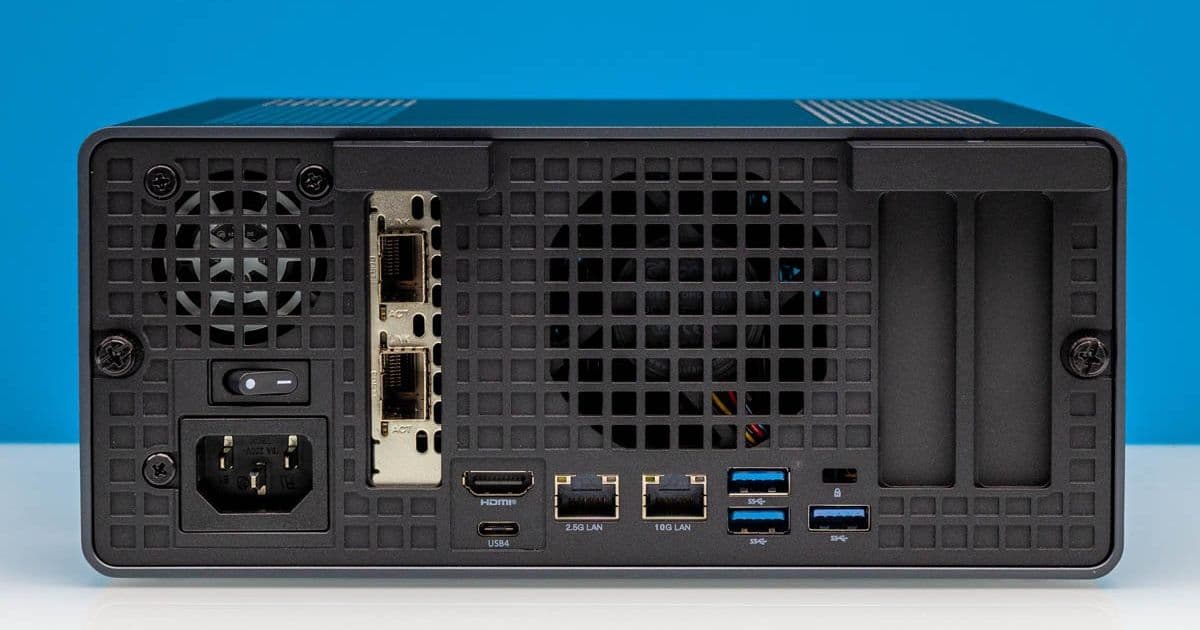
Minisforum's MS-02 Ultra packs Intel's 285HX, dual 25GbE, and PCIe expansion into a 4.8L powerhouse that redefines SFF performance.
Over the past 18 months, mini-PC vendors have raced to capture the AI development market, each offering their take on compact systems designed for machine learning workloads. Minisforum, already competing with their Ryzen AI Max-based MS-S1 Max, now takes a different approach with the Intel-powered MS-02 Ultra—a modular, discrete system that pushes small form factor boundaries.
Minisforum MS-02 Ultra Key Specs (As Configured)
- Processor: Intel Core Ultra 9 285HX (5.5GHz)
- OS: Windows 11 Pro
- Memory: 64GB SO-DIMM DDR5-4800 (2x32GB)
- Storage: 1TB PCIe 4.0 M.2 2280 SSD
- GPU: Intel Arc Graphics (Xe-LPG, 4 cores)
- PSU: 350W Internal
- Form Factor: Mini-PC (4.8L)
- Dimensions: 222 x 225 x 97 mm
- Weight: 3.45kg (7.6 lbs)
- Wireless: Wi-Fi 7 (2×2) + Bluetooth 5.4
- Ports: Extensive I/O including dual 25GbE SFP28
The MS-02 Ultra officially succeeds the popular MS-01, but this isn't just a spec bump. At nearly three times the volume, it's a complete redesign focused on expandability and performance that truly earns its "Ultra" designation.
External Hardware Overview
Minisforum's new chassis design is dictated by half-height PCIe card support. While the MS-01 accommodated one horizontal card, the MS-02 Ultra fits three cards vertically, requiring significant vertical clearance for both the cards and Intel desktop-class hardware.
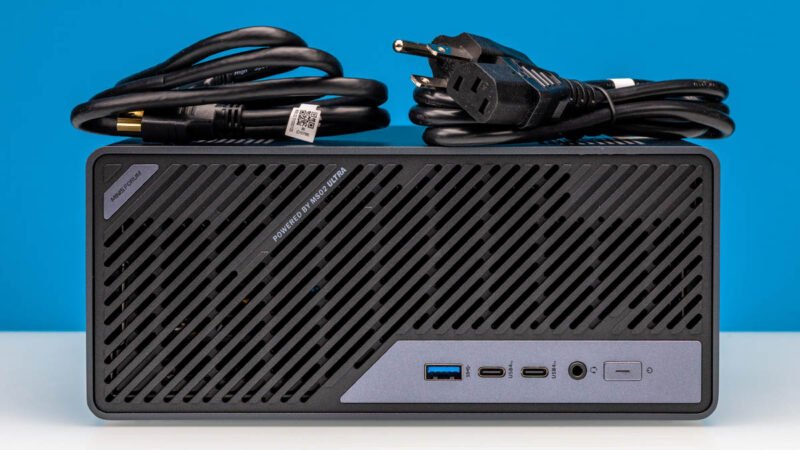
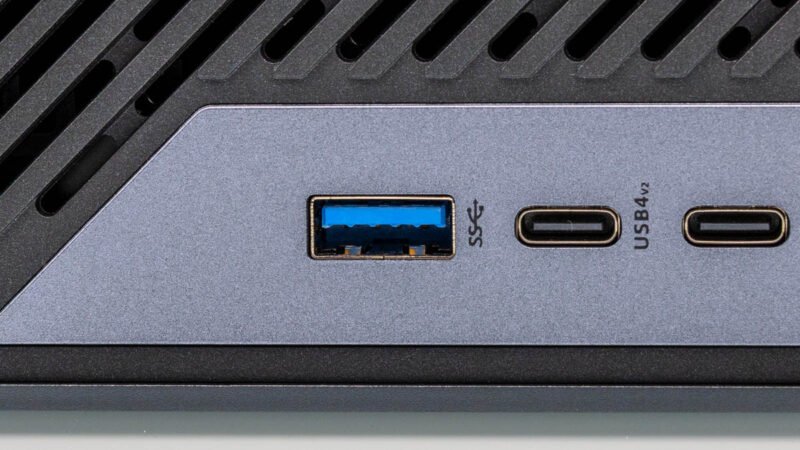
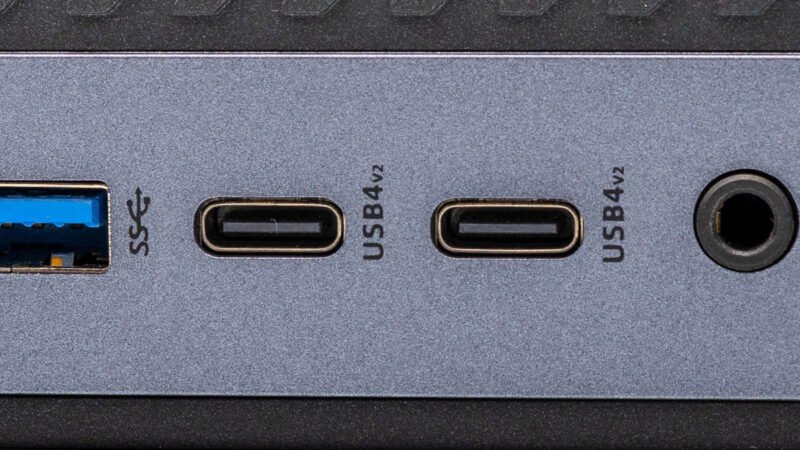
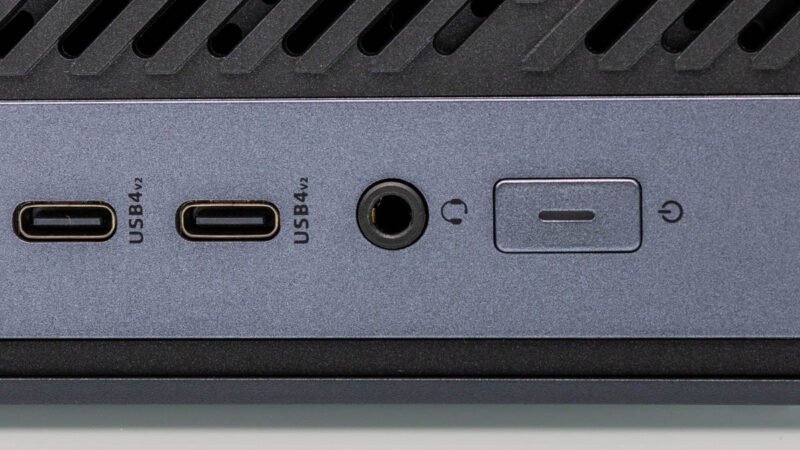
Front expansion is minimal but powerful: a single USB-A 10Gbps port and two USB-C 80Gbps ports. These USB-C ports are particularly noteworthy—they're USB4 v2 ports driven by Intel's JHL9580 Thunderbolt 5 controller. While not officially Thunderbolt 5 certified, they support all major features including PCIe tunneling, 15W power delivery, and Thunderbolt networking.
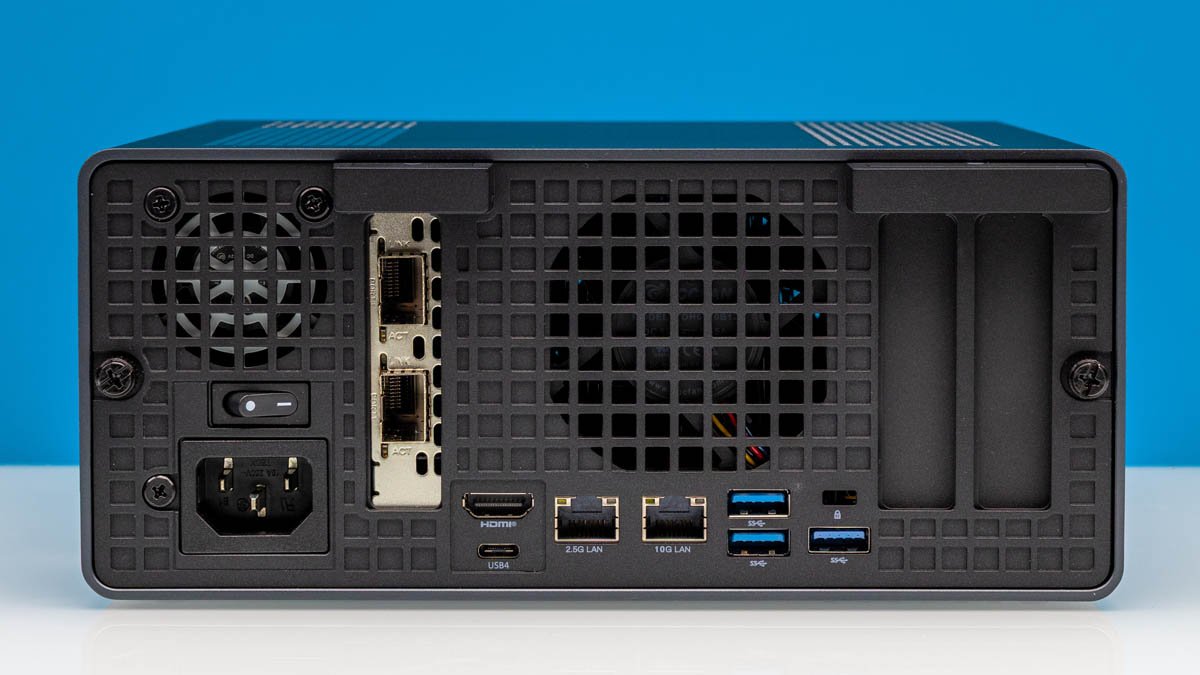
The system supports both horizontal and vertical orientations with rubber feet for each configuration. The rear panel reveals the extensive I/O: three USB-A 10Gbps ports, a 40Gbps USB-C port (with DisplayPort alt mode), HDMI 2.1 output, and the networking crown jewel—dual 25GbE SFP28 ports on the 285HX model.
Networking options are comprehensive: a 2.5GbE port via Intel i226-LM, a budget-friendly 10GbE port via Realtek RTL8127, and the aforementioned dual 25GbE SFP28 ports via Intel E810 controller. This networking firepower, combined with ECC memory support on the 285HX, positions the MS-02 Ultra squarely at AI developers and home lab enthusiasts who need serious bandwidth.
The 350W internal PSU marks another major upgrade over the MS-01's external adapter, though it consumes valuable internal space.
PCIe Expandability
Two unoccupied PCIe slots behind blank brackets provide room for modern video cards. The dual-slot bay accommodates newer dual-slot cards, with the blower facing an external vent for optimal cooling. This expandability comes at the cost of size—the MS-02 Ultra is significantly larger than its predecessor, but the trade-off enables workstation-level performance in a still-compact package.
MS-02 Ultra vs MS-S1 Max
Side-by-side, these systems serve different purposes. The MS-S1 Max excels at AI workloads with its integrated NPU, while the MS-02 Ultra functions better as a traditional server node or desktop workstation. Both can handle AI tasks—our MS-S1 Max currently serves OpenClaw Agents with a Qwen3-Coder-Next model—but the MS-02 Ultra's traditional desktop/server orientation makes it more versatile for general use.
The MS-02 Ultra represents a significant evolution in SFF computing, offering workstation-class features in a package that, while larger than typical mini-PCs, remains remarkably compact for its capabilities. For home lab builders and AI developers who need serious horsepower without sacrificing desk space, it's a compelling option that redefines what's possible in small form factor systems.
Comments
Please log in or register to join the discussion