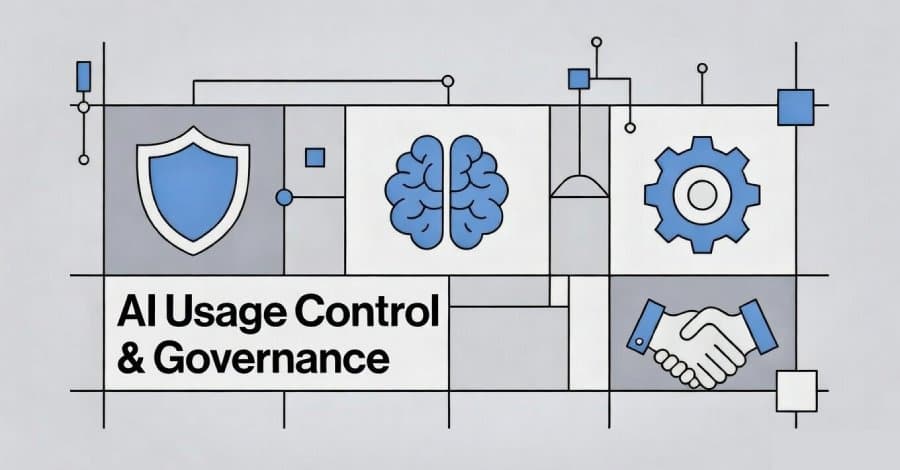
As organizations allocate significant budgets for AI security, many lack the structured requirements needed to evaluate solutions effectively. A new RFP template provides a technical framework to move from vague 'AI security' goals to specific, measurable criteria for AI Usage Control solutions.
As artificial intelligence becomes the central engine for enterprise productivity, security leaders are finally receiving approval and budget to secure these systems. However, a significant challenge has emerged: many organizations recognize they need "AI Governance" but lack clarity on what specific capabilities they should be evaluating in potential solutions.
The result is a quiet crisis in boardrooms worldwide, where security teams risk investing in legacy tools never designed for the age of agentic workflows and shadow browser extensions. To address this gap, a new RFP Guide for Evaluating AI Usage Control and AI Governance Solutions has been released, providing security architects and CISOs with a technical framework to transform abstract security goals into concrete evaluation criteria.
The Shift from App Proliferation to Interaction Governance
Traditional security approaches focus on cataloging every application employees touch, but this strategy is fundamentally inadequate for AI environments. With over 500 new GPT-based tools launching weekly, attempting to secure every AI application is a losing battle.
The new RFP framework proposes a paradigm shift: AI security isn't an "app" problem; it's an interaction problem. By focusing on the precise moment a prompt is typed or a file is uploaded rather than the applications themselves, organizations can gain tool-agnostic control over their AI environments.
"The conventional wisdom says that to secure AI, you need to catalog every application your employees touch. This is a losing battle," explains the framework. "If you focus on the interaction (i.e., the moment a prompt is typed or a file is uploaded) you gain control that is tool-agnostic."
This approach allows security teams to stop being innovation bottlenecks and become guardians of data, regardless of which "Shadow AI" tools departments discover and adopt.
Why Current Security Stacks Fall Short for AI
Many vendors claim to offer "AI security" as a checkbox feature within existing CASB (Cloud Access Security Broker) or SSE (Security Service Edge) solutions. The RFP guide helps organizations see through this marketing by highlighting critical limitations:
Network-layer blindness: Most legacy tools rely on network visibility, which cannot detect activities within browser-side panels or encrypted IDE plugins.
Inadequate coverage: These solutions often fail to detect AI usage in Incognito mode or support "AI-native" browsers like Atlas, Dia, or Comet.
Identity confusion: Legacy systems struggle to distinguish between corporate and personal identities within the same session.
The framework forces vendors to answer these challenging questions, preventing "feature-wash" by requiring them to prove they can operate at the point of interaction without requiring heavy endpoint agents or disruptive network changes.
The 8 Pillars of Effective AI Governance
The RFP template provides a technical grading system across eight critical domains to ensure selected solutions are future-proof:
AI Discovery & Coverage: Evaluates visibility across browsers, SaaS platforms, extensions, and IDEs to ensure comprehensive detection.
Contextual Awareness: Assesses whether the tool understands who is making requests and why, enabling appropriate policy enforcement.
Policy Governance: Tests the ability to implement nuanced controls, such as blocking PII while allowing benign data summaries.
Real-Time Enforcement: Measures the solution's capacity to prevent data leaks before the "Enter" key is pressed.
Auditability: Evaluates the quality and compliance-readiness of reporting for board and regulatory requirements.
Architecture Fit: Assesses deployment feasibility without requiring extensive network reconfiguration.
Deployment & Management: Determines the operational burden on IT staff and ongoing management requirements.
Vendor Futureproofing: Evaluates readiness for autonomous, agent-driven workflows that represent the next evolution of AI technology.
Moving Beyond Subjective Evaluations
Unlike traditional RFPs that often rely on yes/no answers, this framework requires vendors to provide detailed explanations of how their solutions work and offer references to support their claims. This structured approach transforms subjective procurement decisions into objective, score-based comparisons of how vendors handle real-world risks like prompt injections and unmanaged BYOD environments.
"The goal of this RFP isn't just to gather data; it's to grade it," the framework explains. "This level of structure takes the guesswork out of procurement. Instead of a subjective 'feeling' about a vendor, you get a score-based comparison of how they handle real-world risks."
For security professionals tasked with protecting AI systems, this template represents a critical resource. It enables organizations to define their requirements proactively rather than having the market define them reactively. By using this structured approach, security teams can standardize their evaluations, accelerate research, and ultimately implement AI governance frameworks that scale with business needs.
As AI continues to permeate enterprise operations, the ability to govern these systems effectively will separate organizations that leverage AI securely from those that face increasing security and compliance risks. This RFP template provides the foundation for building that governance capability from the ground up.
Comments
Please log in or register to join the discussion