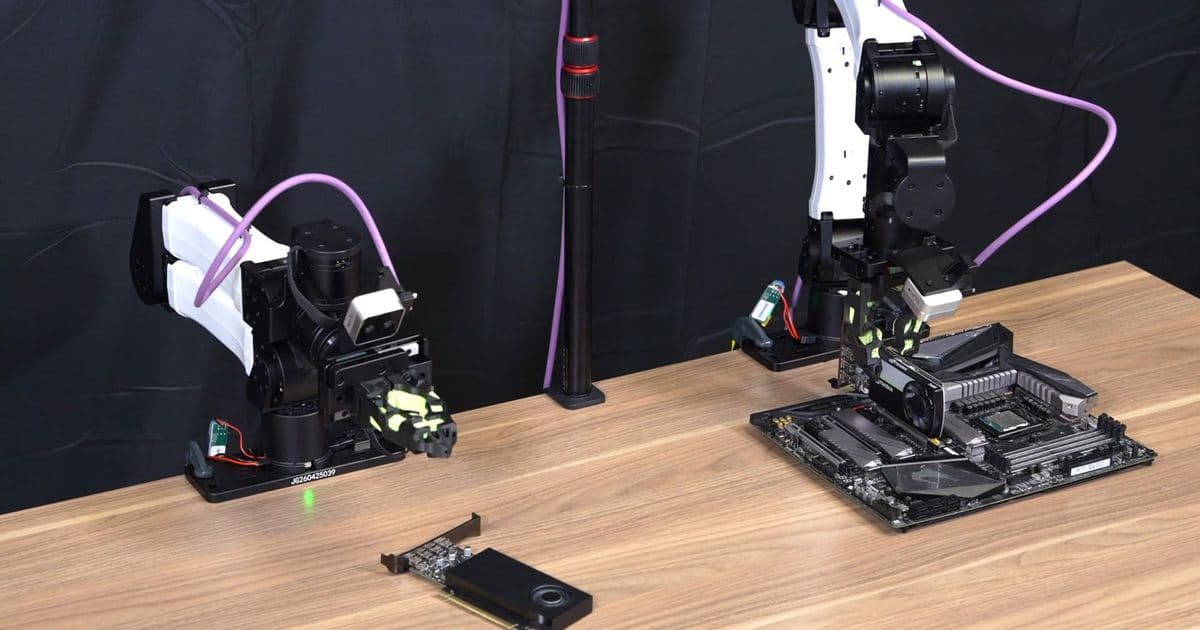
Nvidia's ENPIRE demo gives coding agents robot arms, GPUs and a token budget, then has them train hardware policies through real-world trials.
Nvidia showed a research system that lets AI coding agents train robot arms on high-precision hardware tasks, including graphics card installation, pin sorting and zip tie cutting.
The company calls the system ENPIRE, short for Environment, Policy Improvement, Rollout and Evolution. Nvidia researchers designed it as a feedback loop for physical automation: agents test robot policies on real hardware, review logs, revise code and run the task again. Nvidia Director of AI and Distinguished Scientist Jim Fan said the project can “enable AutoResearch in the physical world.”
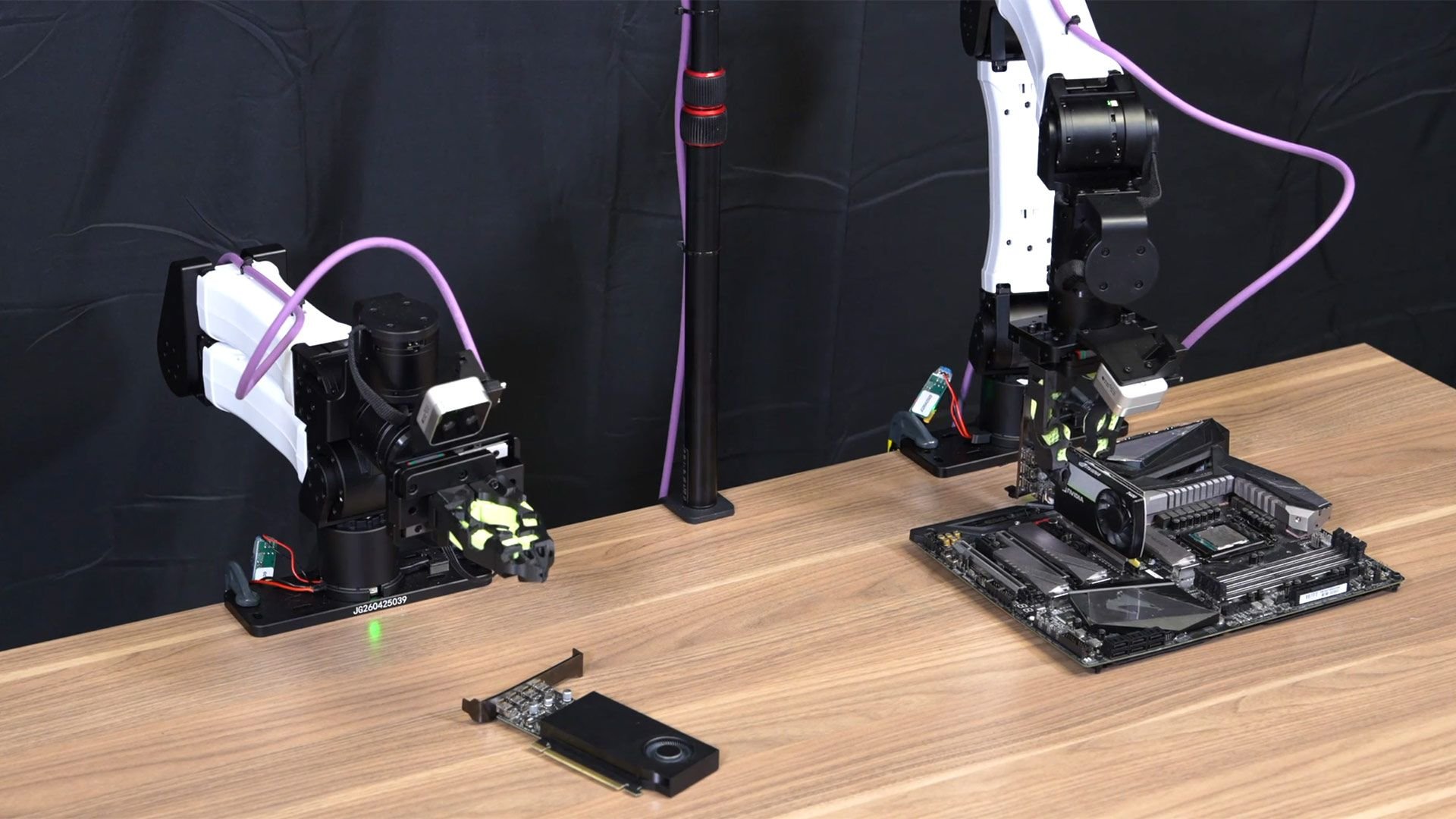
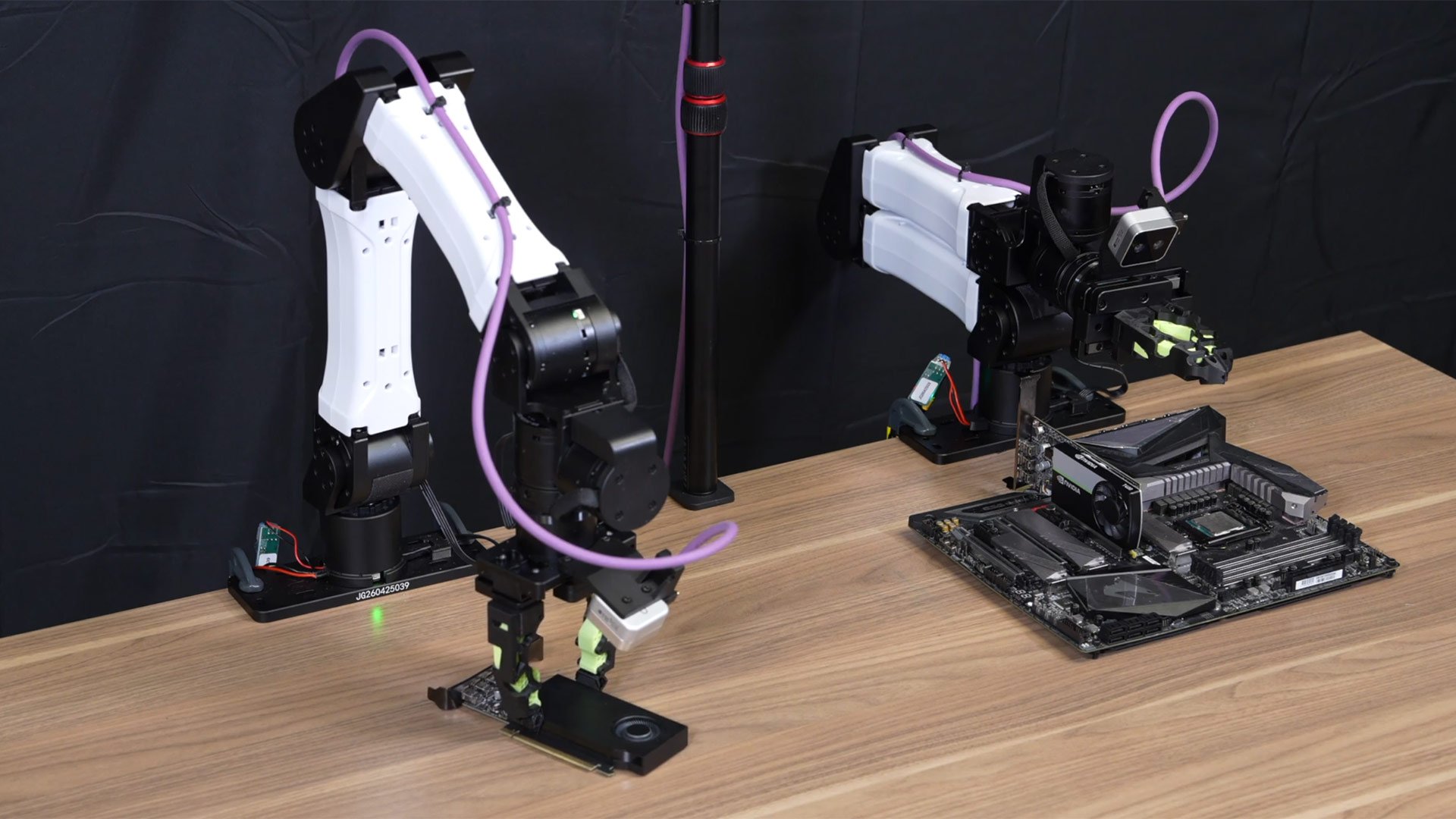
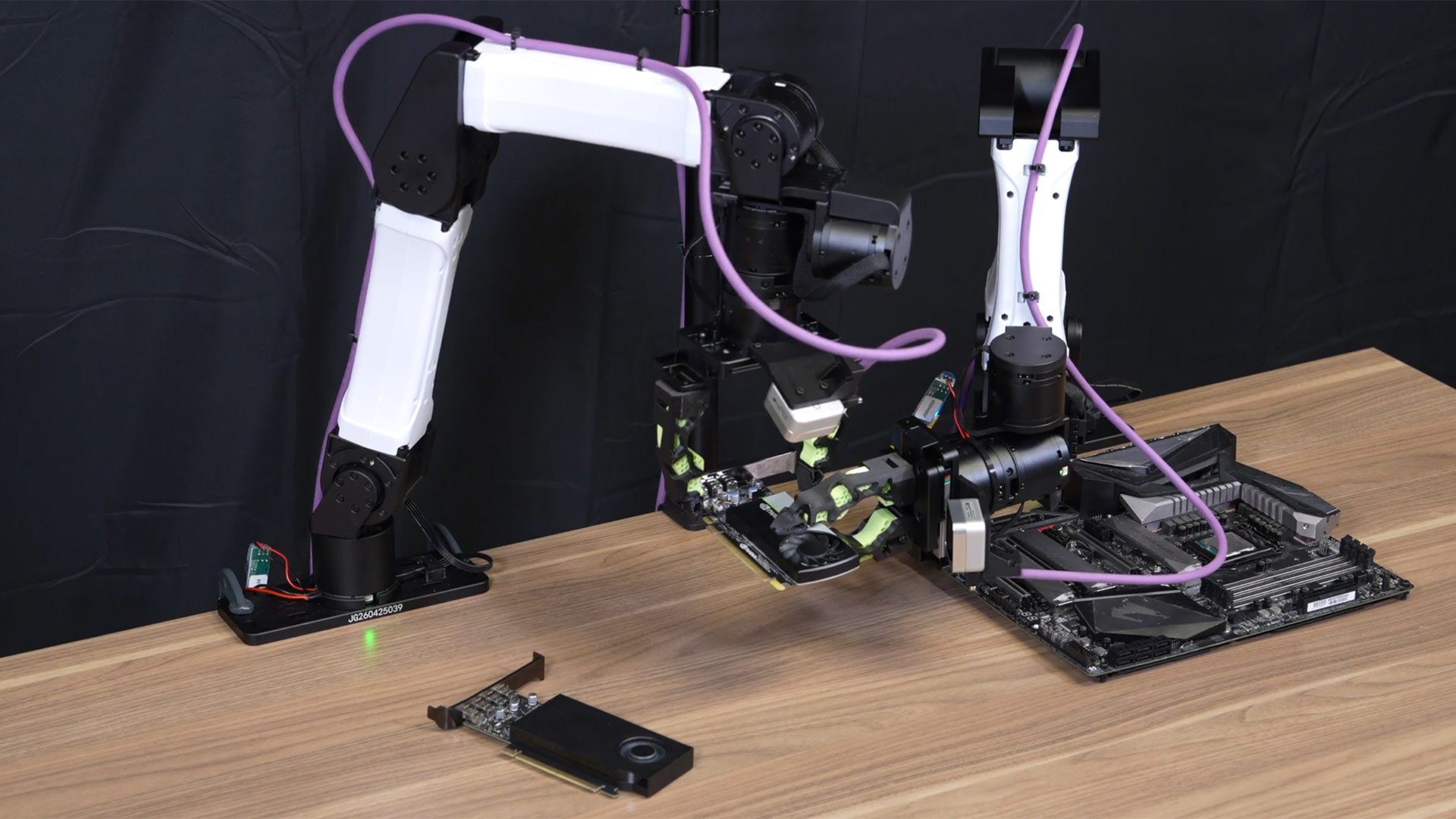
The GPU installation clip gives the demo its clearest supply chain hook. One robot arm picks up a graphics card and passes it to a second arm positioned in front of a motherboard. The second arm lines up the PCIe connector, lowers the card into the slot and presses it into place.
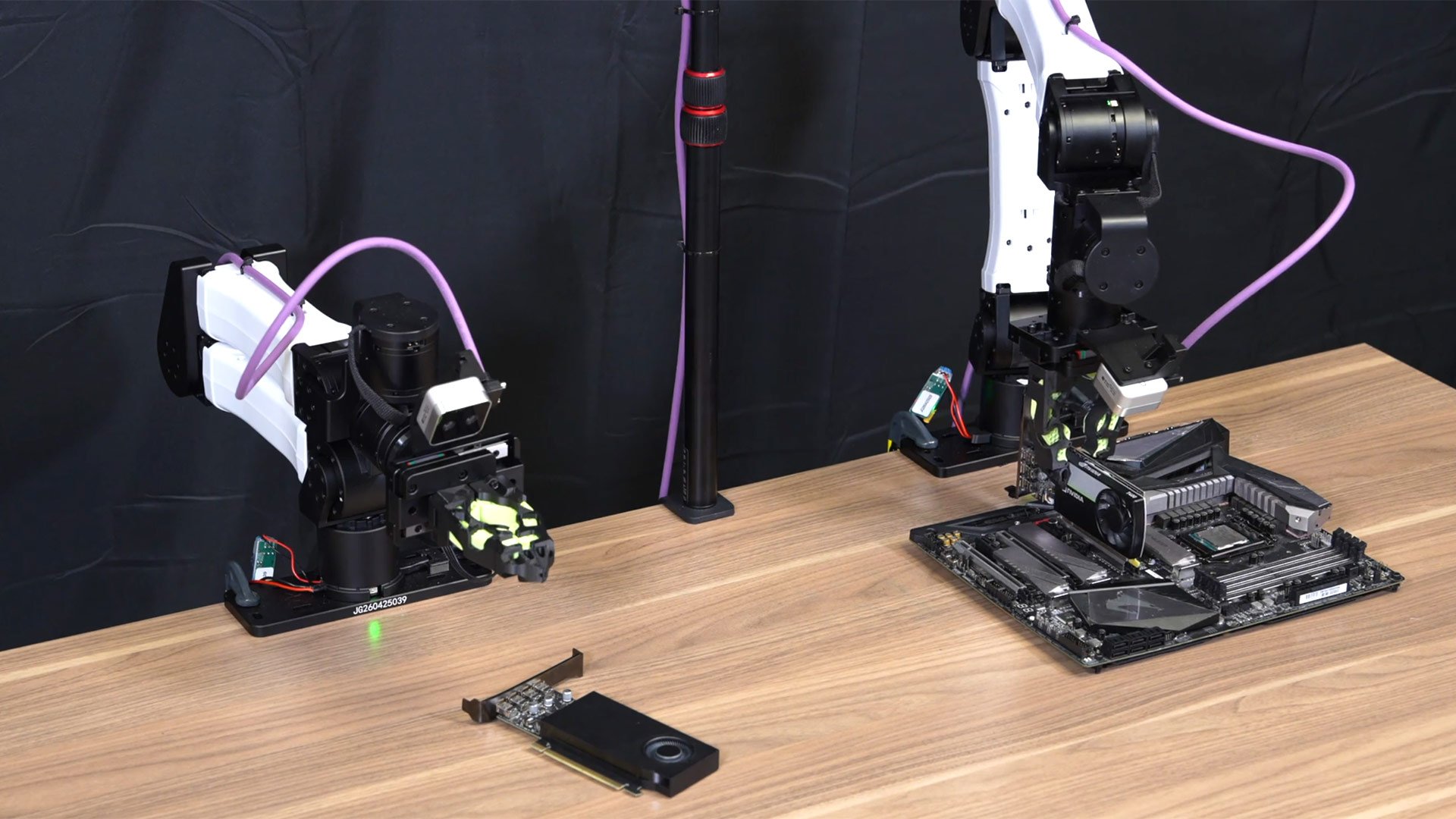
That task stresses more than motion planning. A robot has to identify the board and slot from camera input, estimate the card's pose, control insertion force and recover from small alignment errors. Human builders handle that mix through sight, touch and experience. Nvidia's demo asks software agents to build a workable control policy through repeated runs.
The ENPIRE architecture matters because Nvidia framed the system as a harness for coding agents, not a fixed robotics script. The researchers used an Environment module for reset and verification. They used a Policy Improvement module to generate policy changes. They used a Rollout module to test robot behavior on one arm or a fleet. They used an Evolution module so agents could study logs, consult research papers and change training code.
The source report says Nvidia gave eight Codex agents a robot fleet, GPU access and a token budget, then asked them to solve tasks with speed and accuracy. Fan said the agents learned to look for visual clues, reset scenes, practice skills, inspect failure modes and test changes on hardware.
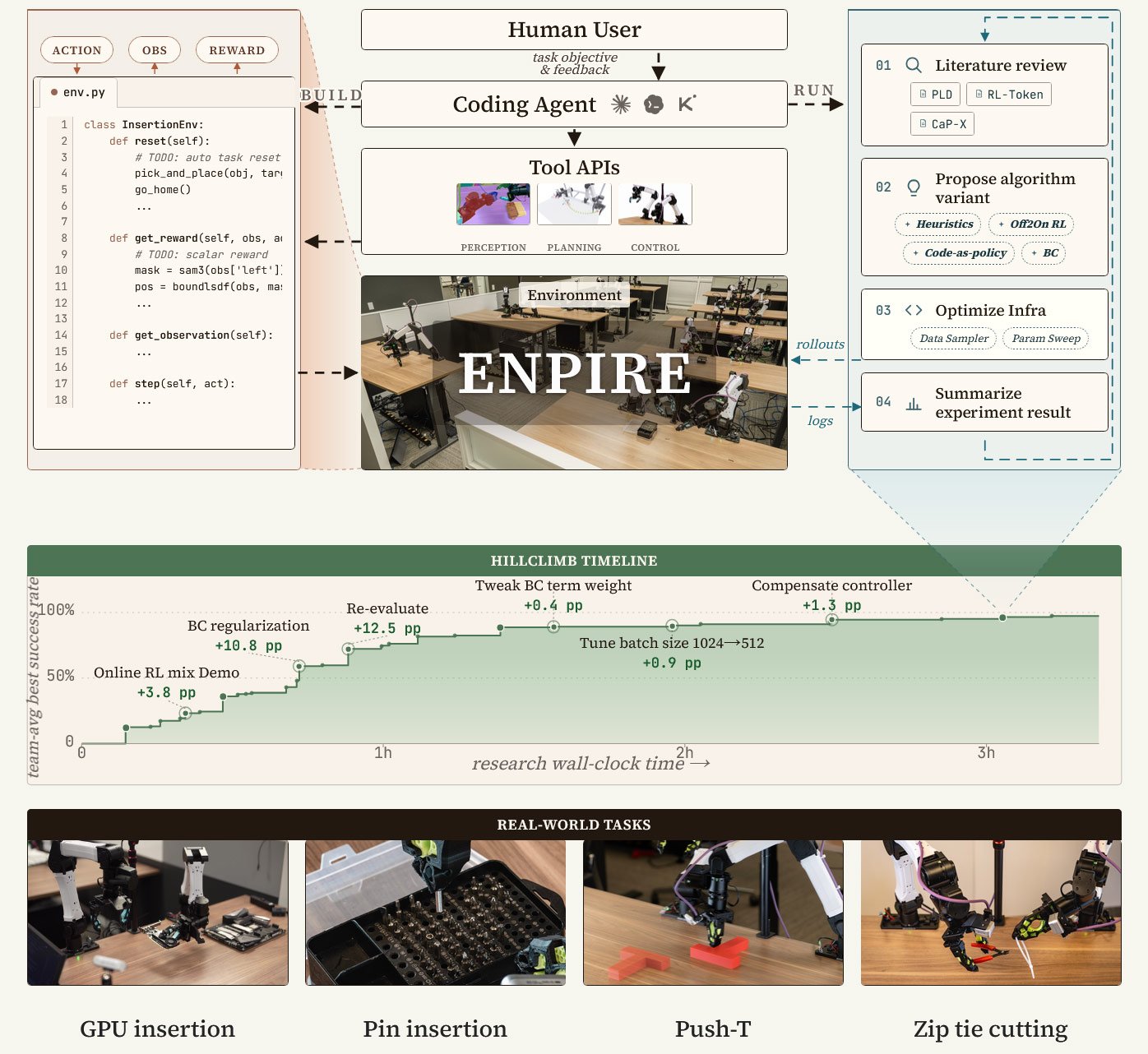
That setup mirrors the way AI labs have used coding agents for software work. A code agent can run tests, read stack traces, edit files and try again. ENPIRE gives the agent an equivalent loop in the physical world: run the robot, capture failures, change the policy and run another trial.
Hardware makes the loop harder. A failed software test costs seconds. A bad robot motion can bend a PCIe connector, knock parts off a board or damage a gripper. The reset system therefore carries much of the technical burden. Researchers need the robot to return parts to a known state, verify the scene and record enough sensor data for the agent to choose a useful change.
The demo also shows why Nvidia cares about fleet scale. The associated paper, according to the report, compares agent systems including Codex with GPT-5.5, Claude Code with Opus 4.7 and Kimi Code with Kimi K2.6. The researchers found that eight robots solved the task faster than smaller fleets because the agents could test more policy variants in parallel.
That point connects robotics research to semiconductor manufacturing. GPU and server assembly depend on repeatable handling of expensive parts, tight connector tolerances and fast production ramps. Contract manufacturers have automated many steps, but dexterous tasks still pull humans into the line because parts vary and fixtures change.
AI-trained robots could reduce that gap if researchers can prove the system outside demos. A plant that builds GPU servers needs robots that handle tray assembly, cable routing, connector seating, inspection and rework. Each station has different parts, tooling and failure modes. A coding-agent loop could help engineers retune automation without writing each behavior from scratch.
Nvidia also has a direct platform interest. The company sells GPUs, robotics software and simulation tools through its robotics business. A system such as ENPIRE strengthens the case for more GPUs inside robot training loops, especially when teams run many agents and many rollouts at once.
The market effect would reach beyond Nvidia's own labs. Server makers and electronics manufacturers spend heavily on automation, but they still face long commissioning cycles when a product changes. If robot policies can improve through controlled trial runs, manufacturers could shorten ramp time for new AI servers, workstation boards and edge devices.
The constraint sits in verification. Engineers need proof that a robot inserted the GPU with correct seating depth, correct force and no hidden connector damage. Visual checks help, but manufacturers may need force traces, electrical tests and post-insertion inspection before they trust the process at production speed.
Nvidia's demo points toward a factory model where software agents help engineers tune physical work cells. Humans still define the task, set safety limits and decide acceptable yield. The agents explore control policies within those limits, and the robot fleet turns each attempt into data.
That combination could matter for AI hardware supply. Nvidia, AMD and custom accelerator vendors keep pushing larger boards, denser racks and tighter power delivery. Assembly partners must place expensive components with less room for error. A robot that learns insertion, sorting and cable tasks can help those partners raise throughput without waiting for a full mechanical redesign.
Tom's Hardware covered the demo in its report on Nvidia's ENPIRE research, and Nvidia's broader robotics materials sit on the company's official site. The core claim from the demo remains narrow but important: coding agents can improve robot behavior through real-world feedback, and Nvidia has now shown that loop on a task PC builders understand.
Comments
Please log in or register to join the discussion