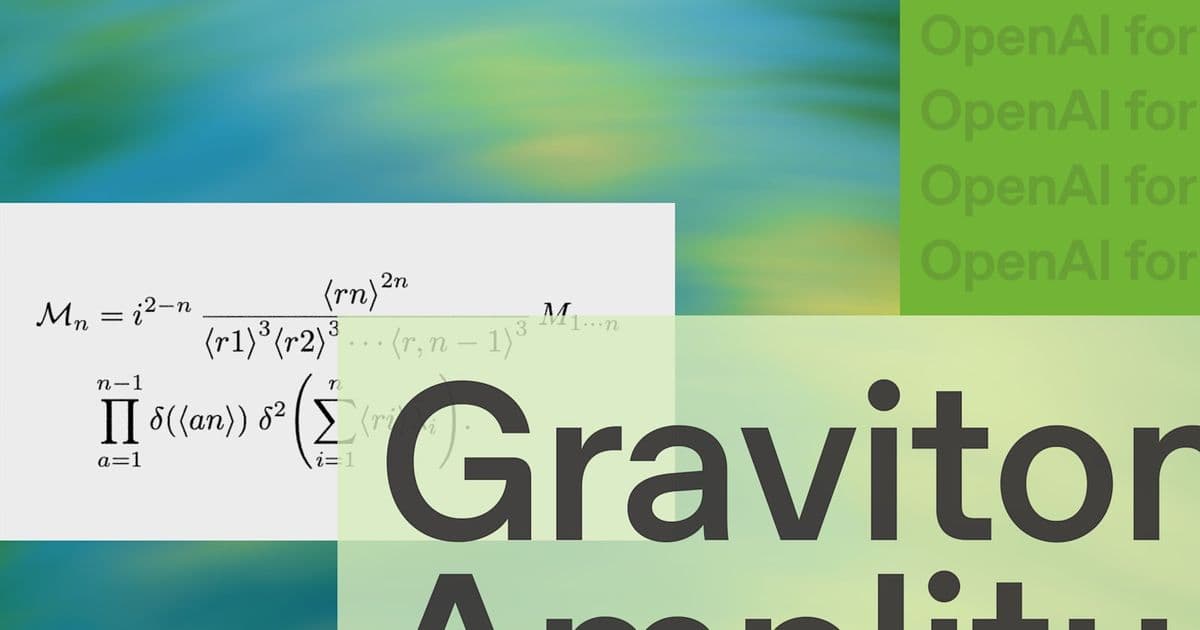
OpenAI researchers used GPT-5.2 Pro to extend recent gluon amplitude results to gravitons, discovering that certain particle interactions previously thought to vanish actually exist under specific conditions.
Researchers at OpenAI have published a new preprint demonstrating how their GPT-5.2 Pro model contributed to a mathematical discovery in quantum gravity theory. The work extends recent findings about gluon interactions to gravitons, showing that certain particle interactions previously assumed to vanish can actually occur under specific kinematic conditions.
The paper, titled "Single-minus graviton tree amplitudes are nonzero," was authored by Alfredo Guevara (Institute for Advanced Study), Alexandru Lupsasca (Vanderbilt University and OpenAI), David Skinner (University of Cambridge), Andrew Strominger (Harvard University), and Kevin Weil (OpenAI).
Understanding the Physics Behind the Discovery
Scattering amplitudes are fundamental mathematical quantities in physics that describe the probability of particles interacting in specific ways. Rather than tracking every intermediate step of particle collisions through complex diagrams, amplitudes provide a compact way to encode final observable outcomes.
This research focuses on gravitons - the hypothetical quantum particles associated with gravity in quantum field theory. The team studied a configuration called a "single-minus amplitude," where one particle has negative helicity while all others have positive helicity. Helicity describes the orientation of a particle's spin relative to its direction of motion.
Standard physics textbooks suggest these amplitudes should vanish at tree level - the simplest approximation where only direct interaction diagrams are considered and quantum loop effects are ignored. However, the researchers found this conclusion depends on assuming generic particle motion.
When particle momenta satisfy a special alignment known as the "half-collinear regime," the usual argument breaks down. In this regime, the amplitudes don't vanish but instead exist as well-defined mathematical distributions supported on a restricted region of momentum space.
The authors derived explicit formulas describing these interactions and showed they follow from symmetry principles and recursion relations that build complex interactions from simpler ones.
GPT-5.2 Pro's Role in the Discovery
After the team completed their earlier work on gluon amplitudes, they provided that paper to GPT-5.2 Pro as context. Using it as a reference point, the model was asked to construct the corresponding amplitudes in quantum gravity - an extension that would have taken human authors considerable time to derive.
The model not only solved this problem but employed a "beautiful and surprising technique" called the directed matrix-tree theorem. GPT-5.2 Pro also produced an excellent preliminary draft of the paper.
You can find a transcript of this initial exchange here (opens in a new window).
Verification and Mathematical Rigor
The derivation combined several established tools in amplitude theory, including recursion relations that iteratively construct many-particle interactions from smaller building blocks and symmetry constraints that restrict the allowed form of the results.
The final formulas were verified analytically and checked for consistency with known physical limits. Further interaction with GPT-5.2 Pro revealed that the amplitudes were also consistent with an infinite-dimensional symmetry first studied in connection with gravity by Roger Penrose.
Implications for Quantum Gravity Research
This result represents a small but significant step toward reconciling quantum mechanics with Einstein's theory of general relativity - one of the central unsolved problems in theoretical physics. The single-minus amplitudes realize an infinite-dimensional "w-(1+∞)" symmetry that Penrose discovered half a century ago in the context of classical gravity.
Many physicists expect this symmetry to play a central role in quantizing the gravitational field. The new preprint shows how, in the simplest possible context, this symmetry acts on gravitons - the elementary quantum bits of the gravitational field.
A Shift in Research Methodology
An important observation emerging from this work concerns the pace of discovery. For this project, much of the time elapsed from the previous gluon result was spent confirming derivations, checking consistency, and preparing formal write-ups rather than generating initial conjectures.
This represents a significant shift in theoretical physics research, with verification and exposition now representing the dominant share of effort. The transition from gluons to gravitons illustrates how mathematical insight can transfer across neighboring areas of theoretical physics.
While the two theories describe different fundamental forces, they share structural features that allow ideas developed in one setting to inform the other. Providing the gluon result as an anchor enabled exploration of this connection, leading to a gravitational construction that was subsequently proven using standard analytic methods.
Looking Forward
Further extensions of these results are currently under investigation. Together with the earlier gluon work, this preprint contributes to an ongoing effort to understand how AI-assisted reasoning can participate in theoretical research while maintaining conventional standards of mathematical verification and scientific rigor.
The research demonstrates that AI models like GPT-5.2 Pro can serve as valuable collaborators in theoretical physics, accelerating the discovery process while still requiring human expertise for verification and formal presentation of results.
Comments
Please log in or register to join the discussion