A fresh leak puts Oppo's iPhone Fold rival on firmer footing, with a 7.6-inch inner screen, a 5.5-inch cover display, and Qualcomm's next flagship silicon reportedly in testing for a Q1 2027 launch.
Oppo's answer to the wide-format foldable race is no longer just a vague rumor. A new leak from well-known tipster Digital Chat Station, posted on Weibo, fills in the spec sheet for a device that has been circulating in whispers since earlier this year, when reports first claimed Oppo was building a book-style foldable specifically to take on Apple's anticipated foldable iPhone.
What the leak says
According to Digital Chat Station, the foldable is well into development and is targeting a Q1 2027 launch. The headline detail is the silicon: the device is reportedly being tested with Qualcomm's upcoming Snapdragon 8 Elite Gen 6, the chipset expected to anchor the next wave of Android flagships. Pairing an unreleased foldable with an unreleased chip lines up neatly with an early 2027 release, since Qualcomm typically introduces its top-tier mobile platform late in the preceding year.
On the display side, the leak points to a 7.6-inch inner panel and a 5.5-inch cover screen. That cover-screen size is the interesting part. A 5.5-inch outer display is wider and more usable than the tall, narrow front panels that defined the first generation of book-style foldables, which is exactly the direction the "wide-format" label implies. The goal is a closed phone that feels closer to a normal handset, and an unfolded tablet that leans more square than letterbox.
Oppo is said to be evaluating panels from both Samsung Display and BOE, a common hedging strategy that lets a manufacturer balance supply, cost, and yield rather than committing to a single source this early. The device's overall design is reportedly similar to Apple's upcoming foldable iPhone, which fits the original framing of this product as a direct competitor.
Why the hinge matters
The leak also claims the foldable will use Oppo's latest-generation crease-minimizing hinge, likely the same system found on the Oppo Find N6. That detail carries real weight for anyone who has used a folding phone. The crease where the flexible panel bends has been the most visible compromise of the form factor since the beginning, and hinge engineering is where most of the meaningful progress has happened.
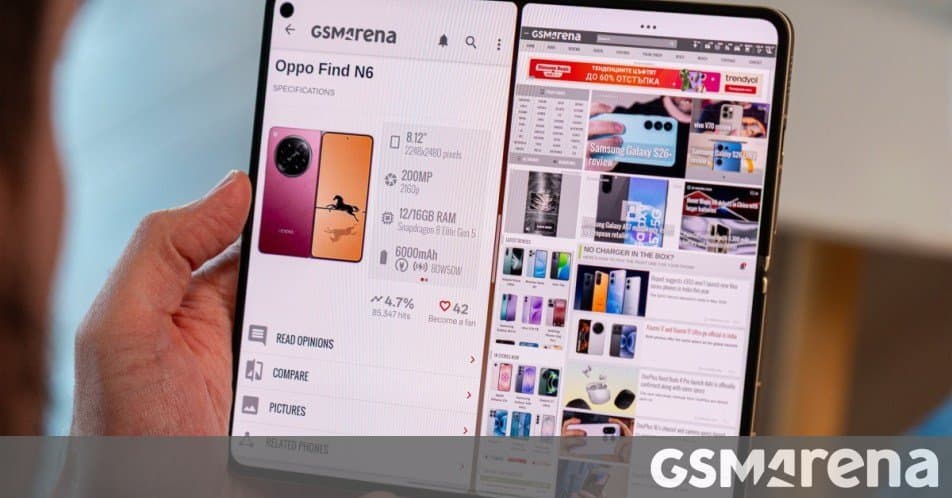
The Find N6 arrived with what Oppo described as a "zero-feel" crease, alongside a 200MP main camera and a 6,000mAh battery, so inheriting that hinge would give the wide foldable a strong mechanical foundation. A flatter fold and a more durable hinge mechanism are the kind of unglamorous improvements that decide whether a foldable feels like a finished product or an expensive experiment.
Branding and ecosystem context
The final name is still up in the air. Recent rumors suggest the device could debut as the Oppo Find N7, slotting it directly into the Find N foldable line as the successor to the current model. Earlier reporting also indicated that vivo, Oppo, and Honor are all working on wide foldables, so Oppo would not be moving alone here. Several Chinese manufacturers appear to be converging on the same wider form factor at roughly the same time, which suggests the category is shifting rather than one company taking a solo gamble.
That timing is the part worth paying attention to. If Apple does ship a foldable iPhone in the same window, buyers will face a familiar decision shaped less by raw specs and more by ecosystem gravity. An iPhone foldable would lock into iMessage, FaceTime, AirDrop, Apple Watch pairing, and the broader Continuity feature set, while an Oppo foldable running ColorOS on Android offers more hardware flexibility, faster charging, and the openness of sideloading and third-party defaults, at the cost of tighter cross-device integration outside China. The Snapdragon 8 Elite Gen 6 would put the Oppo on competitive footing for raw performance, but the choice between these two devices will likely come down to which software world a buyer already lives in.
For now, everything here is a leak, and a Q1 2027 timeline leaves plenty of room for specs to shift before anything is official. The hardware described is concrete and plausible, though, and it points to a foldable built around the parts of the form factor that actually shape daily use: a usable closed-phone front screen, a refined hinge, and current-generation silicon. The remaining question is whether Oppo can land it before, or alongside, Apple's entry, since being early to the wide-format design may matter as much as the spec sheet itself.
Comments
Please log in or register to join the discussion