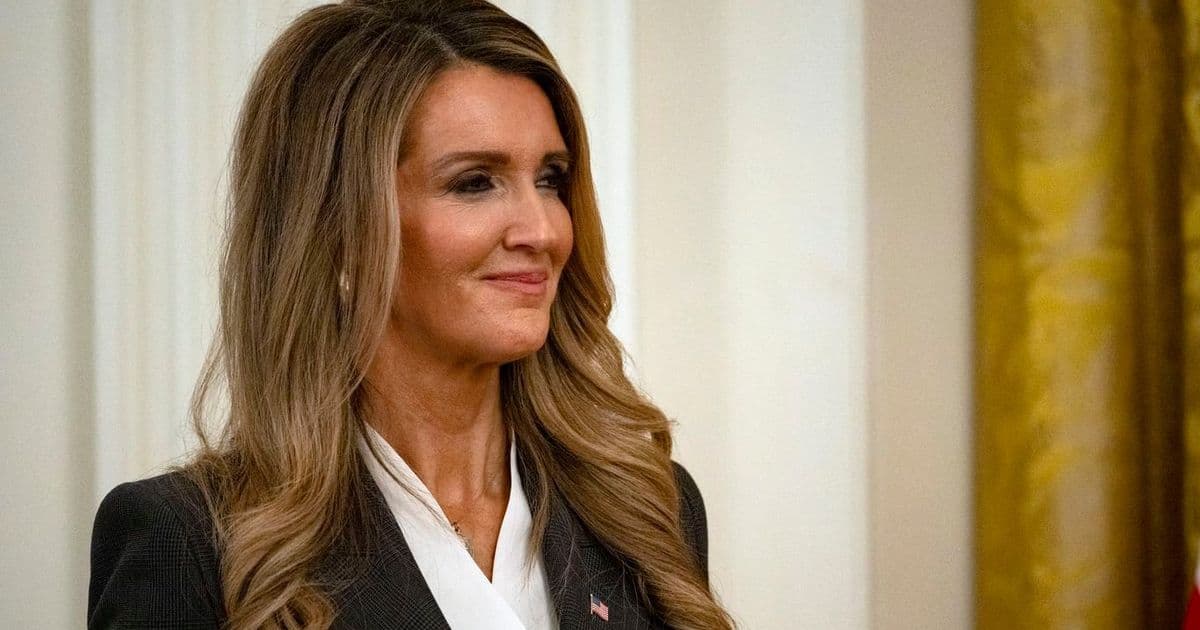
Small Business Administration head Kelly Loeffler is positioning artificial intelligence as the productivity engine for America's roughly 33 million small businesses, a forecast that lands as AI tooling drops in price and lands in the hands of firms that once couldn't afford enterprise software.
Small Business Administration administrator Kelly Loeffler is making a public case that artificial intelligence will become the growth engine for Main Street, signaling where federal small-business policy may steer attention and resources as AI tools move from enterprise budgets into the reach of corner shops and two-person startups.
The prediction matters because of scale. The SBA backs an ecosystem of roughly 33 million small businesses that, by the agency's own accounting, generate close to half of U.S. private-sector employment and a comparable share of GDP. Any productivity shift across that base compounds into national economic numbers. When the head of the agency that guarantees billions in annual lending starts framing AI as a Main Street story rather than a Silicon Valley one, it suggests the technology has crossed from speculative to operational in the eyes of policymakers.
Why the timing lines up
The cost curve is the story underneath the headline. Two years ago, deploying a capable language model meant enterprise contracts and engineering teams. Today a small business can access frontier-class models through metered APIs that charge fractions of a cent per request, or through off-the-shelf subscriptions priced like any other SaaS tool. Tools such as Anthropic's Claude, OpenAI's ChatGPT, and a growing field of vertical applications have collapsed the gap between what a Fortune 500 marketing department and a single-location retailer can each do with automated drafting, customer support, and bookkeeping.
That shift changes the unit economics of running a small firm. A restaurant owner can draft supplier emails, generate social posts, and reconcile invoices with tools that cost less than a single hour of an accountant's time. A contractor can produce bids and scope documents in minutes. The labor that AI substitutes for, administrative overhead, marketing copy, first-line customer service, happens to be exactly the work small businesses have historically struggled to staff. That is the connection Loeffler is drawing: AI does not just make big companies faster, it gives small ones capabilities they previously could not buy.
The market context
The broader numbers support the optimism, with caveats. Spending on generative AI has climbed sharply, and a meaningful slice of that demand now comes from small and mid-sized businesses adopting packaged tools rather than building their own. Payment processors, accounting platforms, and point-of-sale vendors have embedded AI features directly into products that millions of small firms already use, which lowers the adoption barrier to near zero. A merchant using Square or Shopify inherits AI capabilities without ever making a separate buying decision.
The productivity research is still catching up to the rhetoric. Controlled studies have shown double-digit percentage gains for tasks like writing and coding, with the largest improvements going to less-experienced workers. If those findings hold across small-business contexts, the implication is striking: AI would narrow the capability gap between a sole proprietor and a well-staffed competitor. That is a genuinely different distribution of benefits than most prior technology waves, which tended to favor firms large enough to afford the upfront investment.
What it means
For the SBA, framing AI as a small-business catalyst sets up policy follow-through. Expect the agency to lean into training programs, resource guides, and lending criteria that account for AI-driven business models. The agency's network of Small Business Development Centers and SCORE mentors is a natural distribution channel for AI literacy, and prior administrations have used that network to push digital adoption. Loeffler's comments suggest AI fluency could become part of that standard advisory package.
The risks sit in the same place as the opportunity. Small businesses adopting AI without guardrails face exposure on data privacy, customer-facing errors, and overreliance on tools whose pricing and availability they do not control. A firm that builds its customer service around a third-party model is vulnerable to that vendor's price changes or policy shifts, the same dependency risk that has burned businesses reliant on social platform algorithms. Productivity gains are real, but so is the concentration of leverage in the handful of companies that supply the underlying models.
Loeffler's forecast reads as both an economic prediction and a positioning statement. The economic case rests on a defensible premise, that cheap, capable AI lands disproportionately in the hands of the under-resourced, and small businesses are the largest under-resourced cohort in the economy. Whether that translates into measurable Main Street growth will depend on adoption rates, the durability of the cost curve, and how much of the value small firms can capture versus the platforms supplying the tools. For now, the signal from the SBA is clear: the agency sees AI as a small-business story, and it intends to treat it as one.
Comments
Please log in or register to join the discussion