RevenueCat's 2026 report reveals growing disparity in subscription app success, with top performers pulling away while most apps struggle to gain traction.
The subscription app economy is becoming increasingly polarized, with a new report revealing that while more apps than ever are entering the market, the gap between successful apps and the rest is widening dramatically.
RevenueCat's State of Subscription Apps 2026 report paints a stark picture of the current subscription app landscape. The democratization of app development through AI-assisted tools like vibe coding has led to a record number of new app releases in 2025. However, this surge in supply hasn't translated to proportional success across the board.
The Growing Divide
The numbers tell a compelling story about market concentration. The top 25% of apps grew their monthly recurring revenue by 80% year over year, while the elite top 10% saw explosive growth of 306%. This stands in stark contrast to the bottom quartile, which experienced a 33% drop in revenue. Even the middle ground—the remaining 50-75% of apps—only managed a modest 5% gain.
This "increasingly vanishing middle" suggests that the subscription app market is becoming a winner-take-all economy, where a small number of apps capture the majority of revenue growth while the rest struggle to maintain their position.
New App Success Rates Declining
Perhaps most concerning for aspiring app developers is the declining success rate of new apps. In 2024, 19% of all new apps managed to cross the $1,000 per month recurring revenue threshold—a key milestone for subscription app viability. That figure slipped to 17% in 2025.
For apps reaching the more substantial $10,000 per month mark, the trend is even more pronounced. The share of new apps achieving this level fell from 5.3% in 2024 to 4.6% in 2025. This suggests that not only are fewer apps succeeding, but the barrier to achieving meaningful revenue is becoming higher.
Category Performance Varies Widely
Some categories are proving more hospitable to new subscription apps than others. The Photo & Video category showed the highest success rate for new apps, with 21.4% crossing the $1k/month threshold. Gaming apps led in the premium tier, with 8.9% of new gaming apps reaching $10k/month.
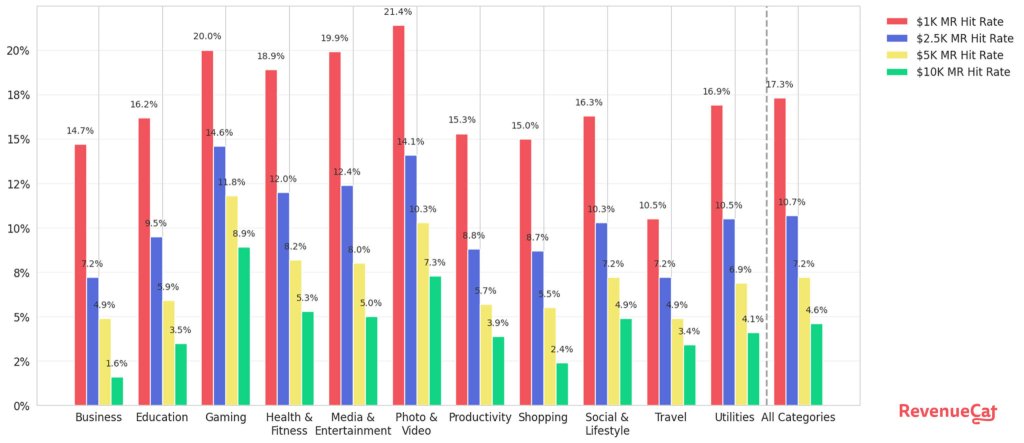
On the opposite end, certain categories are proving particularly challenging for new entrants. Education, Productivity, Travel, Shopping, and Business apps face the toughest competition and lowest success rates for breaking through revenue thresholds.
The Price Paradox
One of the report's most interesting findings concerns the relationship between pricing and user value. Higher-priced apps generate significantly more lifetime value per user—a median of $62.19 per user per year compared to just $10.69 for low-priced apps.
However, there's a counterintuitive twist: lower-priced apps retain users for longer. The median retention rate for low-priced apps is 36%, compared to 23% for high-priced apps. This suggests that while users may stay subscribed longer to cheaper apps, they ultimately spend less over their lifetime as customers.
Freemium vs Paywall Debate
The age-old question of whether to offer a free tier or direct users to a paywall continues to have a clear answer, according to the data. Paywalls still convert almost 6 times as much as freemium apps, despite retention rates being nearly identical (27% versus 28%, respectively).
This finding challenges the conventional wisdom that freemium models are necessary for user acquisition, suggesting that direct monetization through paywalls may be more effective for sustainable growth.
Regional Insights and Future Analysis
The full report includes regional breakdowns that provide additional context for understanding market dynamics across different geographic areas. RevenueCat indicates this is only part one of a two-part report, with additional insights expected in the coming weeks.
The data suggests that while the subscription app market continues to grow in absolute terms, it's becoming increasingly winner-take-all in nature. For developers and entrepreneurs considering entering the space, the message is clear: success requires not just good execution, but exceptional differentiation and value proposition to break through in an increasingly crowded and competitive market.
As AI tools continue to lower the barrier to entry for app development, the challenge will be finding ways to stand out in a sea of new apps, particularly in the most competitive categories where the odds of success are lowest.
Comments
Please log in or register to join the discussion