New data from interviewing.io, Workforce.ai, SignalFire, and TrueUp shows Anthropic and OpenAI now drawing more interview prep than Big Tech combined, intern intakes cut in half, frontend and native mobile titles fading, and AI engineering pay pulling clear of standard software roles.
The second installment of The Pragmatic Engineer's deep dive into the tech employment market landed this week, and the data tells a story most working engineers already feel in their bones: the center of gravity has shifted. Frontier AI labs are now harder to get into than Big Tech, the early-career pipeline is contracting in ways it hasn't before, and entire job titles are quietly disappearing from LinkedIn. The reporting pulls from four data partners with unusual visibility into hiring flows, and the picture they paint is worth sitting with if you're planning your next move or staffing a team.
What's new: AI labs became the most competitive places to work
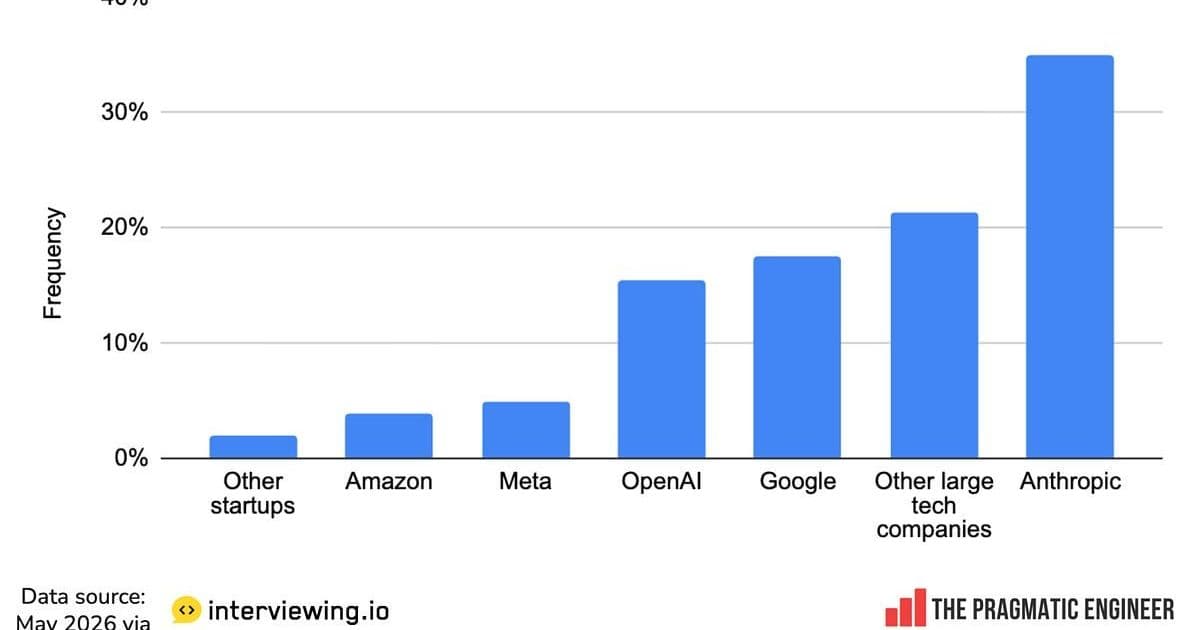
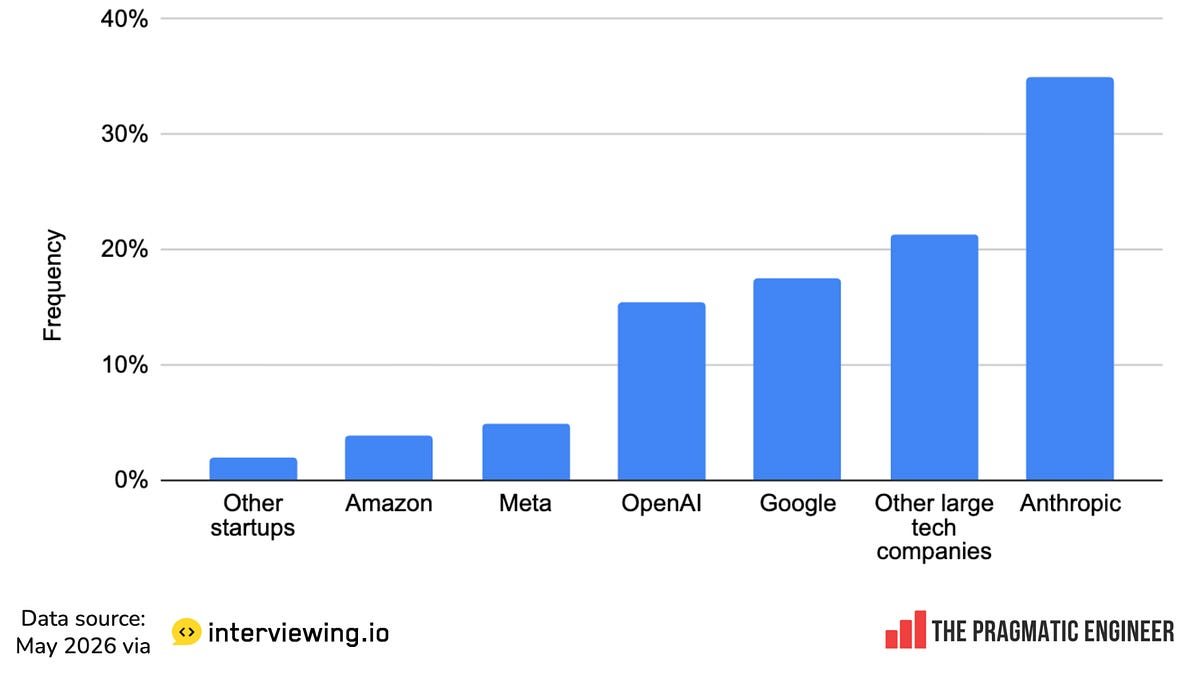
The headline finding is that the two biggest AI labs now attract more interview preparation demand than Google, Meta, Apple, and Amazon. Interviewing.io, which sells coaching for interviews at specific companies, reports that Anthropic is the single most requested employer for prep, and it isn't close. OpenAI pulls roughly 16 percent of candidates, about even with Google at 17 percent. Together, Anthropic and OpenAI account for 51 percent of all coaching requests. That's striking given interviewing.io only added coaching for frontier labs this year.
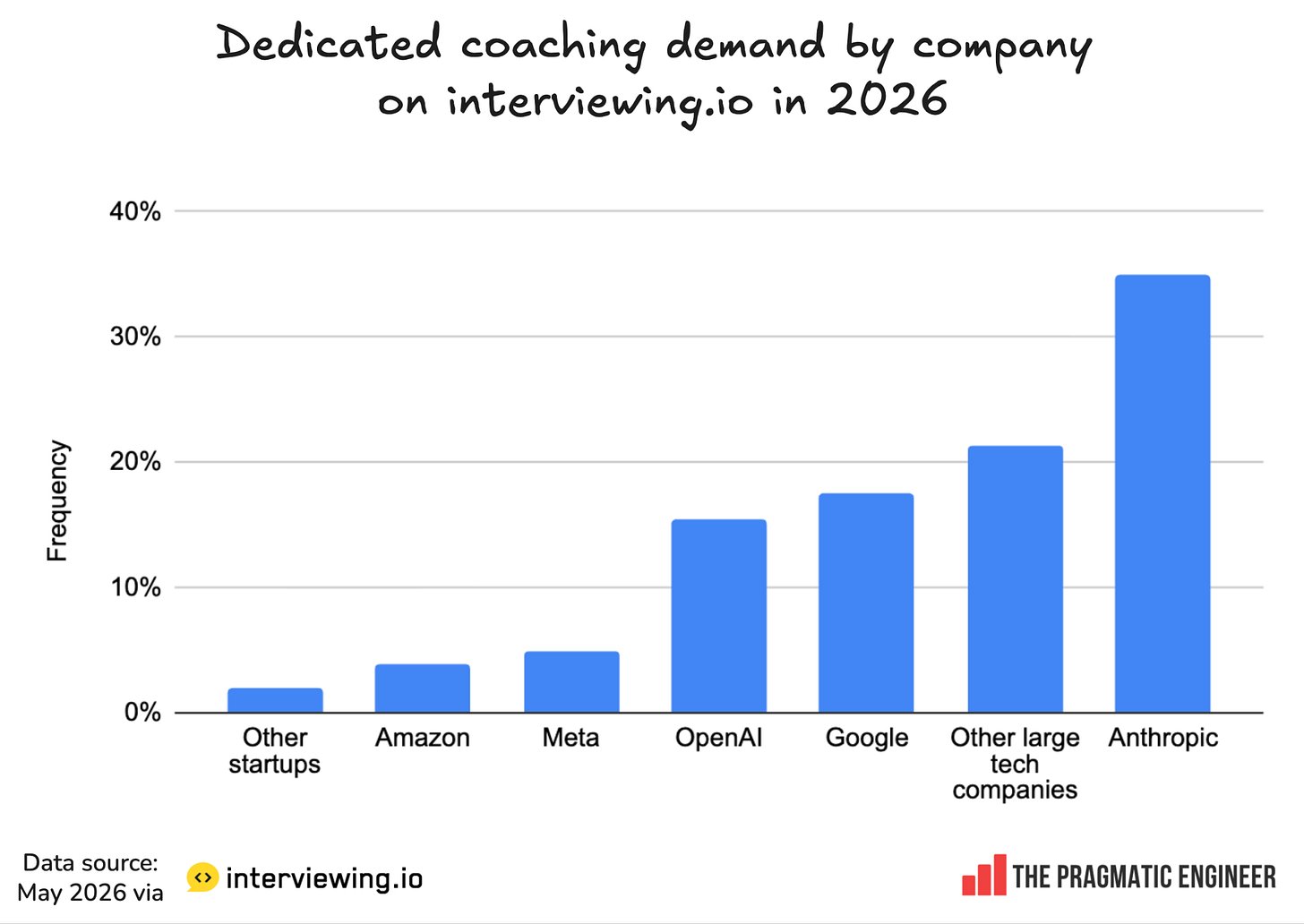
The momentum behind Anthropic specifically has a few plausible drivers. Claude Code remains the most popular developer tool according to the February AI tooling survey, which keeps the company top of mind for the exact population that buys interview coaching. Anthropic also raised a $65B round at a $965B valuation, briefly passing OpenAI in market value, and filed to go public first. For job seekers, a company with product traction, a fresh war chest, and an IPO on the horizon checks every box.
Retention data backs up the demand signal. SignalFire's two-year retention numbers show how sticky these jobs are once you land one:
- OpenAI: 67 percent, roughly in line with the rest of Big Tech
- Google DeepMind: 78 percent, well above the field
- Anthropic: 80 percent, the standout across the entire industry
When four in five engineers are still around two years later, openings stay scarce, which only intensifies the competition for the ones that do open up.
The labs are largely hiring from each other and from the top tier of Big Tech. Anthropic pulls most heavily from Google (often DeepMind), Meta, Stripe, Microsoft, AWS, and Databricks. OpenAI's sources look similar, with Apple, NVIDIA, and Airbnb added to the mix, plus an influx from Statsig after acquiring it. DeepMind fills most senior roles through internal transfers.
Why it matters: the early-career door is closing
The most consequential trend for the long-term health of the profession is what's happening below the senior level. Live Data Technologies tracked intern versus full-time software engineer hiring at 30 to 80 large US tech companies, indexed to 2019 numbers, and found the two lines diverging for the first time in the series.
Full-time software engineering hiring started recovering after the brutal 2023 market. Intern intake did not. It kept falling. As analyst Alex Hamilton put it, intern programs historically bounce back fast once companies resume hiring, but 2024 and 2025 are the first years where recruitment and intern intake moved in opposite directions. Where intern numbers held or grew, it was almost always at earlier-stage or fast-growing companies, not a sign of broad recovery. Large tech companies are now taking on roughly half as many interns as before.
New grad hiring tells the same story. At 28 large US tech companies, recent graduates made up just one in ten engineering hires in 2025, down from nearly three in ten in 2023. And among those who do get hired, pedigree carries more weight: the share coming from the top 20 US computer science programs (MIT, Stanford, CMU, Berkeley, and peers) is rising. Elite credentials always mattered, but as total opportunities shrink, the signal of a known university or a brand-name internship becomes harder to compete against without.
For anyone mentoring junior engineers or running a university recruiting pipeline, this is the part to internalize. The traditional path of intern-to-new-grad-to-engineer is narrowing at exactly the companies that used to anchor it. If you're early in your career, the practical takeaway is to weight earlier-stage and faster-growing companies more heavily, since that's where intern and junior intake is actually holding up.
How the work itself is changing
SignalFire's analysis of how job titles shifted on platforms like LinkedIn over four years surfaces a reorganization of what teams look like.
AI engineering titles are climbing fast, which surprises no one. The more interesting movement is around the edges. Forward Deployed Engineers (FDE) are growing rapidly again after first heating up in 2025. These are engineers who embed with customers to build and integrate, and they blur into sales engineering, which also ticked up as more companies chase enterprise deals.
The declines are where practitioners should pay attention. Native mobile engineer titles, both iOS and Android, are shrinking. More capable cross-platform frameworks mean fewer organizations staff dedicated native teams for a single product. The era of separate native iOS, native Android, and web teams for one app appears to be winding down at many shops.
Frontend-only roles are fading fastest of all. The full-stack engineer has become the default at many companies, and AI assistance lowers the barrier for a strong frontend developer to handle backend work too. The likely endpoint is that pure frontend specialists concentrate at larger organizations with genuine need for dedicated work like design systems, while everywhere else the expectation is full-stack range.
If you specialize narrowly in frontend or native mobile, the move is to deliberately broaden. Pick up backend fundamentals, get comfortable shipping across the stack, and treat the AI tooling that makes that easier as part of your standard kit rather than a threat.
Compensation: AI engineering pulls ahead
The report confirms what's been an open secret: AI engineering compensation now sits above standard software engineering pay at the same companies, and higher still at the leading labs. At the 80th percentile in the US, $300K+ base salaries have become the norm for senior engineers, with the gap widening further once equity enters the picture. AI engineers are both more in demand and better paid, which is the combination that pulls talent across the field toward those roles.
The management layer is thinning
A quieter structural shift is the continued "great flattening" of engineering management. There are fewer engineering managers per engineer across the industry, and fewer VP and director of engineering roles at Big Tech specifically. Combined with rising seniority and tenure (since zero interest rates ended in 2023, Big Tech workers have far fewer incentives to switch and are largely staying put), the result is a more senior, more static workforce with fewer rungs on the management ladder.
For individual contributors eyeing a management track, that's a narrower path than it was a few years ago. For companies, it raises real questions about how you develop and retain senior ICs when the traditional promotion-into-management pressure valve is getting smaller.
What to do with this
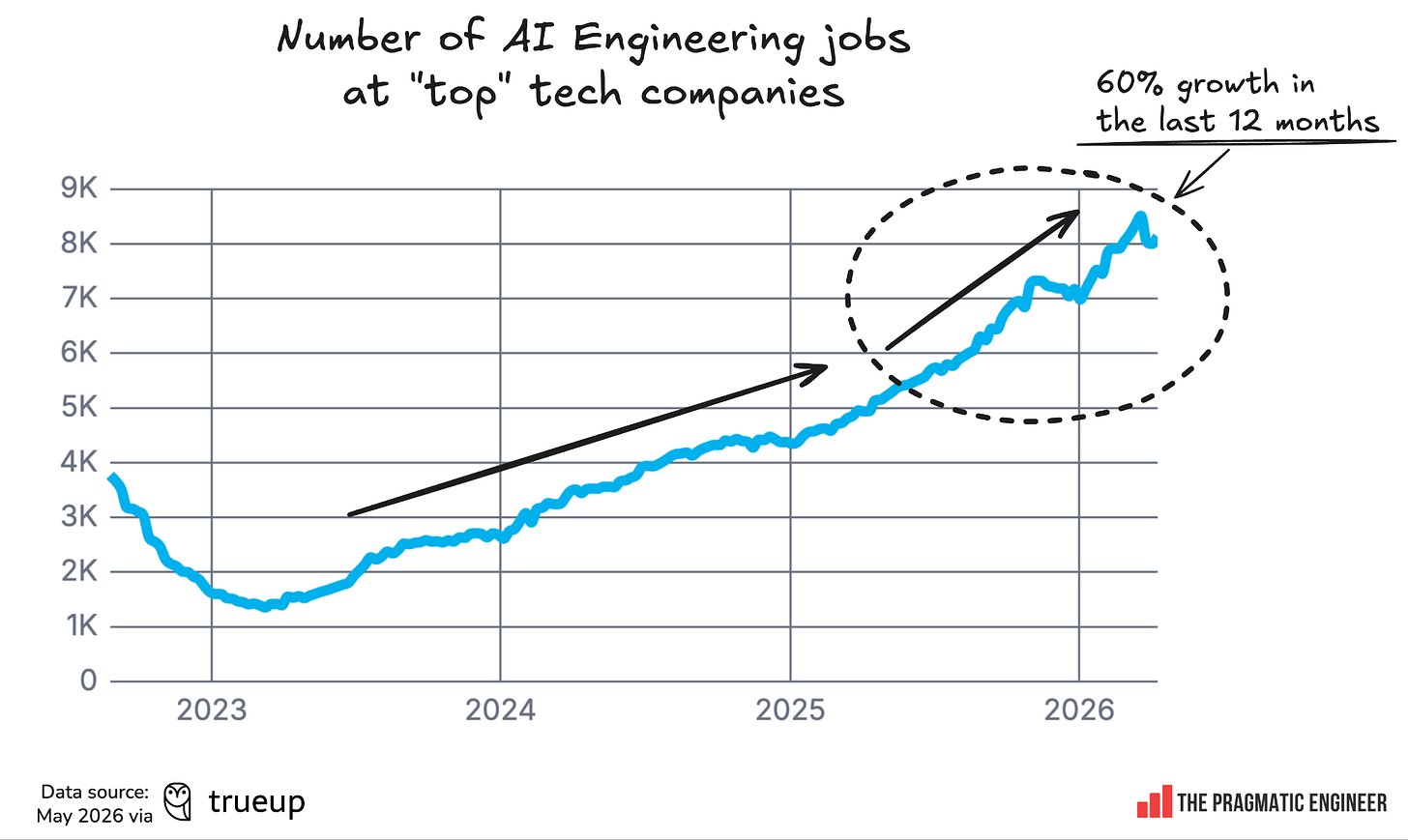
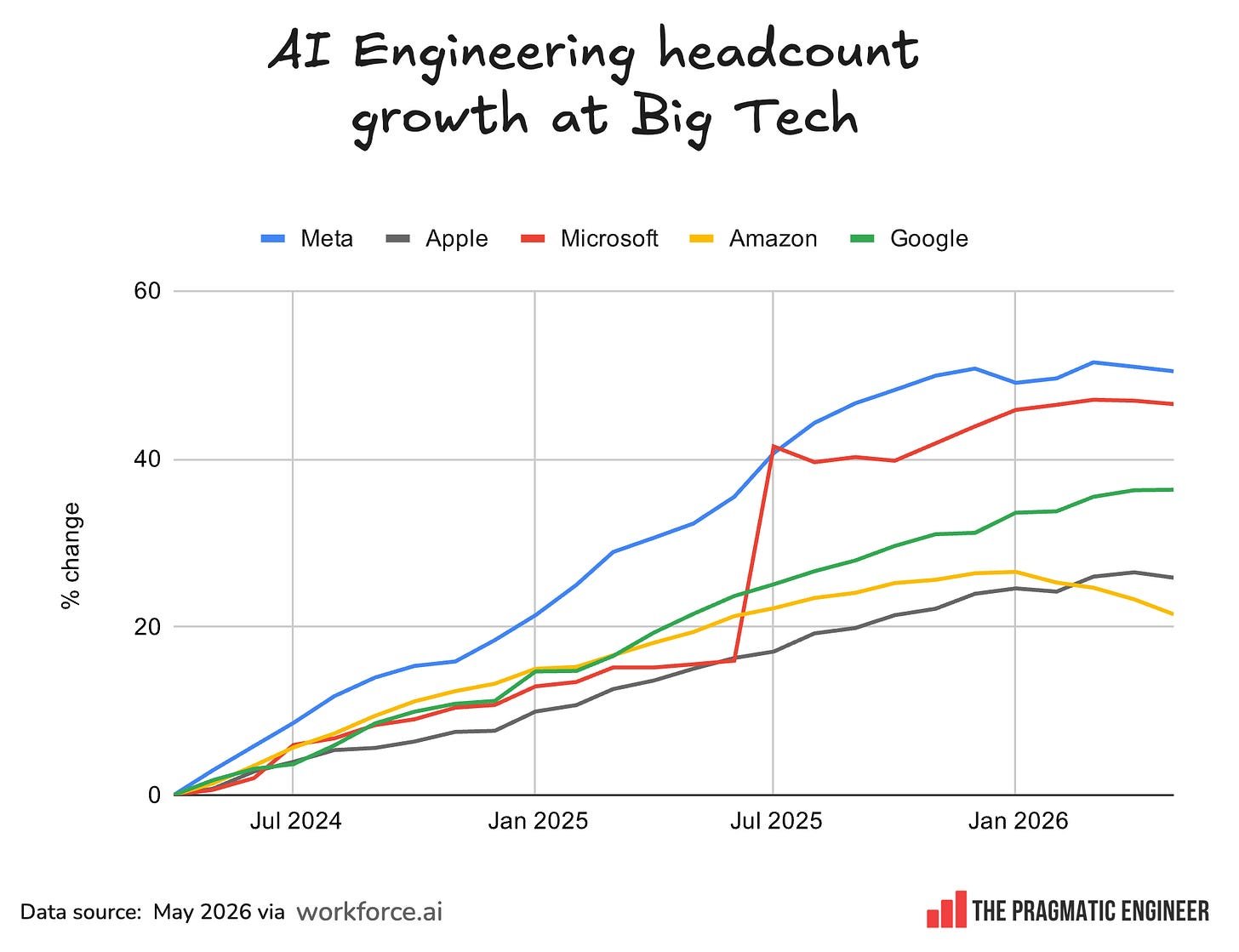
The through-line across all of it is concentration. Demand, compensation, and prestige are pooling around AI work and the labs that lead it, while the broad base of the profession (interns, new grads, narrow specialists, the management layer) is getting squeezed. None of this means software engineering is a bad bet. Full-time hiring is recovering and AI engineering openings grew 60 percent year over year against 7 percent for general software roles. But the safe, predictable paths are reshaping under your feet.
The practical posture is to stay broad, get hands-on with AI tooling rather than treating it as someone else's specialty, and weight your job search toward where intake is actually growing. The full breakdown, including the detailed compensation data and the list of companies engineers are most actively preparing to leave, is in The Pragmatic Engineer's Part 2 deep dive, with Part 1 covering the recruitment recovery and the explosion in AI engineering demand.
Comments
Please log in or register to join the discussion