
An examination of GitHub's transformation under Microsoft ownership, its impact on developer experience, and the emerging alternatives challenging its dominance in the code hosting landscape.
The digital realm has witnessed an interesting transformation in recent years as GitHub, once the crown jewel of developer collaboration, appears to be undergoing a significant identity crisis. David Bushell's provocative assessment that 'GitHub is sinking' captures a sentiment increasingly shared among developers who have witnessed the platform's gradual decline in reliability and its apparent shift from developer-centric tool to corporate asset.
At the heart of this concern lies the relationship between GitHub and its parent company, Microsoft. The acquisition of GitHub by Microsoft in 2018 was met with apprehension from many in the open-source community, who feared the potential consequences of a corporate giant taking control of a platform central to collaborative software development. Several years later, these concerns seem to be materializing in various ways, from declining uptime metrics to the introduction of features that prioritize corporate interests over developer needs.
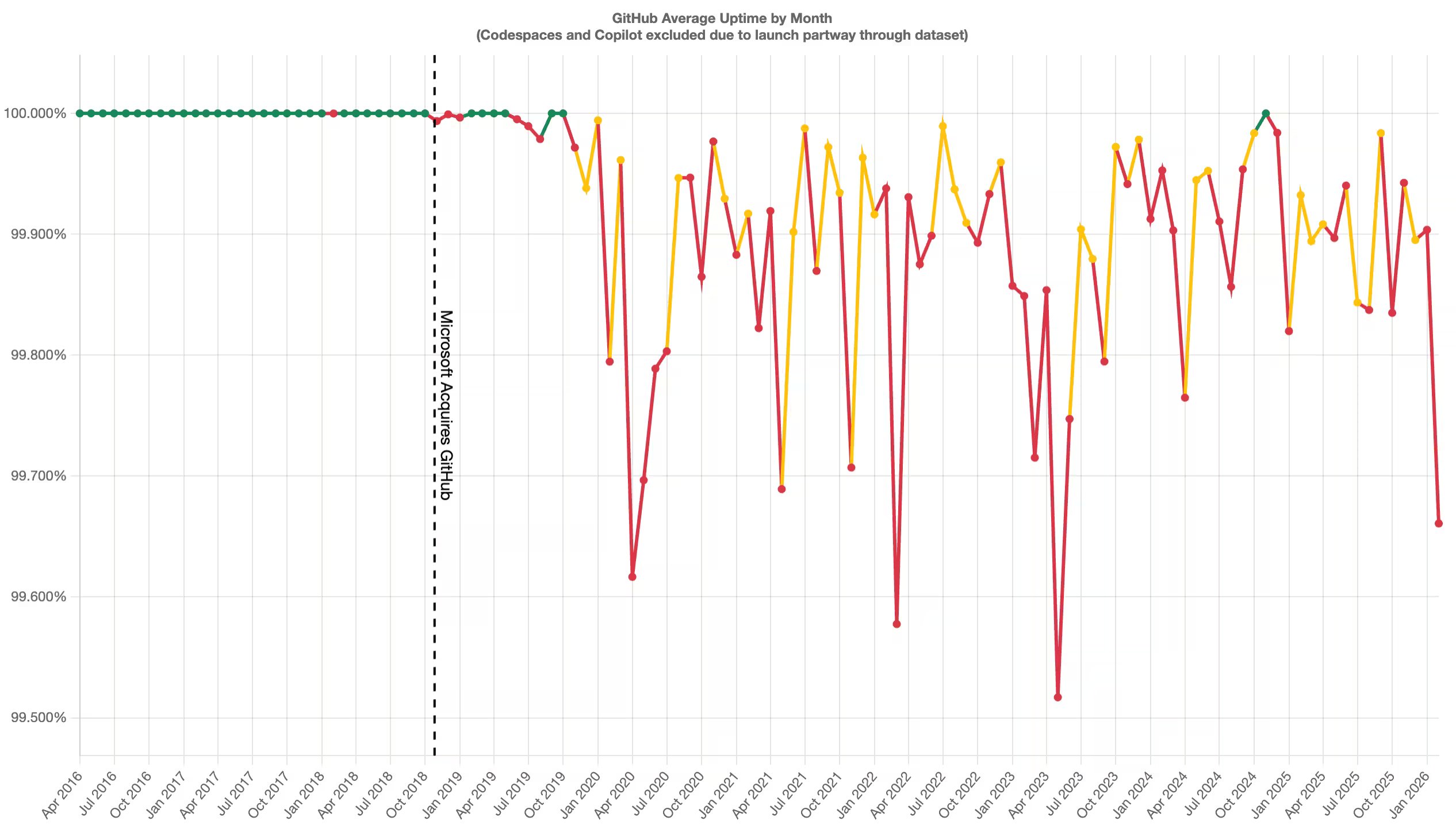
The reliability concerns raised by Bushell are particularly noteworthy. While official uptime statistics may tell one story, the developer experience often reveals a different narrative. The 'roller coaster' pattern of GitHub's availability, as depicted in the accompanying chart, suggests a platform struggling to maintain the consistent performance that once made it indispensable. This reliability issue becomes increasingly problematic as GitHub has evolved from a simple code repository to a comprehensive development platform with integrated CI/CD through GitHub Actions, package management, and numerous other services that depend on consistent uptime.
The exodus of notable developers and projects from GitHub further underscores these concerns. The departure of respected figures like Mitchell Hashimoto, Armin Ronacher, and Jonas Hietala represents not just individual choices but potentially significant shifts in influential circles. When creators of widely-used tools abandon a platform, it sends ripples throughout the ecosystem, potentially encouraging others to reconsider their own hosting arrangements.
A crucial point made in the article is the distinction between Git and GitHub. Git, the distributed version control system, remains an open-source, decentralized technology that functions independently of any particular hosting service. GitHub, in contrast, represents a centralized implementation that added social features, issue tracking, and collaboration tools to the core Git functionality. This distinction is vital as it highlights that developers are not abandoning version control itself but rather the specific platform that has become synonymous with it.
The criticism of GitHub Actions as an 'abomination' reflects broader concerns about the direction of GitHub's development. While Actions has undoubtedly expanded GitHub's utility, it has also introduced complexity, potential vendor lock-in, and performance issues that frustrate developers seeking efficient CI/CD solutions. The platform's evolution from a simple repository to a comprehensive development environment has created tension between its original purpose and its current ambitions.

The alternatives emerging to challenge GitHub's dominance represent interesting developments in the developer tools space. Codeberg, as a non-profit, community-led project, offers an appealing ethical alternative that aligns with open-source values. Tangled's integration with the AT protocol suggests experimentation with new approaches to decentralized collaboration. Gitea and GitLab provide more traditional alternatives with different trade-offs between simplicity and feature completeness.
The self-hosted option, exemplified by Forgejo, represents a return to the principles of distributed systems that underpin Git itself. While self-hosting introduces additional responsibilities, it offers maximum control and independence from corporate platforms. This approach resonates with developers who prioritize autonomy and have the technical capability to manage their own infrastructure.
The network effect that has benefited GitHub remains a significant barrier to alternatives. The concentration of developers, projects, and tooling integrations on GitHub creates a gravitational pull that is difficult to overcome. However, as the platform's reliability and alignment with developer interests continue to erode, this network effect may gradually weaken, creating opportunities for alternatives to gain traction.
The suggestion that 'Git is not GitHub' is particularly insightful. It reminds us that the underlying technology remains sound and that the problems lie with the specific implementation and its corporate stewardship. This distinction allows developers to separate criticism of the platform from the value of version control itself, potentially facilitating a more rational evaluation of alternatives.

The migration away from GitHub, while potentially daunting, need not be an all-or-nothing proposition. Incremental approaches, such as maintaining repositories on multiple platforms or gradually shifting projects based on their criticality, can make the transition more manageable. The key is recognizing the need for change and taking proactive steps to reduce dependency on a platform that appears to be increasingly misaligned with developer needs.
As the developer ecosystem continues to evolve, the relationship between open-source tools and corporate ownership will remain a critical consideration. GitHub's transformation under Microsoft ownership serves as a case study in how platforms can change following acquisition, potentially losing the qualities that initially made them valuable. The emergence of alternatives suggests a healthy ecosystem that can adapt and find new solutions when existing ones no longer serve their purpose.
The future of code hosting may involve a more diverse landscape with multiple platforms serving different needs and priorities. Some developers may prioritize ethical considerations and choose community-led alternatives. Others may require enterprise-grade features and support, leading them to platforms like GitLab. Those valuing maximum control may opt for self-hosted solutions, while others may experiment with new approaches like Tangled's integration with decentralized protocols.
Regardless of the specific path chosen, the current moment represents an opportunity for reflection on the values that should guide developer tools and collaboration platforms. As GitHub continues its transformation under Microsoft's stewardship, the developer community faces important questions about which features matter most, which trade-offs are acceptable, and how to maintain the open, collaborative spirit that has driven software development forward.
Comments
Please log in or register to join the discussion