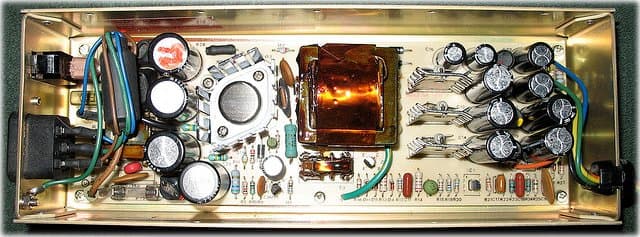
Steve Jobs claimed every computer rips off Rod Holt's Apple II power supply. The historical record, dug up by engineer Ken Shirriff and confirmed by people who actually built these things, tells a messier story: switching power supplies had already taken over computing years before the Apple II shipped, driven not by one designer but by a quiet revolution in semiconductor parts.
There is a particular kind of origin story the tech industry loves to repeat, the one where a single visionary cracks a problem nobody else could see. The biography Steve Jobs by Walter Isaacson hands us one of these about the Apple II's power supply. Jobs is quoted insisting that Rod Holt's switching power supply "was as revolutionary as the Apple II logic board," that Holt "doesn't get a lot of credit" for it, and that "every computer now uses switching power supplies, and they all rip off Rod Holt's design."
It is a clean, quotable claim. It is also, when you actually trace the history, mostly wrong. Engineer Ken Shirriff spent an unreasonable amount of time digging through schematics and old electronics journals to test it, and his investigation lays out a pattern worth paying attention to, because the same pattern shows up every time a famous company gets credited with a technology that an entire industry was already building.
What the power supply actually does
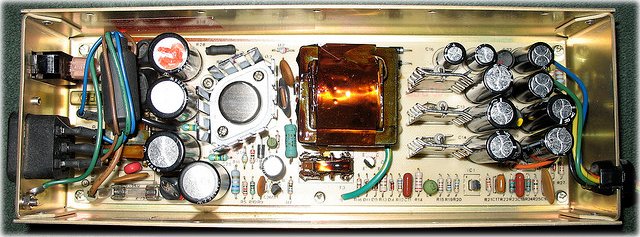
Start with the thing itself, because the story only makes sense once you understand what was being designed. A computer power supply turns the AC from your wall into the regulated low-voltage DC that chips need. There are two broad ways to do it.
The old way is a linear power supply: a bulky transformer drops the voltage, a diode bridge rectifies it, and a linear regulator burns off the excess as heat to hold the output steady. These are almost trivial to design. The catch is that they waste something like half to two-thirds of the power as heat, which means heat sinks, fans, and weight.
The other way is a switching power supply. Instead of bleeding off excess energy as heat, it converts the line input to high-voltage DC and then chops that DC on and off thousands of times a second, tuning the timing so the average output lands where you want it. In theory nothing is wasted; in practice you get 80 to 90 percent efficiency, far less heat, and a much smaller, lighter box. The price you pay is complexity. A linear regulator might take a week to design. A switching supply, by one estimate in Marty Brown's Power Supply Cookbook, could take eight person-months. It also leans hard on its components, demanding transistors that can switch high power at high speed without melting.
That last sentence is the whole story, so hold onto it.
The revolution happened before Apple showed up
The Apple II shipped in 1977. By then, switching power supplies were not exotic. They were everywhere in computing.
The principles dated to the 1930s, and discrete-component switchers were built in the 1950s. NASA and the aerospace industry pushed the technology hard in the 1960s, where small size and efficiency justified the cost; Telstar used a switching regulator in 1962. The computer industry followed quickly. DEC's PDP-11/20 used one in 1969. By 1971, a trade article noted that the companies using switching regulators "read like a 'Who's Who' of the computer industry: IBM, Honeywell, Univac, DEC, Burroughs, and RCA." Hewlett-Packard, Data General, Texas Instruments, and IBM were all shipping switching supplies through the early and mid 1970s. By 1976 they were inside color televisions in people's living rooms.
There was a kitchen-table startup in this story, and it was not Apple. Robert Boschert quit his job in 1970 and started building power supplies on his kitchen table, focused on making switchers cheap enough to compete with linear designs. By 1977 his company had 650 people and was selling into satellites and the F-14. Byte magazine announced Boschert's 80-watt switching supply for microcomputers in 1976, a year before the Apple II.
So the consensus that Jobs was selling, that Apple introduced switching supplies to computing, collapses against a decade of prior shipping product. That part is not even close.
The real driver was the transistor
Here is the more interesting observation buried in the history. The thing that actually made switching supplies practical was not any single circuit design. It was the components, specifically the switching transistors.
The limiting factor for years was how much voltage a transistor could handle. A 1972 Computer Design article spelled it out: "high voltage, high speed transistors are increasingly available at low cost, an important factor in the more widespread use of switching regulator supplies." Transistor capability moved so fast that a 500-watt supply on the cover of Electronics World in 1971 could not have been built with the parts available eighteen months earlier. Once transistors could take hundreds of volts, designers could throw out the heavy 60 Hz transformer entirely and run "off-line" straight from line voltage. Faster switching meant smaller, more efficient supplies.
Then in 1975 and 1976 came the controller ICs, chips like the Silicon General SG1524 that collapsed dozens of discrete parts into one package. The cover of Electronic Design in June 1976 read "Suddenly it's easier to switch." That, more than any individual designer, is what industry veterans point to as the turning point.
This is the counter-perspective the Jobs quote erases. Revolutions in hardware are usually component revolutions wearing a product's clothes. The visible artifact, the Apple II's quiet fanless box, was made possible by a supply chain of cheap high-voltage transistors that anyone could buy.
So what did Holt actually design?
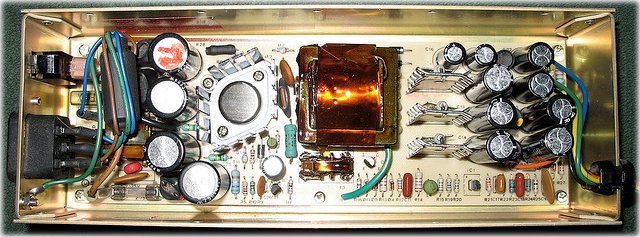
This is where it would be easy to overcorrect into dismissing Holt, and that would be just as wrong as the original myth. His Apple II supply was a simple off-line flyback converter, and it earned a patent. Shirriff read the patent looking for the hidden genius and found two protective mechanisms: an AC-input scheme to safely start the oscillator, and a clamp winding with a diode to return excess transformer energy to the source.
Neither turns out to be unique. The AC-start mechanism shows up in Apple's own later products through the Mac Classic, but almost nowhere outside Apple, and IC controllers made it obsolete. The clamp winding appeared in Boschert's supplies, in Motorola's design guides, and, inconveniently for a tidy "this was the stolen innovation" narrative, in a 1976 Texas Instruments book that described it in detail. The technique on forward converters dated back to a 1956 Philips patent.
The comment thread under Shirriff's article is where the story gets genuinely human, and it is worth reading. A former Astec executive wrote in to say Apple was "the most naive and most profitable customer" they had, and that conversations with Apple were "mostly about aesthetics, never electrical design." Astec's in-house IC designer, Carl Sawtell, pushed back in the other direction, arguing the real credit belongs to Elliot Josephson, whose free-running flyback design "didn't require state-of-the-art transistors" and ended up in Astec's supplies for the IBM PC as well as Apple. Josephson's patent numbers are literally silk-screened onto the Apple II Plus boards, and almost nobody knows his name.
That detail says more than the Jobs quote ever could. The person whose circuit actually shipped in volume is invisible, while the person quoted in the bestselling biography became, in Shirriff's nice phrase, "easily the most famous power supply designer ever."
Modern supplies share almost nothing with Apple's
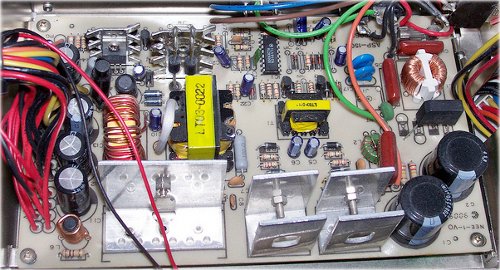
The claim that every computer "rips off" Holt's design fails one last test: just look at what came after. The 1981 IBM PC supply was also an off-line flyback, and that is where the resemblance ends. It used an NE5560 controller IC where Apple used discrete transistors, roughly twice the component count, optoisolated feedback instead of a transformer, a fan where Apple famously had none, and a completely different protection scheme.
From there the lineage drifts further away. The IBM PC AT supply became a de facto standard, then Intel's 1995 ATX spec took over, then the half-bridge TL494 design dominated the 1990s, then power factor correction and forward converters and digital control arrived. A modern ATX supply is effectively five switching converters in one box, and with the voltage regulator modules on the motherboard and graphics card, a typical desktop runs something like seven switching supplies at once. A single modern processor can pull more than twice the power the entire IBM 5150 used, and roughly three times the whole Apple II. None of these designs trace back to a flyback converter from 1977.
The pattern worth noticing
The reflexive defense in the comments is predictable and not entirely wrong: Jobs was not an electrical engineer, Apple's genius was packaging and product, and the Apple II's clean quiet supply fit a machine that felt different from the noisy hobbyist boxes around it. All true. One commenter put it well, arguing that Apple's real skill was finding "the right recipe for creating a new product category," not inventing the parts inside.
But that defense quietly concedes the point. The myth was never "Apple integrated existing technology beautifully." The myth was "everyone rips off Rod Holt." Those are different claims, and only the first one survives contact with the evidence.
The useful takeaway is not really about Apple at all. It is about how technology history gets compressed into hero stories the moment a famous name is attached. The switching power supply was the product of decades of incremental work by aerospace engineers, Japanese and American manufacturers, a kitchen-table entrepreneur, an uncredited patent holder named Josephson, and above all the semiconductor industry that kept shipping better transistors. That is a less satisfying story than one man making something everyone copied. It is also what actually happened, and the metal box on your desk is evidence of it whether anyone puts a name on the box or not.
Comments
Please log in or register to join the discussion