
A backend that heals after a restart is often not healing the application. It is resetting stale network state that the system failed to detect.
Problem
The most misleading backend outages are the ones that look random. No deploy happened. No schema changed. CPU is normal. The database dashboard says healthy. A container restart makes the service recover, which points everyone toward application memory, thread pools, or a bad release that somehow escaped the audit trail.
That restart often fixes the symptom because it destroys network state. It closes stale sockets, rebuilds connection pools, refreshes DNS, resets retry queues, and forces the process to rediscover the world. The application did not become correct. It forgot the broken assumptions it had cached.
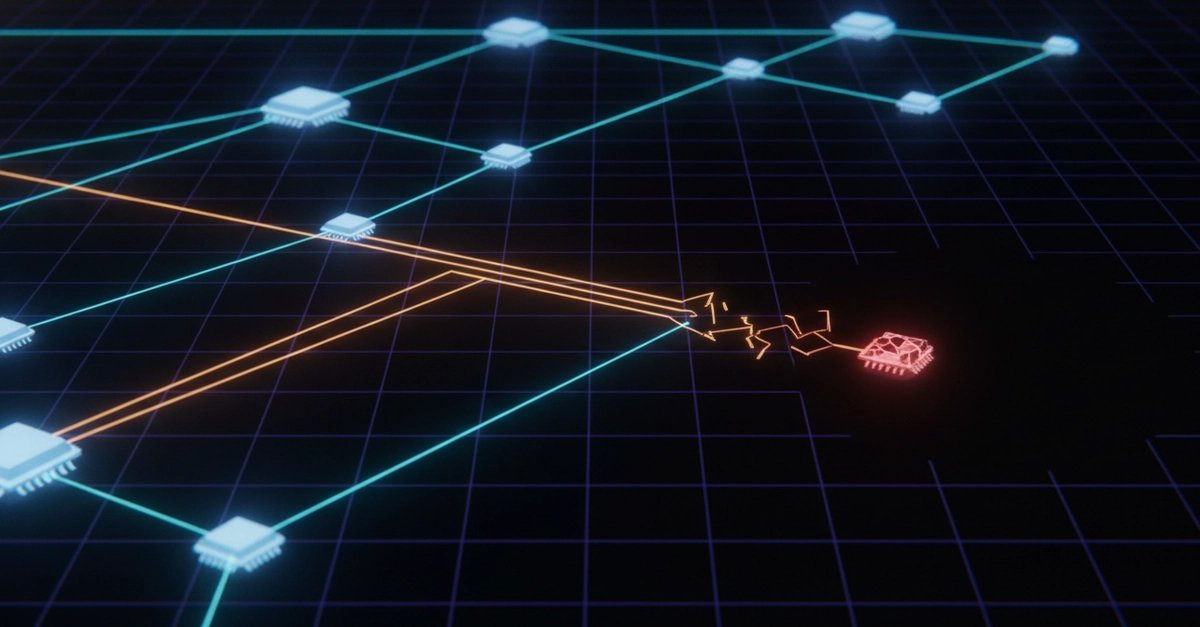
Distributed systems make this worse because every backend is now a graph of network dependencies: managed databases, queues, caches, third-party APIs, internal services, service meshes, API gateways, load balancers, NAT gateways, DNS resolvers, and observability exporters. Each hop has state. Each hop has timeouts. Each hop can disagree with the others about whether a connection is alive.
A common failure chain starts with a slow upstream. A service issues requests, waits too long, retries, and keeps sockets occupied. The upstream recovers, but now the caller is saturated. Connection pools fill. Worker queues back up. Health checks begin failing. Kubernetes restarts pods. The restart appears to fix the application, but the actual failure was uncontrolled pressure across a network boundary.
This is why timeout handling is not just an application setting. It is a distributed systems contract. A timeout says how long one component is willing to let another component consume scarce local resources. A retry says how much extra load the caller is willing to create when the callee is already unhealthy. A connection pool says how many concurrent bets the process can place on the network path being usable.
DNS creates another class of false confidence. Teams rotate a database endpoint, lower the record TTL, wait for propagation, and assume clients will follow. Some clients do. Others keep the old address in a JVM DNS cache, a long-lived resolver cache, a database driver, or a connection pool that never needed to resolve the name again. The DNS record changed, but the running process did not. The outage arrives when the old target disappears.
TCP adds its own traps. A database connection can look open inside the process while a NAT gateway, firewall, or load balancer has already evicted the idle flow from its state table. The next query goes into a connection that exists only from the client’s point of view. The database is healthy. The network is healthy for new connections. The old socket is dead in the middle.
MTU mismatches are even less friendly. Overlay networks, VPNs, tunnels, and cloud networking layers add headers. A packet that fits on one segment of the path may be too large for another. If Path MTU Discovery depends on ICMP and ICMP is blocked, large packets can vanish while small packets continue working. This creates the worst kind of production failure: pings work, small requests work, logs are quiet, and one workload hangs.
Solution Approach
Treat network behavior as part of backend correctness. That starts with making every outbound dependency explicit: API clients, database pools, message brokers, DNS behavior, retry policy, connection lifetime, idle timeout, keepalive settings, and circuit breaker behavior. If those settings live as library defaults, production is already depending on behavior nobody has reviewed.
For third-party APIs and internal services, use circuit breakers instead of retrying until local capacity collapses. A circuit breaker detects repeated failure, opens for a period, and fails calls quickly while the upstream has time to recover. Martin Fowler’s circuit breaker writeup is still a useful conceptual reference, and libraries like Resilience4j provide production-oriented implementations for JVM services.
A circuit breaker should be paired with bounded retries, deadlines, and jittered backoff. Retries without jitter synchronize callers around the same timeout windows. That turns a temporary slowdown into a coordinated load spike. Amazon’s Timeouts, retries, and backoff with jitter explains this pattern well: retries are useful only when they are capped, delayed, randomized, and budgeted.
Deadlines are better than isolated per-hop timeouts. If an incoming request has 800 ms left before the user gives up, an internal service should not spend 1 second waiting on a dependency. Pass a request deadline through the call graph and make each service spend from the same budget. This keeps one slow dependency from consuming resources long after the original work has stopped mattering.
Connection pools need active validation. For databases, configure maximum connection lifetime, idle timeout, validation queries or driver-level health checks, and TCP keepalives. The exact knobs vary by driver and pool, but the principle is stable: do not assume a socket is alive only because the process still has a file descriptor. Linux TCP keepalive behavior is controlled through kernel settings documented in the Linux networking sysctl documentation, including values such as tcp_keepalive_time, tcp_keepalive_intvl, and tcp_keepalive_probes.
The keepalive interval must be lower than the idle timeout of the network devices on the path. If a load balancer drops idle flows after 350 seconds and the host sends keepalives after two hours, keepalives are not protecting the application. They are ceremonial. In cloud systems, compare application pool settings against load balancer, NAT gateway, firewall, and database proxy idle timeout values.
DNS must be tested from inside the application runtime, not just with dig. A shell command proves what one resolver sees at one moment. It does not prove what a JVM, Go runtime, Node process, database driver, or sidecar proxy will reuse after hours of uptime. For planned endpoint changes, lower TTL well ahead of the change, restart or drain long-lived clients if needed, and verify the application’s actual address selection during the migration.
Kubernetes adds another layer. Service discovery, kube-proxy or eBPF dataplanes, CNI overlays, sidecars, and node-level NAT can all affect connection behavior. The official Kubernetes networking model is the right baseline, but production clusters also require understanding the chosen CNI. If you run Calico, read its MTU configuration guidance. If you run Flannel, understand the encapsulation mode in the Flannel repository and how much header overhead it adds.
For MTU issues, test the path that production traffic actually uses. traceroute shows hops, but it does not prove the largest safe packet size. tracepath, documented by man7.org, is often more useful because it reports Path MTU information. In container networks, also check pod-to-pod, pod-to-service, pod-to-external, and node-to-external paths. They may not share the same effective MTU.
Observability should make network-state failures visible. Track connection pool utilization, wait time for a connection, active versus idle connections, DNS resolution failures, request deadline exhaustion, retry counts, circuit breaker state, upstream latency percentiles, socket resets, and timeout categories. A single timeout metric is too vague. A connect timeout, TLS handshake timeout, read timeout, pool acquisition timeout, and request deadline timeout point to different failures.

Trade-offs
The trade-off with shorter timeouts is false failure. If a dependency normally responds in 80 ms but occasionally needs 600 ms during compaction, failover, or cache misses, a 200 ms timeout may create unnecessary retries and reduce success rate. Longer timeouts reduce false failure, but they retain local resources longer and increase the blast radius of a slow upstream. The right value comes from latency distributions, user-facing deadlines, and capacity modeling, not instinct.
Retries have the same tension. A retry can hide a transient packet loss or connection reset. It can also multiply traffic during the exact period when the upstream has the least spare capacity. Retrying non-idempotent operations adds correctness risk unless the API is designed around idempotency keys. Public APIs such as Stripe’s idempotent request model show the pattern clearly: the client sends a stable key so retrying a create operation does not create duplicate side effects.
Circuit breakers protect callers and upstreams, but they can reject work that might have succeeded. A breaker with aggressive thresholds may open during a short burst and turn a small incident into visible errors. A breaker with loose thresholds may open too late to protect the system. This is why circuit breakers need metrics, alerting, and careful defaults per dependency. A payment processor, search index, metrics exporter, and recommendation service should not share the same failure policy.
DNS-based failover is simple to operate, but it is not instant failover. TTL is advisory across caches, runtimes, and connection reuse. Load balancer based failover gives more control, but it introduces another stateful network component. Client-side discovery can react quickly, but it moves complexity into every service. None of these choices is free. The failure mode merely moves.
Long-lived connections are efficient, especially for databases and high-throughput APIs, because they avoid repeated handshakes and authentication. They also accumulate stale assumptions about the path. Short-lived connections refresh state more often, but they add handshake overhead and can exhaust ephemeral ports under load. The practical middle ground is usually pooled connections with bounded lifetime, active health checks, and keepalives tuned to the infrastructure.
Service meshes can help by centralizing retries, timeouts, mTLS, and traffic policy. They can also hide behavior from application teams. A mesh-level retry policy stacked on top of an application retry policy can produce request amplification that neither team intended. If a call path has three layers and each retries three times, the downstream may see far more traffic than the original request rate suggests. Retry budgets should be owned at the system level, not scattered across YAML and client code.
The pragmatic response is not to blame the network for everything. It is to stop treating the network as a transparent pipe. In a distributed system, the network is a stateful, lossy, policy-heavy subsystem with caches, queues, timers, and partial failures. Applications that ignore that reality eventually learn it during an incident.
A good backend outage review asks specific questions. Did retries increase load after the upstream became slow? Did the connection pool saturate before the service became unavailable? Did clients keep using old DNS answers? Did idle connections outlive a NAT or load balancer timeout? Did packet size affect success rate? Did our metrics distinguish pool wait time from upstream response time? These questions move the investigation from folklore to mechanisms.
The restart that fixes production is a clue. It says the process was holding state that had stopped matching reality. The durable fix is to identify which state was wrong, then make the system refresh, bound, validate, or discard it before customers find the failure path again.
Comments
Please log in or register to join the discussion