Exploring the exact mathematical solution to the nonlinear pendulum equation using Jacobi elliptic functions, revealing insights beyond linear approximations.
The motion of a simple pendulum has captivated physicists and mathematicians for centuries, yet its complete solution remained elusive until the development of advanced mathematical functions. When we consider a pendulum with significant initial displacement, the traditional linear approximation proves insufficient, necessitating more sophisticated mathematical tools. The nonlinear pendulum equation, θ″(t) + c² sin( θ(t) ) = 0 where c² = g/L, presents a fascinating challenge that cannot be solved using elementary functions alone.
The significance of this equation extends beyond theoretical interest. In engineering applications ranging from clock design to seismology, understanding the true behavior of oscillatory systems under large displacements is crucial. When the initial angle θ0 exceeds small values, the approximation sin θ ≈ θ introduces substantial errors that accumulate over time, particularly affecting the period of oscillation.
The exact solution to this nonlinear differential equation requires Jacobi elliptic functions, a class of twelve special functions that generalize trigonometric functions to handle more complex periodic behavior. Unlike elementary trigonometric functions, Jacobi elliptic functions incorporate both an argument and a parameter, allowing them to model a wider range of oscillatory phenomena. The solution takes the form θ(t) = 2 arcsin( a cd(ct | m) ), where a = sin(θ0/2), m = a², and cd represents one of the Jacobi elliptic functions.
What makes these functions particularly powerful is their ability to capture the exact nonlinear behavior of the pendulum without approximation. The parameter m, which equals sin²(θ0/2), determines the character of the solution, transitioning between different regimes as the initial displacement changes. This parameterization elegantly encodes the physical properties of the system into the mathematical structure of the solution.
Implementing this solution computationally presents interesting challenges. As the author notes, SciPy does not directly implement the cd function, but it can be computed as the ratio of cn to dn functions. The ellipj function in SciPy returns all four Jacobi elliptic functions simultaneously because their computational cost is nearly identical—a practical consideration that reveals the underlying computational complexity of these special functions.
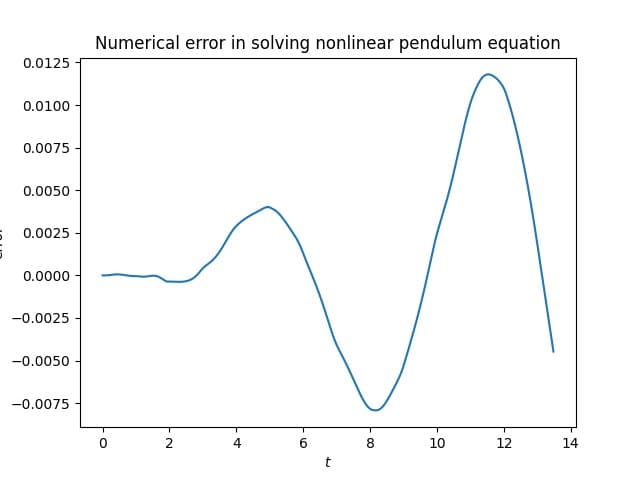
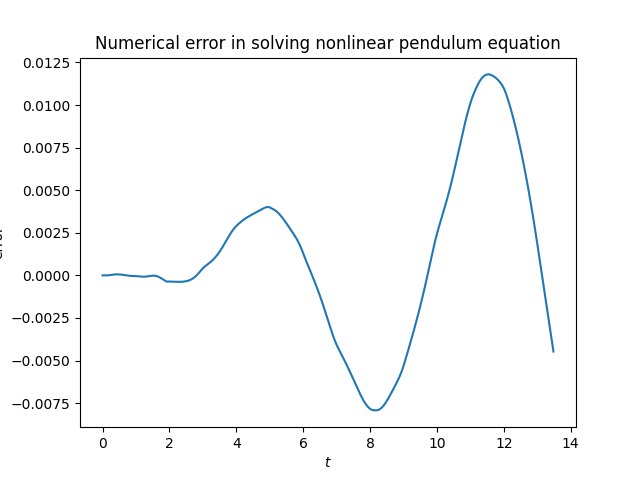
The comparison between the exact solution and numerical approximations reveals the limitations of traditional computational methods. While numerical integration provides practical results for specific cases, it introduces errors that accumulate over time, particularly for longer time spans or larger initial displacements. The exact solution, by contrast, provides a mathematically precise representation that can be evaluated at any point without error propagation.
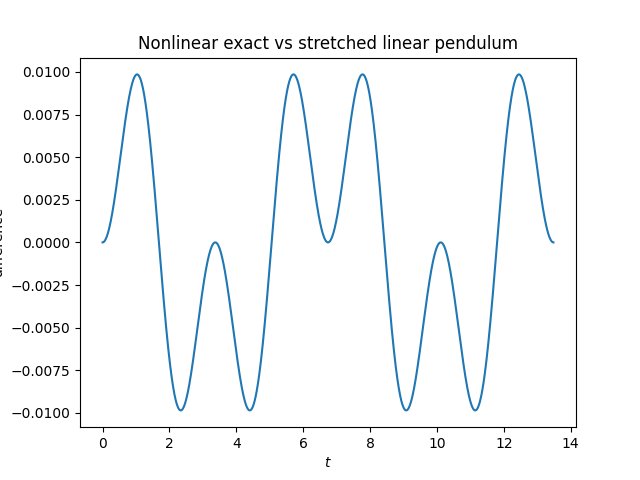
The exact solution also illuminates the relationship between linear and nonlinear pendulum behavior. The period of the nonlinear pendulum depends on the amplitude of oscillation, a phenomenon absent in the linear case. The exact period can be expressed as T = 4K(m)/c, where K(m) is the complete elliptic integral of the first kind. This amplitude dependence explains why pendulum clocks require compensation for different swing amplitudes to maintain accurate timekeeping.
From a pedagogical perspective, the nonlinear pendulum serves as an excellent introduction to the power of special functions in solving physical problems. It demonstrates how mathematical tools are developed to address specific challenges in modeling physical reality, expanding our ability to describe increasingly complex systems. The Jacobi elliptic functions, while initially appearing abstract, provide concrete solutions to tangible physical problems.
The implications of this exact solution extend beyond pendulum mechanics. Similar mathematical structures appear in numerous physical contexts, including the motion of celestial bodies, quantum mechanical systems, and electromagnetic phenomena. Understanding the nonlinear pendulum provides foundational insights into these more complex systems, revealing common mathematical structures that underlie diverse physical phenomena.
For those interested in exploring this solution further, resources on elliptic functions and integrals provide deeper mathematical context. The Digital Library of Mathematical Functions offers comprehensive information on these special functions, while Wolfram MathWorld provides accessible introductions to related concepts. The implementation details shared in the original post demonstrate how theoretical mathematics translates into practical computational solutions.
In conclusion, the exact solution to the nonlinear pendulum equation using Jacobi elliptic functions represents a beautiful intersection of theoretical mathematics and physical reality. It not only provides a precise description of pendulum motion but also exemplifies how advanced mathematical functions enable us to solve problems that resist elementary approaches. As computational tools continue to evolve, the ability to implement and utilize these exact solutions becomes increasingly valuable, bridging the gap between theoretical understanding and practical application.
Comments
Please log in or register to join the discussion