Federal cuts and grant freezes have pushed U.S. researchers into a funding crisis that now threatens space science, public health research and the startup pipeline built on basic science.
U.S. researchers built modern science around a simple bargain: Congress funds risky work, scientists pursue questions with public value, and industry turns some discoveries into products. President Donald Trump’s second administration has strained that bargain through grant freezes, staff cuts and new political filters on research language.
Scientific American’s July 2026 report centers on AXIS, the Advanced X-ray Imaging Satellite, a proposed NASA observatory led by Christopher Reynolds at the University of Maryland. NASA gave the team a $5 million grant in October 2024 to refine the design. The mission aimed to study early black holes, galaxy formation and high-energy physics with single-crystal silicon x-ray mirrors.
The AXIS team needed engineers at NASA’s Goddard Space Flight Center to finish cost and schedule work. Federal buyouts and budget moves stripped the project of key staff. Reynolds’ group lost 20 people, including the project manager and William Zhang, the astrophysicist behind the mirror technology. NASA then moved engineers toward projects that matched the president’s budget request. The AXIS team missed its cost target, and NASA killed the mission after almost 10 years of work.
AXIS shows the blunt force of federal science policy. Congress can fund a program, but agency leaders can still starve a project by moving staff, slowing review and forcing teams to hit deadlines after shutdowns or buyouts. Researchers can lose a mission without a formal cancellation notice.
The same pattern now hits biomedical research. The National Institutes of Health once issued hundreds of funding opportunities each year. Scientific American reports that NIH issued 120 in 2025 and 14 by mid-March 2026. Researchers who depend on NIH grants now face frozen payments, delayed awards and demands to scrub terms tied to diversity, equity and inclusion from applications.
That creates a startup problem, too. Venture capital can fund a company after researchers turn a discovery into a product thesis. It does not replace years of basic research on disease mechanisms, materials, instrumentation or space systems. The NIH, National Science Foundation and NASA fund work that investors avoid because no founder can promise a market in two years.
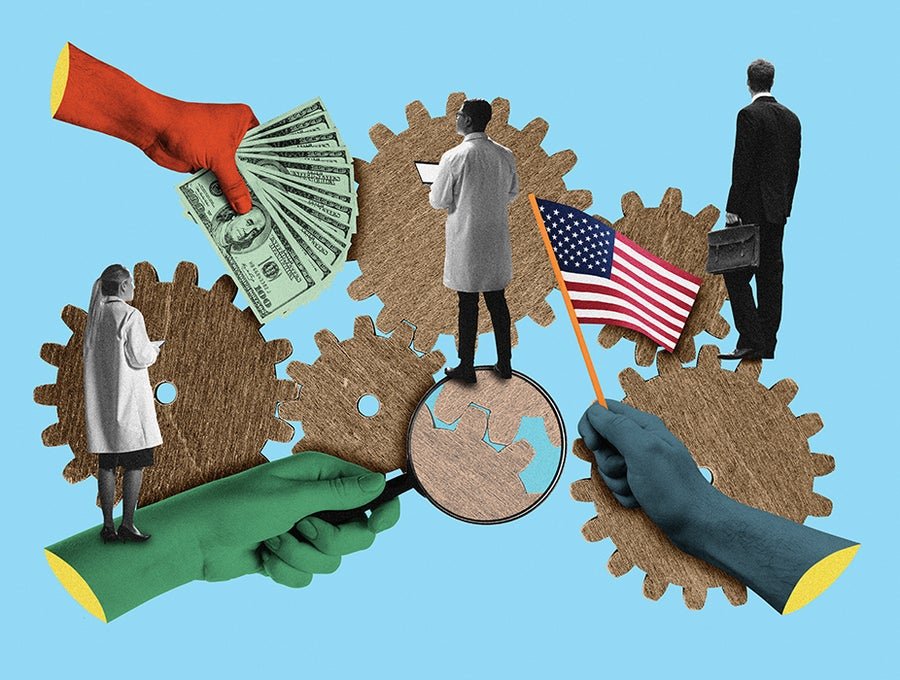
The postwar model came from Vannevar Bush’s 1945 report, Science, the Endless Frontier. Bush argued that federal support for basic research would feed national health, jobs and security. Congress later created funding agencies around that premise. Universities accepted review panels and paperwork. Scientists accepted years of uncertainty. In return, the federal government paid for work that markets would ignore.
The model changed after 1980. The Bayh-Dole Act let universities keep patent rights from federally funded research. Venture investors gained a path to commercialize lab discoveries through licenses and startups. That shift helped build biotech, software and advanced materials companies, but it also pulled university research toward financial returns.
The Trump administration has pushed that shift further by filling science advisory roles with technology executives and investors. The White House reestablished the President’s Council of Advisors on Science and Technology in 2025. Its roster includes Marc Andreessen, Jensen Huang, Lisa Su and other private-sector leaders. Those appointments signal a view of science that prizes AI, chips, crypto and commercial speed.
That view can produce useful policy in areas where private demand already exists. AI companies need chips, power and talent. Drug companies need translational research. Defense contractors need procurement. Basic science works on a different clock. A lab studying a rare pathway, a telescope mirror or a social determinant of kidney disease may need years before anyone can name a product.
Researchers now face another risk: political review. Scientific American reports that NIH and NSF program managers received word lists that could threaten grants. Scientists studying structural racism, overseas disease outbreaks or health disparities now must decide whether to soften research descriptions or risk funding loss. That distorts the work before a review panel reads the science.
The overseas subcontract ban adds a practical constraint. A U.S. virologist cannot study Ebola or Lassa fever with U.S.-only fieldwork. Kristian Andersen of Scripps Research told Scientific American that those diseases drove his move to the United States. His lab saw fewer postdoctoral applicants from Europe, a warning sign for U.S. talent recruitment.
The startup ecosystem should care because lab talent forms part of its supply chain. Graduate students and postdocs start companies, join biotech teams and build tools that become platforms. If fewer students enter science, fewer founders will carry hard technical knowledge into the market. If foreign researchers choose Europe or Asia, U.S. companies lose part of the hiring pool they count on.
Investors often frame federal science as slow money. That critique has force when agencies bury researchers in process. But process reform differs from political control. A faster NIH review cycle could help labs. A ban on key research terms makes studies weaker. A tighter NASA budget could force priority choices. Staff cuts that remove the engineers who know the hardware destroy institutional memory.
The U.S. has spent decades treating public research as the upstream engine for private growth. GLP-1 drugs, cancer therapies, satellites and internet-era tools all drew from research that no seed fund would have backed at the start. Venture capital can scale a discovery. It cannot invent the scientific base by itself.
The federal science crisis now asks a commercial question: Who pays for the work before a market exists? If Washington retreats from that role, universities, companies and philanthropies can fill some gaps. They will choose narrower bets. They will favor projects with donors, customers or near-term patents. Researchers who study public health, space science and basic biology will lose ground first.
That outcome would leave the U.S. with more technology policy and less science. Tech executives can advise presidents on markets. Scientists still need stable funding, review by peers and room to ask questions before anyone can price the answer.
Comments
Please log in or register to join the discussion