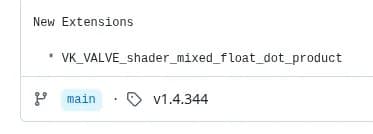
The latest Vulkan 1.4.344 specification includes a new VK_VALVE_shader_mixed_float_dot_product extension enabling optimized mixed-precision dot product operations for shaders, targeting performance gains on modern GPU architectures.

The Vulkan API continues evolving with today's release of version 1.4.344, headlined by a significant new extension developed by Valve engineers. While primarily a maintenance update addressing minor fixes and clarifications, this revision introduces VK_VALVE_shader_mixed_float_dot_product – an extension specifically crafted to optimize shader performance through flexible precision control.
Developed by Valve's Mike Blumenkrantz and Georg Lehmann, this extension enables shaders to perform dot product accumulate operations using mixed floating-point precisions. This technique allows developers to combine lower-precision inputs (like FP16 or 8-bit floats) with higher-precision accumulation (FP32), balancing computational throughput against numerical accuracy requirements.
The mathematical foundation comes from the companion SPIR-V extension SPV_VALVE_mixed_float_dot_product, which defines four distinct operation types:
- 2-component FP16 vectors with FP32 accumulation
- 2-component FP16 vectors with FP16 accumulation
- 2-component BF16 vectors with FP32 or BF16 accumulation
- 4-component 8-bit float vectors with FP32 accumulation
This precision flexibility directly impacts rendering and compute workloads. Dot product operations are fundamental to lighting calculations, physics simulations, and machine learning inference. By permitting lower-precision inputs where full FP32 precision isn't critical, shaders can achieve higher throughput on architectures with optimized low-precision execution units like NVIDIA's Tensor Cores or AMD's Matrix Cores.
Performance trade-offs deserve consideration: FP16/BF16 operations consume less memory bandwidth and execute faster than FP32 equivalents, but sacrifice numeric range and precision. Applications requiring high dynamic range (like HDR rendering) might retain FP32 accumulation, while post-processing effects could leverage FP16 throughout. The extension puts these choices directly in developers' hands without requiring wholesale precision changes.
Implementation requires GPU driver support and explicit activation via Vulkan's extension mechanism. Hardware compatibility will likely emerge first on discrete GPUs from AMD, NVIDIA, and Intel that already feature robust variable-rate shading capabilities. Developers should monitor vendor driver release notes for adoption timelines.
This addition continues Vulkan's trajectory toward finer-grained performance control. While not a revolutionary change, it provides another tool for optimizing shader efficiency – particularly relevant as game engines increasingly blend traditional rendering with machine learning techniques. The complete Vulkan 1.4.344 specification changes are available in the Khronos GitHub repository.
For graphics engineers and performance-focused developers, this extension warrants attention during shader optimization passes. Benchmarking mixed-precision implementations against existing approaches will reveal concrete performance uplifts on supported hardware, potentially yielding significant frame rate improvements in precision-tolerant workloads.
Comments
Please log in or register to join the discussion