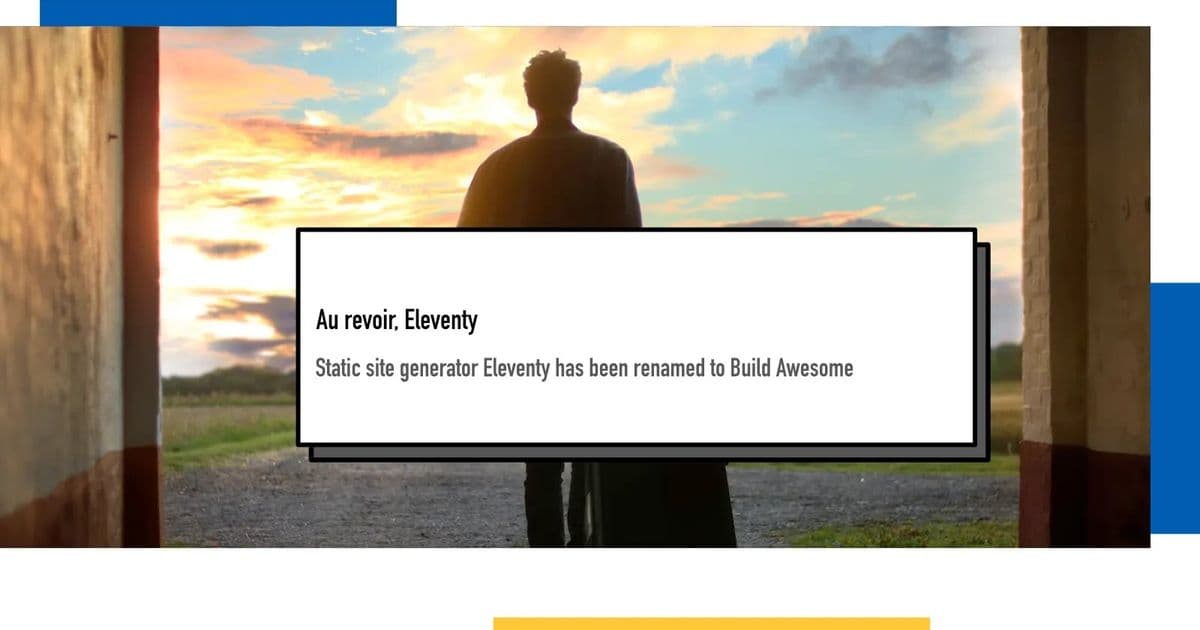
A developer reflects on the emotional and practical challenges of parting ways with a beloved static site generator after its corporate rebranding, exploring the deeper questions of tool dependency and technological independence.
The relationship between a developer and their tools often runs deeper than mere functionality. When Juha-Matti Santala announced his departure from Eleventy after six years of dedicated use, he wasn't just switching software—he was ending a chapter that had defined much of his professional identity. The static site generator that once represented simplicity and creative freedom had transformed into something that no longer aligned with his values or needs.
Santala's journey with Eleventy began in 2018, when version 0.3.1 was fresh off the release line. What started as a colleague's recommendation became a cornerstone of his web development practice. Over the next six years, he built dozens of websites using the tool, wrote extensively about it (achieving top 10 author status on 11ty Bundle), taught others its intricacies, and spoke about it at various meetups. This wasn't casual usage—it was a deep, committed relationship with a piece of technology.
The transformation came not through any dramatic technical change, but through a rebranding that signaled a fundamental shift in direction. Eleventy's metamorphosis into "Build Awesome" accompanied a crowdfunding campaign by Font Awesome, marking the tool's evolution from a community-driven project to a corporate product. The change wasn't in the engine itself, but in the scope and vision that now surrounded it.
What makes this departure particularly poignant is that Santala acknowledges the core functionality will likely remain intact. The static site generator that served him so well won't suddenly stop working. Yet he recognizes a pattern he's seen before—when tools begin expanding their feature sets and corporate ambitions, they often drift away from the simplicity and focus that made them valuable in the first place.
This decision reflects a broader philosophy about technological independence that Santala articulated 1.5 years prior. In an era where software increasingly lives in the cloud as SaaS services, he values tools he can download, install, and control locally. The distinction between a JavaScript library he can pin to a specific version and store locally versus a service that could disappear overnight represents a fundamental approach to digital autonomy.
His perspective reveals a tension that many developers face but few articulate so clearly. The technology industry moves at breakneck speed, with new tools, frameworks, and platforms emerging constantly. Yet there's something profoundly valuable about finding a tool that works and sticking with it for years. Six years of consistent use in this field is remarkable—it represents stability in an otherwise chaotic landscape.
The emotional weight of this decision extends beyond mere practicality. Santala expresses genuine appreciation for Zach, the project's developer, and the community that made Eleventy special. He acknowledges the economic realities that drive such transformations—the need for sustainable funding models in open-source and independent software development. This isn't a condemnation of the project's new direction, but rather a recognition that it's simply not the path he wants to follow.
What emerges from this reflection is a meditation on the nature of our relationship with technology. We don't just use tools; we form attachments to them. We build our workflows, our knowledge, and sometimes even our identities around specific pieces of software. When those tools change—whether through corporate acquisition, feature bloat, or philosophical shifts—it can feel like losing a trusted companion.
The decision to "pin" to the current version and maintain a local copy speaks to a desire for permanence in a transient digital world. It's a small act of rebellion against the constant churn of technology, a statement that sometimes the best tool is the one that already works perfectly for your needs.
Santala's willingness to share this personal transition so openly invites others to reflect on their own relationships with technology. How many developers have quietly abandoned tools they once loved without articulating why? How often do we continue using software that no longer serves us simply because change is difficult?
The broader implication extends to how we think about software dependencies in general. In an age of microservices, cloud platforms, and interconnected systems, the question of what we truly control becomes increasingly complex. Santala's preference for locally-installable tools over SaaS services represents one approach to maintaining autonomy in an ecosystem that often prioritizes convenience over independence.
As he looks toward the future, Santala isn't just seeking a replacement for Eleventy—he's searching for tools that align with his values of simplicity, control, and longevity. This isn't about finding the newest or most feature-rich option, but about discovering software that respects the developer's need for stability and autonomy.
The end of this chapter with Eleventy marks not just a technical transition but a philosophical one. It's a reminder that in our relationship with technology, sometimes the most important feature isn't what a tool can do, but what it represents about how we want to work and live in the digital world.
Comments
Please log in or register to join the discussion